

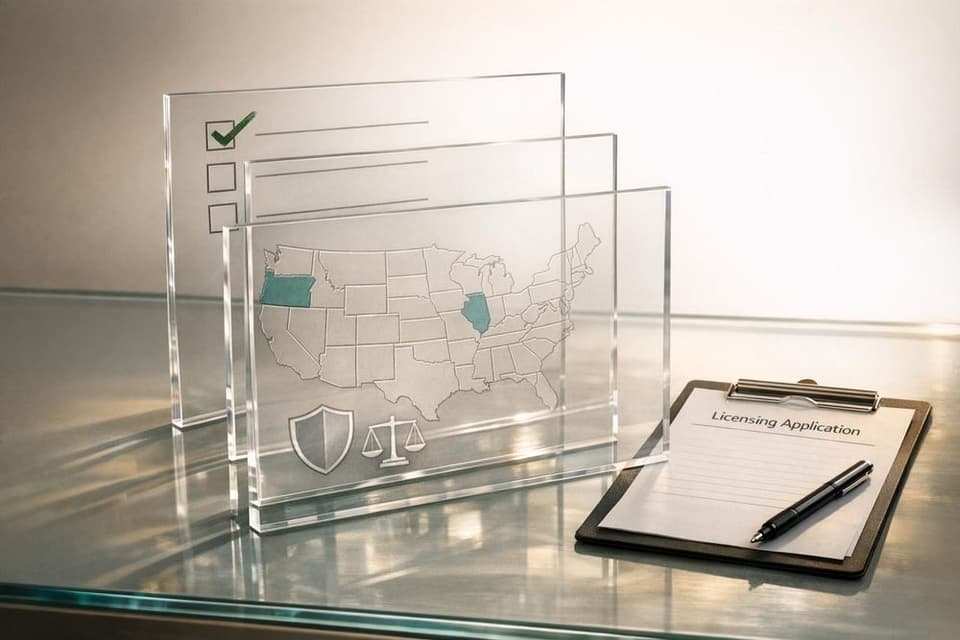
Passive debt buyers - those who purchase defaulted consumer debt but outsource collections - must navigate complex licensing rules across the U.S. While some states, like California and Nevada, require licenses for all debt buyers, others, such as Massachusetts, exempt passive buyers under specific conditions. Federal laws, such as the Fair Debt Collection Practices Act (FDCPA), also apply, holding passive buyers accountable for outsourced collection activities. Non-compliance can lead to fines, lawsuits, and operational restrictions.
Key Points:
- Who needs a license? Licensing depends on state laws; 36 states and 4 cities require debt collector licenses.
- State variations: California mandates licenses for all debt buyers, while Massachusetts exempts passive buyers who outsource to licensed agencies.
- Federal compliance: Even passive buyers must follow FDCPA rules, including restrictions on credit reporting and time-barred debt collections.
- Risks of non-compliance: Penalties include fines, legal challenges, and revoked collection rights.
Understanding state and federal requirements is essential to avoid costly mistakes and maintain compliance.
Passive vs. Active Debt Buyers: Understanding the Differences
What Are Passive Debt Buyers?
Passive debt buyers focus on acquiring portfolios of defaulted consumer debt - like credit cards, medical bills, or auto loans - without getting involved in the actual collection process. Instead of running collection operations, they rely on licensed third-party agencies to handle all recovery efforts. Their primary goal is to achieve investment returns rather than managing the logistics of debt collection.
This hands-off approach has historically meant fewer regulatory hurdles. For instance, in Massachusetts, the Division of Banks clarified that passive debt buyers who outsource all collection activities to licensed agencies typically don’t need a debt collector license themselves. However, they must still comply with the FDCPA. Deputy Commissioner Joseph A. Leonard, Jr. explained:
"A debt buyer who purchases debt in default but is not directly engaged in the collection of these purchased debts is not required to obtain a debt collector license provided that all collection activity performed on behalf of such debt buyer is done by a properly licensed debt collector".
What Are Active Debt Buyers?
Active debt buyers take a more hands-on approach. They not only purchase defaulted debt but also manage the collection process directly. This means they operate call centers, send collection letters, communicate with debtors via email, report to credit bureaus, and even file lawsuits. Essentially, they run a full-scale collection operation instead of outsourcing it.
Because of their direct involvement with consumers, active debt buyers are almost always required to obtain collection agency licenses in any jurisdiction where they operate. If your business includes direct interactions with consumers, you fall into this category, and licensing is a must. These operational activities are a key factor in determining licensing requirements.
How Business Activities Affect Licensing Requirements
The distinction between passive and active debt buyers is becoming less clear, and this evolution significantly impacts licensing requirements. Even businesses that identify as passive can find themselves needing licenses if they engage in certain activities, such as:
- Credit reporting: Reporting tradelines to credit bureaus, even through a vendor, can classify you as an active participant.
- Litigation: Filing lawsuits via contracted law firms is increasingly seen by regulators as active collection, requiring a license.
- Vendor oversight: You’re legally accountable for the actions of third-party agencies you hire, making strict oversight a necessity.
New regulations are also reshaping the landscape. Recent laws like California's Debt Collection Licensing Act, Nevada's SB 276 (effective June 16, 2023), and Wyoming's House Bill 284 (effective July 1, 2023) now broadly define debt buyers as collection agencies, regardless of how involved they are in collections.
Ultimately, your actual business activities - not just how you label yourself - determine your licensing obligations. If your portfolio spans multiple states, you may need licenses in each one, potentially amounting to 25 or more separate requirements. To stay compliant, it’s wise to carefully assess your operations and apply for licenses proactively when there’s any uncertainty about exemptions.
Capital Compliance Group | Jud Phillips Discusses Licensing Updates | Receivables Roundtable Ep. 39
Federal Licensing and Compliance Requirements
When it comes to debt collection, federal compliance adds another layer of oversight on top of state-specific regulations, ensuring that debt buyers adhere to nationwide standards.
The Fair Debt Collection Practices Act (FDCPA) Explained
While there’s no federal licensing requirement for debt buyers, the Fair Debt Collection Practices Act (FDCPA) sets the ground rules. Whether or not your business must comply boils down to one key factor: if your primary business purpose is debt collection, you’re classified as a "debt collector" under federal law - even if you outsource the actual collection work.
The FDIC Consumer Compliance Examination Manual clarifies this point:
"An institution's principal business purpose is the collection of debts it has purchased. The institution is a debt collector both when it contacts consumers itself and when it hires other collection agencies to do so".
This means that even passive debt buyers - those who outsource collections - are often subject to FDCPA requirements. The Supreme Court decision in Henson v. Santander added further nuance, stating that collecting your own purchased debt doesn’t necessarily make you a debt collector under the "owed to another" rule. However, attorney Amy Loftsgordon highlights an important exception:
"If a business's principal purpose is debt collection, it must comply with the requirements of the FDCPA, even if the entity owns the debts it collects".
As a result, passive debt buyers must navigate these federal rules carefully, even when outsourcing their collection activities. Below are the key federal regulations that shape compliance practices.
Federal Compliance Requirements
Regulation F (12 CFR Part 1006), which implements the FDCPA, provides detailed instructions for debt collection practices. One critical rule prohibits passive collection activities - debt collectors cannot report information to credit bureaus before first contacting the consumer. Specifically, a validation notice must be sent within five days of initial communication, and collectors must wait 14 days after sending the notice before providing data to credit reporting agencies. This notice must include details like the debt amount, the creditor, and the consumer's rights.
For time-barred debts, federal law explicitly bans filing lawsuits or threatening legal action after the statute of limitations has expired.
Recordkeeping is another key requirement. Collectors must retain all records related to collection activities for at least three years after the final action on each debt. Non-compliance can result in hefty penalties: up to $1,000 per violation in individual cases, or up to $500,000 - or 1% of the company’s net worth, whichever is lower - in class action cases.
Federal rules also restrict how often you can contact consumers. For example, making more than seven calls about a specific debt within a seven-day period is presumed to violate the FDCPA. Importantly, businesses are held accountable for ensuring that any third-party agencies they work with follow all federal standards.
State Licensing Requirements for Passive Debt Buyers
State Licensing Requirements for Passive Debt Buyers: A Comparison Guide
State Licensing Requirements for Passive Debt Buyers: A Comparison Guide
Licensing requirements for passive debt buyers differ significantly from state to state. Some states mandate licenses, others allow exemptions under specific conditions, and many don't address the issue at all. Knowing where the accounts in your portfolio are located is crucial - buying debt across 25 states could mean securing 25 separate licenses.
States That Require Licenses for Passive Debt Buyers
Several states now require licenses for debt buyers, whether they actively collect debts or outsource the work. California, Nevada, Minnesota, Oregon, and Wyoming are among the states enforcing this rule, signaling a shift away from distinguishing between passive and active debt buyers.
In California, the Debt Collection Licensing Act (DCLA) defines a "debt buyer" as any entity regularly purchasing charged-off consumer debt for collection, regardless of whether they collect the debt directly, use third parties, or hire attorneys for litigation. This definition effectively eliminates any exemptions for passive debt buyers.
Nevada enacted SB 276 on June 16, 2023, expanding licensing requirements to include all entities regularly purchasing charged-off debts.
Wyoming followed suit with House Bill 284, effective July 1, 2023, requiring all debt buyers to register as "collection agencies".
Minnesota requires debt buyers to obtain a collection agency license, which includes an initial fee of $1,000 ($500 for the license and $500 for an investigation). The state also mandates a corporate surety bond of at least $50,000, which can increase to $100,000 based on the volume of debt collected from Minnesota residents. Annual renewals cost $400 and are due by June 30.
Oregon, a pioneer in this area, introduced a specific debt buyer license back in 2017.
As noted by Cornerstone Staff:
"In states like Nevada and California, updated laws now explicitly require debt buyers to license as collectors, regardless of how they manage their portfolios".
States That Exempt Passive Debt Buyers from Licensing
Massachusetts is a notable example of a state offering exemptions for passive debt buyers. In Massachusetts, passive buyers are exempt if they outsource all collection activities to licensed entities or attorneys authorized to practice in the state.
However, this exemption is limited. If passive buyers engage in activities like credit reporting or initiating direct litigation, they may lose their exempt status.
States with No Specific Licensing Requirements
In many states, licensing laws don't specifically address debt buyers. Instead, they apply general "debt collector" definitions similar to the federal Fair Debt Collection Practices Act (FDCPA). In such states, whether a passive debt buyer needs a license depends on how regulators interpret "debt collection" activities.
Certain actions, even in states without specific statutes, can still trigger licensing requirements. For example, reporting tradelines to credit bureaus, initiating lawsuits through law firms, or exercising significant control over third-party vendors might count as "active participation" in debt collection.
Taking a cautious approach is often recommended. As Cornerstone Staff advises:
"Be conservative in your approach and get a legal opinion. Have that opinion updated as your portfolio changes – different asset classes require different licensing".
The type of debt purchased also plays a role. Medical debt, student loans, payday loans, and mortgage debt may come with different requirements than standard consumer credit card debt. Factors like interest rates, the loan's origin state, and charge-off status all influence licensing obligations.
This patchwork of regulations highlights the need to carefully review state laws for each acquisition.
| State Category | Licensing Status | Examples |
|---|---|---|
| Explicitly Required | Statutes specifically include debt buyers in licensing definitions | California, Nevada, Minnesota, Oregon, Wyoming |
| Exempt (with conditions) | Exemptions available if using licensed third parties and no direct contact | Massachusetts |
| Silent/Ambiguous | No specific debt buyer statute; general "debt collector" definitions apply | Varies by state |
How to Apply for a Passive Debt Buyer License
Steps to Apply for a License
To apply for a Passive Debt Buyer License, you must complete the process electronically through the Nationwide Multistate Licensing System & Registry (NMLS). Start by requesting a "Company Account" in NMLS, then fill out Form MU1 with your business and financial details. For principal officers, directors, managing members, and anyone owning 10% or more of the business, submit Form MU2. If your business operates in multiple locations, you'll also need to file Form MU3 to register each site.
Once you’ve submitted your application, its status will show as "Pending-Incomplete" in NMLS. If any additional information is required, the state will send deficiency notifications, and you’ll have 60 days to respond. Missing this deadline may result in your application being abandoned. According to the Department of Financial Protection and Innovation (DFPI):
"The review process will take approximately ninety days from the date the application is submitted if you successfully meet all the licensing requirements to obtain your license."
Before diving in, check if your entity qualifies for an exemption. FDIC-insured banks, licensed finance lenders, and mortgage servicers are often exempt from this licensing requirement. Completing the forms is just the beginning - accuracy and proper documentation are critical for avoiding delays.
Documents You'll Need to Submit
After initiating your application in NMLS, you’ll need to gather and upload several supporting documents. These include a certificate of good standing from your state’s Secretary of State (dated within 60 days), as well as your articles of incorporation, partnership agreements, or operating agreements. You’ll also need an organizational chart showing 100% of direct and indirect ownership, including affiliates, and a management chart listing all directors, officers, and managers involved in debt collection activities.
Other required documents include samples of your initial collection letter and any state-specific consumer notices, a description of your debt collection methods, and details about the products you offer. You’ll also need to designate a registered agent for service of process in the state where you’re applying. Key personnel must undergo fingerprinting for criminal background checks (results typically arrive within 48 hours) and authorize the state to review their credit reports. If fingerprints on file with NMLS are more than three years old, new ones will be required.
Application Costs and Processing Times
Before submitting your application, review the fees and processing requirements. In California, the application fee is $350, and there’s an additional $150 investigation fee for each applicant or affiliate. You’ll also need to budget for fingerprinting and credit report fees, which vary depending on the vendor. A surety bond of at least $25,000 is required - this refers to the bond amount, not the premium you’ll pay. Once licensed, a minimum annual assessment fee of $250 will apply.
| Fee Type | Cost (California) |
|---|---|
| Application Fee | $350 |
| Investigation Fee | $150 per applicant/affiliate |
| Minimum Surety Bond | $25,000 |
| Minimum Annual Assessment | $250 |
To ensure smooth communication, use a generic company email like compliance@company.com. If all requirements are met, the state review process typically takes about 90 days from the time of submission. However, delays in providing necessary information can extend this timeline. Throughout the process, it’s crucial to follow all state-specific guidelines to avoid setbacks.
Compliance Requirements After Licensing
State Compliance Monitoring and Reporting
Getting your license is just the beginning - staying compliant is an ongoing responsibility. Most states require annual reports to ensure you're adhering to their regulations, and missing these deadlines can lead to enforcement actions. For instance, in California, you must file your annual report by March 15th through the state's self-service portal. In Minnesota, the timeline is different: licenses and individual registrations expire annually on June 30th, and renewals must be completed through the NMLS.
California mandates a minimum surety bond of $25,000, while Minnesota uses a tiered system, starting at $50,000 and increasing by $5,000 for every $100,000 collected from Minnesota debtors, with a cap at $100,000. Beyond financial requirements, state regulators can conduct periodic examinations of your records. For example, the California Commissioner of Financial Protection and Innovation can audit your operations at any time, so maintaining proper documentation is essential.
Penalties for Non-Compliance
Failing to meet compliance requirements comes with steep consequences. In California, if you don't pay the annual assessment fee by January 1st, your license could be suspended or revoked. According to the California Department of Financial Protection and Innovation:
"Any licensee that fails to pay by January 1 is subject to an order of summary suspension or revocation of its Debt Collection license and additional penalties."
Non-compliance can lead to desist and refrain orders, forcing you to halt unlawful practices immediately. Courts may also impose penalties like refunds, restitution, profit disgorgement, and damages. Public enforcement actions - posted on the DFPI website and the NMLS Consumer Access portal - can harm your reputation and business relationships. Importantly, outsourcing collection activities doesn’t absolve you of responsibility. California warns that licensees are accountable for illegal actions by third parties they hire.
How to Maintain Compliance
To avoid penalties and keep your license in good standing, follow these steps:
- Mark your calendar for critical deadlines: March 15th (California) and June 30th (Minnesota).
- Use a dedicated compliance email (e.g., compliance@company.com) to ensure you receive important notices, even during staff changes.
- Monitor your collection volume regularly, as Minnesota adjusts surety bond requirements based on the amount collected.
- Update your NMLS profile within 10 days of changes to principal officers, directors, or other key roles.
- Audit third-party vendors to ensure they follow the rules.
- Keep your records well-organized and ready for audits, as regulators can request access at any time.
Here’s a quick summary of compliance deadlines and requirements:
| Requirement | California (DCLA) | Minnesota |
|---|---|---|
| Annual Report Deadline | March 15th | June 30th (via Renewal) |
| Surety Bond Amount | $25,000 | $50,000 - $100,000 |
| License Expiration | Annual | June 30th |
| Change Notification | Standard NMLS | Within 10 days |
| Communication Rule | License # in 12-point type | Not specified |
Staying proactive with these measures will help you navigate compliance smoothly and protect both your license and reputation.
Conclusion
Licensing plays a critical role in maintaining a passive debt-buying business. The outdated belief that outsourcing collection activities shields buyers from regulation no longer holds true. States like California, Nevada, and Wyoming have closed this gap by requiring debt buyers to obtain licenses, even if they rely on third-party agencies for collections. This shift reflects the growing consensus among industry experts.
Experts agree that a passive stance does not exempt debt buyers from regulatory obligations. You are legally accountable for the actions of any collection agencies or law firms you hire, making vendor oversight a priority. Operating without the proper licenses exposes you to fines, lawsuits, and regulatory penalties, all of which are increasing as oversight tightens at both state and federal levels.
Regulations continue to evolve, as seen in states like California, Nevada, and Wyoming. Federal agencies are ramping up their scrutiny, and more states are broadening licensing requirements to include activities like credit reporting and litigation. What qualifies as "passive" today could demand active licensing tomorrow, as regulators expand their reach.
To mitigate these risks, evaluate every state where your portfolio holds accounts. Multi-state portfolios often mean navigating multiple licensing requirements. Don’t rely on assumptions about exemptions - seek formal legal opinions tailored to your specific asset types, whether you're acquiring medical debt, student loans, or credit card accounts. If state laws are unclear, taking a proactive approach to licensing can help you stay ahead of regulatory changes and avoid costly legal challenges.
Beyond risk management, proper licensing enhances your reputation and market position. It demonstrates reliability and ensures your business remains stable in the long run. Treat licensing not as a one-time task, but as an ongoing commitment to compliance and success.
FAQs
Do I need a license if I never contact consumers?
No, passive debt buyers typically do not require a license as long as they do not engage in direct communication with consumers. However, they are still obligated to adhere to the Fair Debt Collection Practices Act (FDCPA) and any other relevant regulations. Understanding and following these legal requirements is crucial for staying compliant while managing debt portfolios.
Can credit reporting or lawsuits make me “active”?
Passive debt buyers, who simply acquire debt without engaging in activities like credit reporting or filing lawsuits, are generally not classified as "active" under the FDCPA. However, if a debt buyer involves itself in these activities, it may be considered active and could fall under additional collection regulations.
How do I figure out which state licenses I need?
To figure out which state licenses you need as a passive debt buyer, start by examining your activities to see if they meet the criteria for licensing in each state. Licensing requirements differ from state to state - some mandate licenses for debt buyers, even if your role is passive. Check state-specific resources or licensing maps to confirm the rules. Once you know what's needed, submit your application through the correct authority, like the Nationwide Multistate Licensing System (NMLS) or individual state agencies.
