

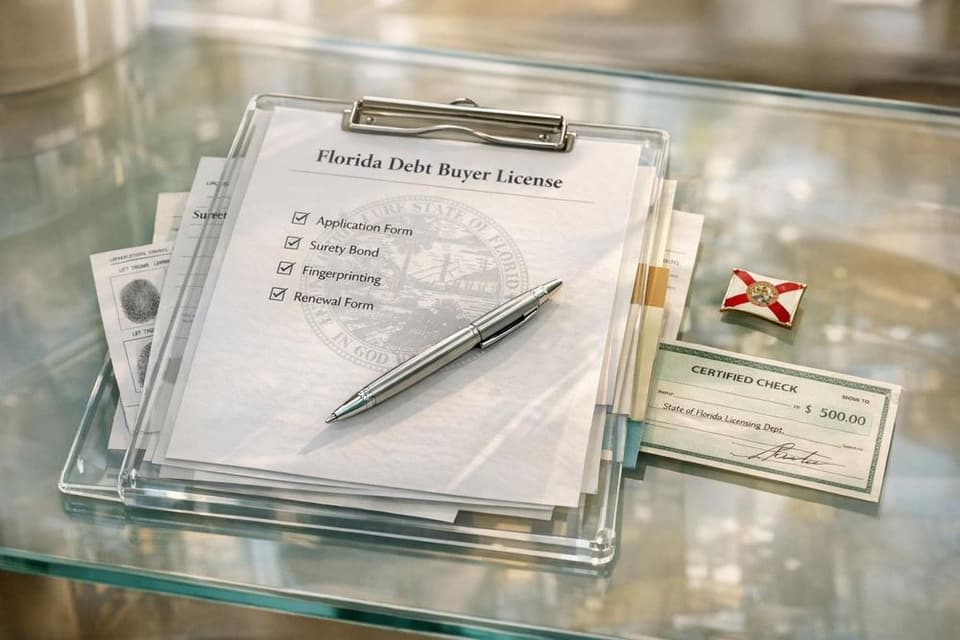
If you're buying debt in Florida, here's what you need to know: a license is mandatory. Florida requires all debt buyers to register as Consumer Collection Agencies under Chapter 559, Part VI of state law. This applies whether you're collecting on purchased accounts or reselling them. Operating without a license can lead to fines, legal action, and business disruptions.
Key details:
- License Types: Consumer Collection Agency (no surety bond) or Commercial Collection Agency (requires a $50,000 bond).
- Application Fees: $200 for consumer agencies, $500 for commercial agencies.
- Renewal: Annual, between October 1 and December 31.
- Regulatory Oversight: Florida Office of Financial Regulation (OFR).
Being licensed ensures compliance with both Florida and federal debt collection laws, like the FCCPA and FDCPA, which outline strict rules for contacting consumers and handling disputes. Non-compliance can lead to fines of up to $10,000, lawsuits, or license suspension.
The process involves business registration, application submission through the OFR's online system, and meeting financial requirements. Stay compliant by renewing on time and keeping records organized to avoid penalties during audits.
For detailed steps, legal nuances, and compliance tips, read on.
Florida Debt Buyer License Requirements and Compliance Guide
Florida Debt Buyer License Requirements and Compliance Guide
Who Needs a Florida Debt Buyer License?
In Florida, there isn’t a specific license solely for debt buyers. Instead, businesses that purchase delinquent consumer accounts and attempt to collect on them must register as Consumer Collection Agencies under Chapter 559, Part VI. This requirement applies to companies operating as assignees, meaning they collect on debts originally owed to another party.
Debt Buyers vs. Debt Collectors
The distinction between debt buyers and debt collectors is key. Debt buyers purchase ownership of debt portfolios, while debt collectors act on behalf of creditors. A debt buyer may collect on these accounts for their own benefit or resell them.
The Florida Office of Financial Regulation explains:
"This registration authorizes the holder to collect or attempt to collect consumer debts, asserted to be owed or due to another person, including third party collectors (assignee) of debts made by individual consumers".
Whether you are collecting as the owner of the debt or as an agent, registration is required. Florida also differentiates between Consumer Collection Agencies, which handle personal, family, or household debts, and Commercial Collection Agencies, which focus on business-to-business claims. Consumer Collection Agencies can work on commercial debts too, as long as less than 50% of their collection revenue comes from these claims.
Business Models Requiring a License
Several business models fall under Florida’s registration requirements. These include:
- Companies acquiring delinquent accounts for collection or resale.
- Third-party debt collection agencies.
- Law firms primarily engaged in consumer debt collection.
- Businesses buying consumer debt portfolios.
Out-of-state debt buyers must also register if they solicit consumer debt accounts from creditors with a presence in Florida. Once registered as an assignee, you are required to notify debtors in writing about the debt assignment within 30 days of the transfer.
Exemptions from Licensing
Not every entity needs to register. For example, original creditors collecting their own debts are exempt. Other exemptions include:
- Members of The Florida Bar.
- FDIC-insured financial institutions and their wholly owned subsidiaries.
- Licensed real estate brokers.
- Authorized insurance companies.
- Consumer finance companies licensed under Chapter 516.
- Businesses licensed under Chapter 520, like motor vehicle and retail installment sellers.
Out-of-state debt collectors may qualify for an exemption if they do not solicit accounts from Florida-based creditors. However, if they purchase debt portfolios from creditors with a Florida presence, registration is mandatory.
Legal and Regulatory Framework for Debt Buyers in Florida
Debt buyers in Florida must navigate a complex set of state and federal regulations designed to protect consumers and establish clear collection practices. Knowing these rules is crucial to avoid penalties and maintain proper registration.
Florida Consumer Collection Practices Act (FCCPA)
The FCCPA is Florida's main law governing debt collection and buying activities, applying to both original creditors and third-party collectors. It sets boundaries on how and when debtors can be contacted. For example, you cannot reach out to a debtor between 9 p.m. and 8 a.m. in their time zone unless they’ve given prior consent. Additionally, contacting a debtor’s employer about their debt is off-limits unless a judgment has already been obtained. If a consumer disputes a debt, you’re required to disclose this when reporting to credit bureaus.
The law also bans deceptive practices. For instance, you cannot falsely claim that an attorney is involved in your collection efforts, use documents that mimic official government or court forms, or impersonate a government agent. Harassment, such as threats of violence, profane language, or sending mail with embarrassing wording visible on the envelope, is strictly prohibited.
In a notable case, Nina Quinn-Davis vs. TrueAccord Corp. (Nov. 2024, Case No. 1:23-cv-23590-LEIBOWITZ/REID), the U.S. District Court for the Southern District of Florida ruled that sending debt collection emails between 9 p.m. and 8 a.m. doesn’t automatically violate the FCCPA. The court stated that a “communication” occurs only when the debtor opens and reads the email, as the law focuses on disruptive actions like loud phone calls, not silent emails.
Violations of the FCCPA can result in serious penalties. Unregistered debt collectors may face fines up to $10,000. Consumers who successfully sue under the FCCPA can recover up to $1,000 in statutory damages, along with actual damages, punitive damages (if awarded by the judge), and attorney fees. The FDCPA, a federal law, complements these state-level protections.
Federal Fair Debt Collection Practices Act (FDCPA)
The FDCPA (15 U.S.C. §§ 1692 et seq.) sets nationwide standards for third-party debt collectors and debt buyers whose primary business involves collecting debts. While the FCCPA covers both original creditors and third-party collectors, the FDCPA generally excludes original creditors from its scope.
Both laws share common prohibitions, such as banning harassment, deceptive practices, and contacting debtors at inconvenient times. However, they apply only to consumer debts - those incurred for personal, family, or household purposes - not business-related debts.
| Feature | Federal FDCPA | Florida FCCPA |
|---|---|---|
| Regulated Entities | Third-party collectors and some buyers | Debt collectors, buyers, and original creditors |
| Registration | No federal requirement | Mandatory registration with the OFR |
| Statutory Damages | Up to $1,000 | Up to $1,000 plus potential punitive damages |
| Enforcement | CFPB and private lawsuits | Florida OFR, Attorney General, and private lawsuits |
Debt buyers operating in Florida must comply with both federal Regulation F (which implements the FDCPA) and Florida Rule 69V-180. Meeting federal standards alone isn’t enough to fulfill Florida’s requirements.
Role of the Florida Office of Financial Regulation (OFR)
Florida Office of Financial Regulation
The OFR plays a key role in regulating debt buyers in Florida. Its Bureau of Registration handles license applications, while the Bureau of Enforcement investigates complaints and conducts compliance reviews. The OFR also has a Division of Financial Investigations tasked with addressing fraud in the financial services industry.
The OFR enforces compliance through fines, registration suspension or revocation, and legal action. Operating without a valid registration results in immediate penalties. To verify registration status, debt buyers can use the publicly available "Verify a License" tool.
Debt buyers are required to maintain specific records according to retention schedules and renew their registration annually through the online "REAL" licensing system. Regularly reviewing Chapter 559, Part VI, Florida Statutes, and Rule 69V-180, Florida Administrative Code, ensures ongoing compliance with the OFR’s legal requirements.
How to Apply for a Florida Debt Buyer License
Getting a Florida debt buyer license involves setting up your business, preparing the necessary paperwork, and meeting specific financial criteria. The process varies slightly depending on whether you're handling individual consumer debts or commercial debts.
Business Formation and Registration
First, you need to register your business with the Florida Department of State, Division of Corporations. Start by checking the Sunbiz web portal to confirm your desired business name is available. If the name is already taken, you'll need to select a different one to avoid rejection.
Once you’ve secured a name, file your Articles of Organization through Sunbiz. For a standard LLC, expect to pay around $160, which includes a $100 filing fee and a $25 fee for designating a registered agent. The registered agent is the person or entity authorized to receive legal documents on your business’s behalf. When completing the online forms, simply typing your name in the signature block is legally sufficient.
After forming your business, apply for an Employer Identification Number (EIN) through the IRS. This number is essential for hiring employees or applying for a state license. Planning to operate under a name different from your official business name? You’ll need to register a fictitious name (DBA) with the state. Also, keep in mind that starting January 1, 2024, most businesses must report Beneficial Ownership Information (BOI) to the U.S. Department of Treasury.
Once these steps are complete, you can move forward with your application.
Application Submission Process
Applications are submitted electronically through the Florida Office of Financial Regulation's Regulatory Enforcement and Licensing (REAL) online system. First, figure out which license you need: a Consumer Collection Agency license (for individual consumer debts) or a Commercial Collection Agency license (for business debts). Note that consumer collection agencies can also handle commercial debts, as long as these make up less than 50% of their total collection revenue.
Before starting your application, disable pop-up blockers to ensure all necessary windows (like those for adding owners or officers) load properly. Have your business financial statements and formation documents ready to avoid session timeouts.
For consumer collection agencies, all control persons must submit Live Scan fingerprints for state (FDLE) and federal (FBI) background checks. Commercial collection agencies, on the other hand, must provide a statement listing every Florida county where they currently operate or plan to operate within the next year.
Each person listed in your organization's management section must provide a biographical summary, along with answers to disclosure questions about any legal or regulatory issues. If you answer "yes" to any of these questions, you’ll need to provide detailed explanations and relevant legal documents. Additionally, you’ll need to supply your main business address, record storage location, and proof of a physical presence in Florida.
Surety Bond and Financial Requirements
Once the online application is complete, you’ll need to meet the financial requirements to finalize the process. These requirements vary depending on the type of license:
- Consumer Collection Agency: A $200 application fee applies, and no surety bond is required.
- Commercial Collection Agency: A $500 application fee is required, along with a $50,000 continuous surety bond issued by an authorized company in Florida. Be sure to verify the bond company’s authorization before purchasing.
The annual premium for a surety bond typically ranges from 0.75% to 5% of the bond amount, meaning you’ll pay between $375 and $2,500, depending on your credit and financial standing. Make sure the business name on your surety bond matches the name registered on Sunbiz and used in your application - any mismatch could delay processing.
After submitting your application, you can track its progress by logging into the REAL system and selecting "View Outstanding Filings" to check for any drafts or pending items.
| Requirement | Consumer Collection Agency | Commercial Collection Agency |
|---|---|---|
| Application Fee | $200 | $500 |
| Surety Bond | Not required | $50,000 |
| Background Check | Fingerprinting for all control persons | Disclosure of disciplinary history |
| Annual Renewal Fee | $200 | $500 |
Both licenses are valid for one year and must be renewed annually between October 31 and December 31. If you miss the December 31 deadline, the license will expire, and you’ll need to submit a new application.
Compliance and Ongoing Obligations
Once you’ve secured your Florida debt buyer license, staying on top of renewal deadlines and operational standards is key to avoiding financial and legal trouble. The Florida Office of Financial Regulation (OFR) keeps a close watch on licensed agencies to ensure they follow state laws.
Annual Renewal Process
Your license needs to be renewed every year between October 1 and December 31. This process is handled online through the OFR Online Services portal, where you’ll pay a $200 renewal fee. It’s also a good time to double-check that all your business details are up to date. If you’ve had changes to your business name, address, or principal place of business, make sure to update that information immediately. Registrations based on outdated or false details can become void.
Additionally, ensure your registered agent is active and authorized to accept legal documents on your behalf. Any changes in control or structure of your business must be reported within 30 days to avoid compliance issues or fines. After renewal, conducting regular internal reviews can help you maintain compliance throughout the year.
Monitoring and Audits
The OFR’s Bureau of Enforcement performs periodic reviews and investigations of licensed debt buyers to ensure they’re following Florida law. These audits might include an examination of your records, accounts, and collection practices. It’s crucial to keep all records organized and accessible, as failing to comply during an audit could result in immediate license revocation.
The OFR also monitors consumer complaints. If your agency racks up five or more unresolved complaints within a 12-month period, you could face administrative action. Common issues include contacting consumers outside permitted hours or disclosing information without authorization. Implementing strong internal procedures can help you steer clear of these problems. Florida law does offer a “bona fide error” defense for unintentional violations if you can prove you had documented prevention measures in place. However, discrepancies in your records during an audit can still lead to severe penalties.
Penalties for Non-Compliance
Failing to meet compliance standards, operating without a valid license, or breaking state regulations can lead to hefty penalties. Administrative fines range from $100 to $1,000 per violation, depending on whether it’s your first, second, or third offense. License suspensions can last between 3 and 30 days, while repeated or severe violations may result in permanent revocation.
| Penalty Type | 1st Citation | 2nd Citation | 3rd Citation |
|---|---|---|---|
| Administrative Fine | $100 - $350 | $350 - $750 | $750 - $1,000 |
| License Suspension | 3 - 10 days | 11 - 20 days | 21 - 30 days |
| Unlicensed Activity Fine | $100 - $250 per act | $250 - $500 per act | $500 - $1,000 per act |
On top of administrative penalties, you could also face civil lawsuits from consumers. Under the Florida Consumer Collection Practices Act (FCCPA), statutory damages can go up to $1,000 per individual action, along with actual damages, court costs, and attorney fees. Class action lawsuits can result in damages capped at either $500,000 or 1% of your net worth, whichever is lower. Operating without proper registration or attempting to register through fraud or misrepresentation is considered a first-degree misdemeanor under Florida law.
The OFR has up to two years from the date of the last violation to take administrative action, including revoking or suspending your license or issuing fines. For minor violations, they might issue a Notice of Non-Compliance, giving you a chance to address the issue before harsher penalties are imposed.
Conclusion
Securing a Florida debt buyer license is a must for operating legally and effectively in the state’s debt buying industry. Depending on your business model, you’ll need either a Consumer Collection Agency or Commercial Collection Agency license. Applications are processed through the Florida Office of Financial Regulation's REAL online system, and you’ll need to submit the required fees and documentation to complete the process. For commercial licenses, a $50,000 surety bond is necessary, while consumer licenses require background checks and fingerprinting for all control persons.
Once licensed, compliance is key. Renew your license annually between October 1 and December 31, and promptly update any changes to your business information with the OFR. The OFR enforces regulations through audits and by monitoring consumer complaints, ensuring all agencies follow Florida’s legal framework. Failing to maintain your registration can result in administrative fines, license suspension or revocation, and even civil lawsuits under the FCCPA.
Having a valid license does more than just keep you compliant - it enhances your credibility with credit grantors and consumers alike. By following these steps, your business can operate smoothly and establish itself as a trusted player in Florida’s competitive debt buying market.
FAQs
Does my company need a Florida license if we only buy debt and don’t collect it?
If your company solely buys debt without conducting any collection activities, you don't need a license in Florida. However, if your business involves collecting consumer debts on behalf of others, obtaining a license is mandatory. It's important to carefully review Florida's regulations to ensure your operations align with state laws.
What counts as a “control person” for fingerprinting and background checks?
A "control person" refers to anyone with substantial management or ownership authority within a company. This can include individuals who directly or indirectly manage the business, own at least 50% of voting securities, or have the authority to sign contracts on the company’s behalf. In Florida, these individuals are required to undergo fingerprinting and background checks to meet the state’s licensing and regulatory requirements.
Do I need a physical office in Florida to register with the OFR?
No, you don’t need a physical office in Florida to register with the OFR. The entire registration process can be done online through the OFR's online services.
