

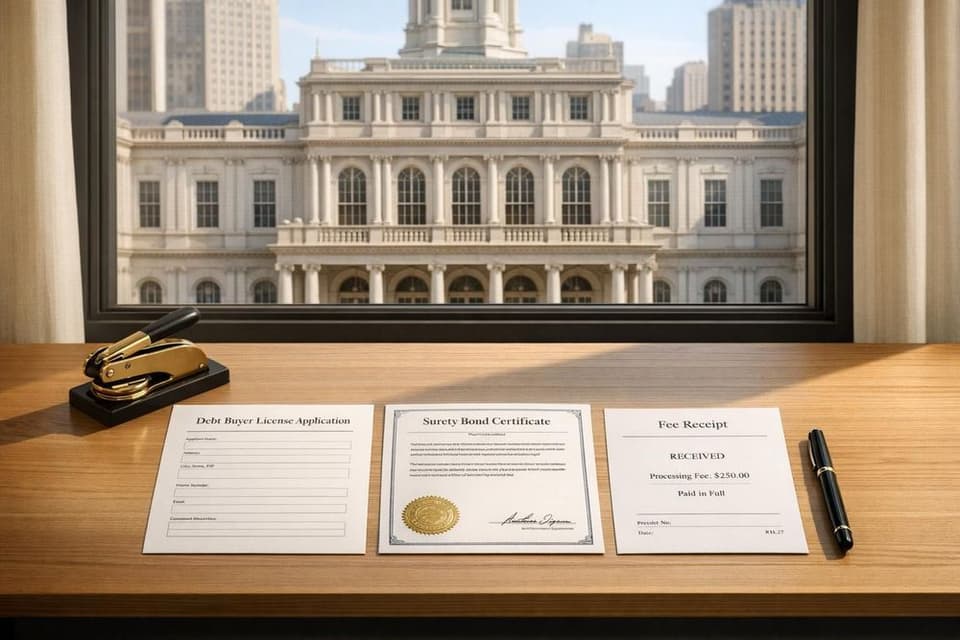
If you're planning to buy and collect debts in New York City, you'll need a Debt Collection Agency license issued by the Department of Consumer and Worker Protection (DCWP). This applies even if your business operates outside the city but collects from NYC residents. Without proper licensing, you risk fines, penalties, and legal issues.
Here’s what you need to know:
- Eligibility: Register your business with the New York State Division of Corporations and meet background check requirements for all key personnel.
- Surety Bond: A $5,000 surety bond is mandatory.
- Documents: Submit forms like the Basic License Application, Debt Collection Agency Licensing Supplement, and others.
- Application Fees: Fees vary by filing date, ranging from $38 to $150.
- Compliance: Follow strict operational rules, including providing debt substantiation within 60 days of a consumer request.
Renew your license every two years to avoid disruptions. Failure to comply with these rules can lead to penalties, including suspension or revocation of your license.
New York Debt Buyer License Application Process and Requirements
New York Debt Buyer License Application Process and Requirements
Eligibility Requirements for a New York Debt Buyer License
To legally collect debts from New York City residents, you must meet specific criteria established by the DCWP. These rules address your business structure, the backgrounds of key personnel, and financial protections.
Business Registration and Legal Entity Requirements
Your business must be registered with the New York State Division of Corporations as a corporation, LLC, or partnership. Be sure to include your corporate name and any DBA names on all required documents. Additionally, provide an EIN, SSN, or ITIN for each key individual involved.
If your business is based outside New York City but collects debts from NYC residents, you’ll need to complete and submit a "Debt Collection Agency Non-Resident Form" along with your standard application. Once your business registration is in order, confirm that all key personnel meet the required background standards.
Background Checks for Owners and Officers
The DCWP thoroughly evaluates the integrity of individuals in leadership positions. Owners, partners, shareholders, and officers must disclose their full criminal and civil histories, including unresolved legal matters, and report any prior involvement with DCWP licensing.
All applicants are also required to complete a Debt Collection/Child Support Form to confirm compliance with child support obligations. This form is mandatory, even if you do not plan to collect child support debts. If your business does intend to handle child support payments, you’ll need to submit copies of your disclosure forms and NYC contracts.
Surety Bond Requirements
Financial protections are a critical part of the licensing process. You must secure a $5,000 surety bond, naming the City of New York as the Certificate Holder, to operate in New York City and Buffalo. Without this bond and the necessary supporting documents, your application will be denied by the DCWP. Surety bonds can be obtained through licensed insurance companies or bonding agencies authorized to operate in New York State.
Documents Needed for Your Application
To meet the eligibility requirements mentioned earlier, you'll need to gather specific documents for your application. Having everything ready beforehand can help you avoid unnecessary delays. The DCWP requires that business names and addresses match exactly across all forms and documents. Any discrepancies could lead to an automatic denial of your application. These requirements are part of New York's strict licensing standards.
Primary Application Forms
Your application starts with two main forms: the Basic License Application and the Debt Collection Agency Licensing & Renewal Supplement. These forms cover essential details like your business structure, contact information, and tax identification numbers for key personnel. The Basic License Application serves as the general form for all NYC business licenses, while the supplement is specifically tailored for debt collection agencies.
Additional Required Documents
In addition to the primary forms, you'll need to include other key documents to confirm your business's compliance:
- Debt Collection/Child Support Form: This is mandatory for all applicants.
- Debt Collection Agency Non-Resident Form: Required if your business operates outside New York City.
- Granting Authority to Act Affirmation: Necessary if someone else is filing the application on your behalf.
- $5,000 Surety Bond and Bond Receipt: These must show full payment and remain valid through January 31 of the next odd-numbered year.
Financial and Ownership Disclosures
Transparency about your business's ownership and management is a crucial part of the application. You'll need to provide details about all owners, partners, shareholders, and officers, including their complete histories of criminal and civil charges. Additionally, disclose any prior licensing history with the DCWP for these individuals and their relatives.
Although you may not need to submit your Certificate of Incorporation or Partnership Certificate right away, keep them accessible. The DCWP may request these documents during the review process. Lastly, your business must maintain an active registration status with the New York State Division of Corporations for the entire application period.
How to Apply for a New York Debt Buyer License
Once you've gathered all the necessary documents, the next step is submitting your application. As noted earlier, ensuring your documentation is accurate and complete is essential. The New York City Department of Consumer and Worker Protection (DCWP) has simplified the process, offering multiple submission options to suit different needs.
Submitting Your Application Online
The NYC Business portal is the quickest and most convenient way to submit your application. Start by creating a registered account on the portal. Once logged in, complete the Basic License Application and the Licensing & Renewal Supplement forms. Be sure to reference the required forms listed in the Documents section before proceeding.
You’ll need to upload several items, including:
- The completed application forms
- A signed $5,000 surety bond along with the bond payment receipt
- The Debt Collection Agency Non-Resident Form (if your business operates outside New York City)
Pay the license fee online using a credit card (Visa, Mastercard, American Express, or Discover) or an eCheck. Note that credit card payments include a nonrefundable 2% convenience fee.
After submitting, a confirmation page will be generated. Save this page, as it lists any remaining steps you need to complete. If additional items are required, submit them within five business days of your application.
For technical support, you can email onlineappsdocs@dcwp.nyc.gov or call 487-4060 during business hours (Monday through Friday, 8:00 a.m. to 4:00 p.m.).
In-Person and Mail Application Options
Applications can also be submitted in person or by mail, though these options are generally reserved for special circumstances. The DCWP Licensing Center is located at 42 Broadway, Lobby, New York, NY 10004.
- In-person submissions: These are limited to hardship cases or individuals with disabilities. Appointments are required, as walk-ins are not allowed. The center is open Monday through Friday from 9:00 a.m. to 5:00 p.m., with extended hours on Wednesdays until 5:30 p.m.. Payments can be made by check, money order (payable to "NYC Department of Consumer and Worker Protection"), or credit card.
- Mail submissions: Send your application to the DCWP Licensing Center at 42 Broadway, 5th Floor, New York, NY 10004. Payments for mailed applications must be made by check or money order.
Application Fees and Processing Times
The license fee depends on the date you file your application. All Debt Collection Agency licenses expire on January 31 of odd-numbered years.
| Application Period | License Fee |
|---|---|
| February 1 (Odd Year) – July 31 (Odd Year) | $150 |
| August 1 (Odd Year) – January 31 (Even Year) | $113 |
| February 1 (Even Year) – July 31 (Even Year) | $75 |
| August 1 (Even Year) – January 31 (Odd Year) | $38 |
Once all documents are received, the DCWP typically processes applications within two weeks. You’ll receive a notification letter by mail within this timeframe. If additional information is needed, you’ll have 10 days to provide it. Failure to do so could result in your application being denied. In case of denial, the DCWP will explain the reasons and provide instructions for reapplying. You can also track your application status online through the NYC.gov portal.
Maintaining Compliance and Renewing Your License
Keeping your New York debt buyer license in good standing involves timely renewals, adhering to strict daily compliance rules, and steering clear of penalties.
License Renewal Process
In New York City, debt collection agency licenses must be renewed every two years. To avoid disruptions, submit your renewal package and the $150 fee at least 15 days before your license expires.
The renewal process mirrors the initial application. Complete the Basic License Application and Licensing & Renewal Supplement forms on the NYC Business portal. If your business operates outside New York City, you’ll also need to provide updated details using the Debt Collection Agency Non-NYC Resident Form. Be sure to report any changes to your business structure, ownership, or contact information to the DCWP as part of your renewal.
Daily Compliance Requirements
Once your license is renewed, staying compliant requires following daily operational standards. In addition to maintaining your license, you must adhere to 23 NYCRR Part 1, which regulates debt collection practices across New York State.
Within five days of your first contact with a debtor, send a written notice outlining prohibited practices and exempt income types, such as Social Security, public assistance, and disability benefits. If a consumer disputes the debt, you must provide written substantiation within 60 days. Until this documentation is supplied, all collection activities must stop. The New York State Department of Financial Services emphasizes the importance of meeting this deadline:
"Failure to provide the required information within 60 days of receipt of the request for substantiation is a violation of the rule separately enforceable by the Department."
For consumers on payment plans, you’re required to send a quarterly accounting statement detailing how payments are applied, including any interest or fees. After the debt is fully paid, provide written confirmation within 20 business days. Additionally, maintain all records for six years to comply with state retention requirements.
Penalties for Violations
Falling short of these compliance standards can lead to serious consequences. The Superintendent of Financial Services has the authority to impose civil penalties for breaches of state or federal debt collection laws. Violations could result in license suspension, revocation, or even termination. Missing the 60-day deadline for providing debt substantiation, even if you eventually comply, is treated as a separate violation.
Excessive contact attempts can also lead to penalties. Making more than three attempts or completing more than one call within a seven-day period creates a rebuttable presumption of a violation. For NYC-licensed agencies, failing to respond to DCWP deficiency notices within 10 days can result in application denial.
The impact of these rules is clear. In 2020, New York ranked ninth in the U.S. for consumer complaints about debt collectors. Over half of these complaints (56%) were related to repeated or unwanted calls.
Conclusion
Getting a New York debt buyer license requires thorough preparation, from registering your business and obtaining a $5,000 surety bond to submitting a complete application. The Department of Consumer and Worker Protection (DCWP) is very clear about this:
"The Department of Consumer and Worker Protection (DCWP) will deny your application if you fail to provide the required documents and information."
However, securing the license is just the start. Once approved, you must stay in full compliance with 23 NYCRR Part 1 every single day. The Department of Financial Services has the authority to impose penalties, suspend your license, or even revoke it if you fall short. Staying on top of timely renewals is also essential to prevent disruptions to your operations. Tools designed for compliance management can make these tasks more manageable.
For debt buyers juggling multiple portfolios and complex compliance needs, platforms like Debexpert provide secure file sharing, analytics, and real-time communication to simplify documentation and support compliance. Leveraging these tools can help you maintain smooth and lawful operations.
Thriving in New York's debt buying market means viewing compliance as an ongoing responsibility. With proper preparation and the right tools, you can navigate the state's strict regulatory landscape while building a business that’s set up for long-term success. These strategies not only help you meet New York's high standards but also create a solid foundation for growth.
FAQs
Do I need a NYC debt collection license if I’m not based in NYC?
If you're solely purchasing or owning defaulted debt without actively collecting it, you don’t need a NYC debt collection license. However, the moment you start engaging in collection activities, obtaining a license becomes mandatory. This rule applies whether your business operates within NYC or outside of it.
What can cause a DCWP license application to be denied?
A DCWP license application can be turned down if the applicant doesn't meet the necessary eligibility requirements, fails to provide all required documents, or violates New York's licensing rules. Common problems include missing registration details, incorrect verification of the business structure, or failure to comply with legal obligations. Double-check that everything is in order to prevent delays or outright rejection.
What do I have to do after licensing to stay compliant in New York?
To operate within the law after getting a debt buyer license in New York, you need to stick to state regulations. This means adhering to fair debt collection practices, providing clear and accurate disclosures, and being ready to substantiate debts when requested.
It's also crucial to stay informed about any regulatory updates, keep detailed and accurate records, and handle filings and renewals on time. Avoid illegal practices like using deceptive collection methods or pursuing collections on loans that are not allowed. Following these rules not only helps you avoid penalties but also ensures your business runs ethically and responsibly.
