

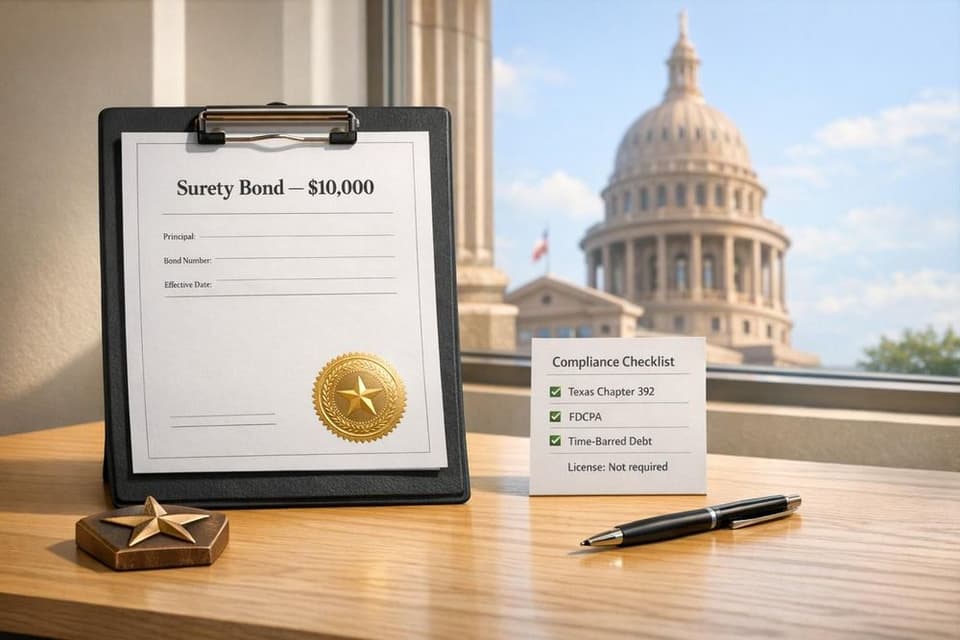
If you're considering buying consumer debt in Texas, here's what you need to know:
- No special license is required for debt buyers in Texas. However, they are classified as third-party debt collectors.
- A $10,000 surety bond must be filed with the Texas Secretary of State before starting any collection activities. This is mandatory under the Texas Finance Code Chapter 392.
- Debt buyers must comply with both state (Texas Debt Collection Act) and federal (Fair Debt Collection Practices Act) regulations.
- Key restrictions include:
- No lawsuits or arbitration on debts older than four years (statute of limitations).
- Clear notices for time-barred debt in bold, 12-point font are required.
- Costs: The surety bond typically costs around $100 annually, with no additional state filing fees.
Failure to meet these requirements can result in civil penalties, criminal charges, or lawsuits. Maintaining compliance by renewing bonds and adhering to collection laws is crucial for operating legally in Texas.
Texas Debt Buyer Compliance Requirements and Steps
Texas Debt Buyer Compliance Requirements and Steps
How Long Does It Take to Launch a Debt Collection Agency?
Legal Requirements for Debt Buyers in Texas
Debt buyers in Texas must adhere to specific legal obligations to operate within the state's regulatory framework. Under Chapter 392 of the Texas Finance Code - commonly referred to as the Texas Debt Collection Act - debt buyers are classified as third-party debt collectors. This classification applies whether they collect the debt themselves, hire a third party, or engage an attorney to handle litigation.
Filing a Surety Bond
Before initiating any collection activities, debt buyers must file a $10,000 surety bond as mandated by Section 392.101 of the Texas Finance Code. This bond serves as a safeguard for consumers and the state, ensuring financial protection for individuals harmed by unlawful collection practices.
Statute of Limitations and Time-Barred Debt
Texas law prohibits filing lawsuits or initiating arbitration on consumer debt that exceeds the four-year statute of limitations. If attempting to collect on time-barred debt, debt buyers must include a clear and conspicuous notice in their initial written communication. This notice must be presented in at least 12-point font, bold, capitalized, or underlined to ensure visibility.
The next sections delve into the specifics of the surety bond requirements and provide an overview of exemptions.
Third-Party Debt Collector Surety Bond
Debt buyers are legally required to file a $10,000 surety bond under Texas Finance Code Section 392.101. According to the Texas Secretary of State, the bond must benefit:
"any person who is damaged by a violation of this chapter; and this state for the benefit of any person who is damaged by a violation of this chapter"
While the Secretary of State does not charge a processing fee to file the bond, debt buyers must pay a premium to the issuing surety company. Importantly, the bond must come from a company authorized to operate in Texas. Failure to file this bond is a violation of Chapter 392 and could lead to criminal penalties under Section 392.402.
Exemptions and Special Cases
Certain entities and situations are exempt from these requirements. For instance, attorneys acting on behalf of clients are not considered debt buyers. Additionally, check services companies and businesses where in-default debt is incidental to a broader portfolio of non-charged-off accounts may not fall under the "debt buyer" classification. Furthermore, Chapter 392 applies only to consumer debt, meaning entities that exclusively collect commercial debt are generally outside the scope of these regulations.
How to Meet Texas Compliance Requirements
To get your Texas debt buying operation off the ground, you'll need to follow a few key steps to ensure you're meeting the legal guidelines. Here's what to do:
Registering Your Business Entity
Before you can apply for the required surety bond, your business must be officially registered with the Texas Secretary of State. If you're starting a new entity in Texas - like an LLC or corporation - you'll need to file formation documents through SOSDirect. For businesses based outside of Texas, registration as a foreign entity is required to legally operate within the state. Be aware that starting operations without registering could lead to late fees. Once you've completed this step, you're ready to move on to securing your bond.
Obtaining the Surety Bond
After registering your business, the next step is obtaining a $10,000 surety bond from a surety company authorized to operate in Texas. The bond is generally affordable, costing around $100 per year or as little as $10 per month if you choose an installment plan. Since this bond is considered low risk, many providers offer it at a flat rate, and in most cases, no credit check is required. Once you've secured the bond, you'll need to file Form 2901 to complete this part of the process.
Filing Form 2901 with the Texas Secretary of State
With your bond in hand, send a copy to the Registrations Unit at the following address:
P.O. Box 13193 Austin, TX 78711-3193
Form 2901 will ask for some basic details, such as your business name, the name of the surety company, the bond number, the bond's effective date, and the necessary signatures. If you have any questions about how to file, you can contact the Statutory Documents Section at 512-475-0775 for assistance.
Compliance Costs
When it comes to meeting regulatory requirements, the compliance costs for debt buyers in Texas are straightforward and manageable. There are no hidden fees, and the upfront expenses are minimal.
The main financial obligation is obtaining a $10,000 surety bond, which serves as mandated coverage rather than a direct cost. The annual premium for this bond is highly affordable, starting at just $100 per year - or about $10 per month if you choose an installment plan. Since debt buyers in Texas are considered low-risk, surety companies typically offer this bond at a flat rate, with no need for a credit check. Additionally, there are no extra charges for filing, background checks, registration, or resident manager requirements.
Cost Breakdown Table
| Expense Category | Requirement | Estimated Cost (USD) |
|---|---|---|
| Surety Bond Coverage | $10,000 bond amount | N/A (Coverage amount) |
| Surety Bond Premium | Annual payment to surety company | $100 per year |
| State Filing Fee | Filing Form 2901 with the Secretary of State | $0 |
| Background Check | Not required in Texas | $0 |
| Collector Registration | Not required in Texas | $0 |
| Resident Manager | Not required in Texas | $0 |
Staying compliant with these requirements is not just about avoiding penalties - it’s about protecting your business. Non-compliance can lead to serious consequences, including criminal misdemeanor charges, civil lawsuits, and costly legal defense fees. Compared to the modest annual bond premium, the potential costs of non-compliance are far greater. Adhering to these rules ensures both legal protection and peace of mind.
Maintaining Compliance
Staying compliant involves more than just filing your surety bond. It requires ongoing attention to ensure you meet all legal obligations and avoid penalties.
Renewing the Surety Bond
Your $10,000 surety bond must remain active as long as you're operating as a debt collector. Since most surety companies issue these bonds annually, it's wise to plan for renewal well ahead of the expiration date. The cost of the bond, known as the premium, depends on your qualifications and is typically a small expense compared to the risks of non-compliance.
Letting your bond expire can lead to serious consequences, including criminal charges. To avoid this, you can use the Texas Secretary of State's "Debt Collector Search" tool to confirm your bond is current and properly registered under your business name.
Once your bond is in place, the focus shifts to your collection practices.
Following State and Federal Regulations
Maintaining compliance also means adhering to both state and federal laws governing debt collection. In Texas, you must follow the rules laid out in Texas Finance Code Chapter 392, as well as the federal Fair Debt Collection Practices Act (FDCPA). These laws strictly prohibit actions like harassment, threats, repeated anonymous calls, or providing false or misleading information.
Another critical point is the statute of limitations. In Texas, you cannot sue or begin arbitration on consumer debt if the four-year statute of limitations has passed. When dealing with time-barred debt, you are legally required to include a notice informing the debtor of this status. Violating these regulations - or allowing your bond to lapse - can result in fines ranging from $100 to $500 per violation and even criminal charges.
Conclusion
Operating as a debt buyer in Texas comes with specific regulatory requirements, even though a dedicated license isn't necessary. To start, you must file a $10,000 surety bond with the Texas Secretary of State - a bond that must remain active throughout your business activities. Any lapse in this bond could result in serious civil or criminal penalties.
Beyond maintaining the bond, compliance with both the Texas Debt Collection Act (Chapter 392 of the Texas Finance Code) and the federal Fair Debt Collection Practices Act is mandatory. These laws dictate how you interact with consumers and outline the boundaries of lawful collection practices. For instance, you cannot file lawsuits or initiate arbitration on debts older than four years.
Adhering to these laws also means implementing robust internal procedures for debt validation and recordkeeping. As industry experts note:
"Penalties for non-compliance with the Texas Debt Collection Act can include civil and criminal penalties. Violators may face legal action from consumers, and the Attorney General can investigate alleged violations." - Cornerstone Licensing
To ensure compliance, you must carefully verify the age of debts, provide mandatory notices for time-barred debts in at least 12-point bold type, and maintain detailed records of all activities. Importantly, in Texas, partial payments or reaffirmations do not reset the four-year statute of limitations.
It's also vital to stay informed about evolving regulations. Regular updates from the Office of Consumer Credit Commissioner can help you navigate any changes and maintain compliance. By following these guidelines, you can safeguard and sustain your debt-buying operations in Texas.
FAQs
Does the $10,000 bond cover my debts or just consumer claims?
The $10,000 bond doesn’t apply to individual debts that consumers owe. Instead, it serves to protect the public by covering any damages resulting from a debt collector’s violations of Texas law.
What documents should I keep to prove a debt isn’t time-barred?
To confirm that a debt isn’t time-barred, it’s crucial to keep detailed records showing when the debt originated or was last active. Key documents to hold onto include the original debt agreement, payment history, and any communication that reflects the most recent activity on the account. Additionally, save copies of statements, notices, or any correspondence that can help establish the timeline. These records are essential for verifying the debt’s status and protecting yourself if someone tries to collect after the statute of limitations has run out.
Do I need a bond if I only use an attorney to collect?
No, you don’t need a bond if you’re using an attorney to collect debt in Texas. The bond requirement is specific to third-party debt collectors and credit bureaus. Attorneys collecting debts on behalf of their clients are exempt from this rule.
