

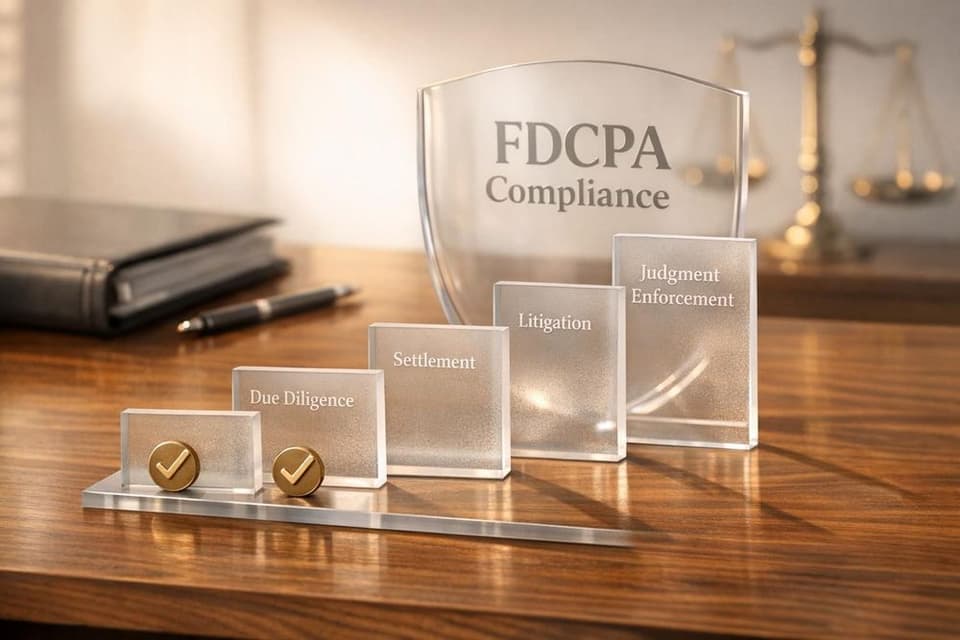
Consumer debt collection attorneys specialize in recovering unpaid debts while ensuring compliance with federal and state regulations. They represent creditors in court, negotiate settlements, and enforce judgments. These professionals are critical for handling complex legal requirements and minimizing risks in debt recovery.
Key Takeaways:
- What They Do: Recover debts, file lawsuits, represent creditors, and enforce judgments.
- Why They're Needed: To navigate strict regulations like the Fair Debt Collection Practices Act (FDCPA) and avoid costly penalties.
- Services Offered:
- Settlement negotiations (e.g., lump-sum payments, payment plans).
- Court litigation for disputed or high-value debts.
- Judgment enforcement through wage garnishments, asset seizures, etc.
- When to Hire: When internal efforts fail, debts are disputed, or legal expertise is required for large amounts or compliance.
Hiring a debt collection attorney ensures legal recovery methods, protects against violations, and improves debt management outcomes.
Debt law: an overview of key issues
Services Provided by Consumer Debt Collection Attorneys
Consumer debt collection attorneys handle everything from negotiating settlements to pursuing litigation and enforcing judgments. Their work blends legal expertise with compliance measures to help recover debts effectively. Here's a closer look at the key services they provide: settlement negotiations, court litigation, and judgment enforcement.
Debt Settlement Negotiations
Attorneys often start by negotiating with debtors to settle debts. These settlements might involve lump-sum payments, where debtors pay 30% to 60% of the owed amount upfront. This approach offers creditors immediate cash flow while reducing collection expenses. Alternatively, they may arrange structured payment plans, which can include agreements like "pay-for-delete" or updates to credit tradelines, marking the debt as "paid in full" or "settled". Older debts are often settled for even smaller amounts.
As one expert explains:
"A debt collector doesn't care if you owe $250 or $2,500. It just wants to maximize its return, which might be a percentage of what it collects or whatever it can collect over the pennies on the dollar it paid for the debt."
Attorneys ensure all settlement terms - such as amounts, deadlines, and credit reporting agreements - are documented and signed before any payment is accepted. Without proper documentation, creditors or collectors might fail to update credit bureaus after receiving payment. For debts still owned by the original creditor, attorneys typically work on a contingency fee basis, charging between 25% and 60% of the recovered amount.
Court Litigation and Legal Representation
If negotiations hit a dead end, attorneys may take the case to court to secure a judgment. Lawsuits must be filed in the correct judicial district, usually where the debtor resides or signed the original contract. Before filing, attorneys ensure they have all necessary documents, as debt buyers often receive incomplete records during portfolio transfers.
Once in court, attorneys handle the entire legal process - presenting evidence, arguing the case, and representing creditors before a judge. This legal expertise sets them apart from standard collection agencies, which lack the authority to litigate.
Judgment Enforcement Actions
Securing a judgment is only part of the process - actually collecting on it requires strategic enforcement. Attorneys assess assets, legal risks, and timelines to determine the best approach. As the American Bar Association points out:
"Judgment enforcement requires a combination of strategy, creativity, diligence, and patience."
Attorneys use a variety of tools to enforce judgments, including:
- Subpoenas targeting financial institutions
- Post-judgment discovery under Rule 69 of the Federal Rules of Civil Procedure
- Writs of execution, wage garnishments, and asset seizures
For debts involving multiple states, attorneys rely on the Uniform Enforcement of Foreign Judgments Act (UEFJA) or 28 U.S.C. § 1963 to enforce judgments across state lines. If debtors ignore court orders or fail to comply with discovery requests, attorneys can file motions for contempt and request judicial sanctions to compel cooperation. These enforcement actions not only increase the chances of recovery but also add value to debt portfolios.
When to Hire a Consumer Debt Collection Attorney
Sometimes, standard recovery methods just aren't enough, and that's when bringing in a consumer debt collection attorney can make all the difference. While not every situation calls for legal help, certain cases require their expertise to navigate the legal maze and improve your chances of recovering what you're owed.
When Internal Collection Efforts Fail
Internal collection strategies can work well - until they don't. When debtors stop responding to emails, phone calls, or letters, it's time to consider legal action. As Brendan Gilbert puts it:
"If your debtor has been unresponsive and no longer answers your emails, phone calls or letters, then hiring an experienced collections attorney may be necessary."
Things get even trickier when a debtor files for bankruptcy. At that point, collection efforts must legally stop, and only an attorney can guide you through filing claims against the bankruptcy estate. Time is also a factor - statutes of limitations can bar your ability to collect if you wait too long. Acting quickly with the help of a state-licensed attorney ensures you don't miss critical deadlines.
For debts involving large sums or disputes, legal expertise becomes even more critical.
High-Value or Disputed Debts
If a debtor disputes the debt's validity or amount, an attorney can be indispensable. They can trace the chain of ownership from the original creditor to the current holder, ensuring the debt is enforceable. Additionally, they can scrutinize balances for inflated fees or interest by requesting itemized calculations.
Attorneys are also your best defense when collectors violate the Fair Debt Collection Practices Act (FDCPA). Whether it's harassment or failure to validate a debt, these violations can be used as leverage to negotiate settlements - or even have the debt dismissed altogether. Under the FDCPA, consumers may recover up to $1,000 in statutory damages, plus actual damages and attorney fees if collectors break the law.
When it comes to cost, attorneys typically charge in one of three ways: contingency fees (a percentage of the recovered amount, often one-third), flat fees for straightforward tasks like drafting letters, or hourly rates for more complex cases. Before hiring, weigh the potential recovery amount against these fees. Attorneys are most beneficial for high-value or complicated cases that go beyond what internal teams can handle.
But their role isn't just about individual cases - they're also key in managing larger debt portfolios.
Legal Support for Debt Portfolio Transactions
Debt buyers - who are considered "debt collectors" under the FDCPA - must follow strict federal regulations. Attorneys help ensure compliance by conducting due diligence on debt portfolios. They verify that debts weren’t discharged in bankruptcy or tied to identity theft, both of which can lead to costly legal claims. They also make sure no lawsuits are filed on time-barred debts, as doing so violates federal law.
Beyond compliance, attorneys help prevent errors like filing lawsuits in the wrong jurisdiction or using misleading forms that suggest third-party involvement. This level of oversight reduces legal risks and increases the overall value and marketability of debt portfolios.
Hiring an attorney isn't always necessary, but knowing when to bring one in can make all the difference in recovering debts effectively and staying on the right side of the law.
How Attorneys Work with Debt Trading Platforms
In the world of debt recovery, consumer debt collection attorneys play a critical role in ensuring that platforms like Debexpert operate within legal boundaries and function effectively. Their work starts well before a debt portfolio is listed for auction and continues long after the sale, acting as a bridge between buyers and sellers to support efficient recovery efforts.
Legal Review for Portfolio Auctions
Before a debt portfolio is listed on Debexpert, attorneys perform a thorough "data scrub" to confirm that account information is accurate and complete. This step ensures that accounts linked to deceased individuals, active bankruptcies, fraud, or prior settlements are removed.
Attorneys also ensure that the sale process complies with federal regulations such as the Fair Debt Collection Practices Act (FDCPA), the Fair Credit Reporting Act (FCRA), and the Gramm-Leach-Bliley Act (GLBA). A key part of their review involves determining whether a buyer qualifies as a "debt collector" under the FDCPA’s "principal purpose" test. According to the official interpretation of 12 C.F.R. § 1006.2(i):
"A person who collects or attempts to collect defaulted debts that the person has purchased, but who does not collect or attempt to collect... debts owed or due... to another, and who does not have a business the principal purpose of which is the collection of debts, is not a debt collector".
Additionally, attorneys draft purchase agreements that protect confidentiality, secure data, and outline consumer protection responsibilities. They also ensure that sellers provide essential documentation, such as signed contracts, recent account statements, and detailed breakdowns of principal, interest, and fees. For example, OCC Bulletin 2014-37 emphasizes:
"Banks should ensure that their debt buyers have accurate and complete information necessary to enable them to pursue collections in compliance with applicable laws and consumer protections".
Legal professionals also identify accounts with specific protections, such as those eligible under the Servicemembers Civil Relief Act or located in disaster-affected areas. They establish guidelines for any future resales to safeguard account information. Once this legal groundwork is complete, attorneys transition to supporting recovery efforts after the portfolio is sold.
Recovery Support After Portfolio Purchase
After a buyer acquires a portfolio through Debexpert, attorneys step in to develop strategies for recovery and enforcement. They initiate legal actions to convert purchased debt into judgments, which can lead to wage garnishments, bank levies, or judgment liens. They also verify the full chain of ownership from the original creditor to the current buyer by reviewing key documents like contracts, statements, and charge-off notices.
Jeffery Hartman, Managing Member at Fitzgerald Advisors, highlights the importance of documentation:
"A portfolio with a complete 'media chain' - original contracts, statements, charge-off notices - is a defensible, high-value asset. A portfolio with no documents is a speculative gamble and is priced accordingly."
Post-purchase, attorneys perform additional data scrubs using sampling techniques to confirm account balances and identify accounts that should not be pursued, such as those tied to bankruptcies or deceased individuals. They also help buyers create internal collection policies, design compliant communication templates (letters, scripts, emails), and manage relationships with specialized collection law firms. Furthermore, they maintain updated surveys on garnishment laws, right-to-cure provisions, and consumer communication restrictions. In bankruptcy cases, they handle proofs of claim and related court orders.
Throughout the recovery process, attorneys ensure compliance with federal and state-specific licensing and communication rules. This oversight is essential because, as Attorney Amy Loftsgordon of Nolo explains:
"Debt buyers rarely succeed in litigation against consumers who fight back... mainly because debt buyers often lack the necessary documentation to prove their court case."
Compliance Requirements and Best Practices
FDCPA Compliance Requirements for Debt Collection Attorneys
FDCPA Compliance Requirements for Debt Collection Attorneys
Staying compliant with debt collection laws is crucial for protecting your business and reputation. Consumer debt collection attorneys must navigate a maze of federal and state regulations, with the Fair Debt Collection Practices Act (FDCPA) serving as the cornerstone to avoid violations and maintain ethical practices.
FDCPA and Federal Compliance Rules
The FDCPA sets strict rules for how attorneys and debt collectors interact with consumers. As the Federal Trade Commission explains:
"The Fair Debt Collection Practices Act (FDCPA) makes it illegal for debt collectors to use abusive, unfair, or deceptive practices when they collect debts."
If attorneys regularly collect or attempt to collect consumer debts owed to others, they fall under the FDCPA's definition of debt collectors. This classification comes with specific restrictions:
- Contact Timing: Communicate only between 8:00 a.m. and 9:00 p.m. local time.
- Frequency Limits: Limit calls to a maximum of seven within a seven-day period.
- Validation Notice: Within five days of initial contact, provide a notice detailing the debt amount, creditor's name, and the consumer's 30-day right to dispute the debt.
The Consumer Financial Protection Bureau (CFPB) also emphasizes:
"If a debt collector knows that an attorney is representing you about the debt, the debt collector generally must stop contacting you and must contact the attorney instead."
If a consumer disputes the debt in writing within 30 days, collection efforts must pause until proper verification is provided. For electronic communications, such as emails or texts, you must include a clear opt-out option. Additionally, wait at least 14 days after sending the validation notice before reporting the debt to credit bureaus, ensuring the consumer has received the notice.
Violations can lead to serious penalties. Courts may award up to $1,000 in damages per individual case, or in class actions, the lesser of $500,000 or 1% of the collector's net worth. Legal actions to enforce FDCPA liability must be initiated within one year of the violation.
| Requirement Category | Key FDCPA Compliance Rule |
|---|---|
| Contact Hours | Between 8:00 a.m. and 9:00 p.m. local time |
| Call Frequency | No more than 7 calls in 7 days |
| Validation Notice | Must be sent within 5 days of first contact |
| Dispute Period | 30 days from notice receipt |
| Legal Venue | File cases in the consumer's judicial district |
| Damages | Up to $1,000 per individual case |
Adhering to these rules is only part of the equation. Maintaining thorough documentation is equally critical.
Proper Documentation and Records
Accurate and detailed records are essential for compliance and can protect against disputes. Under Regulation F (12 CFR § 1006.100), debt collectors must keep records of all communications and validation details. These records should include:
- An itemization date (e.g., charge-off date, last payment date, or statement date).
- A breakdown of interest, fees, payments, and credits since the itemization date.
Using the CFPB's Model Validation Notice can offer "Safe Harbor" protections if its format and content are followed closely.
To ensure proper delivery of notices, send them via certified mail with a return receipt. For electronic communications, verify contact information and provide an opt-out option. Before sending text messages, confirm that the phone number hasn’t been reassigned within the past 60 days.
Keep recordings of all debt-related phone calls for at least three years. Document the date of the last payment or acknowledgment of the debt, as these actions can reset the statute of limitations. Maintain all compliance records from the start of collection efforts through three years after they conclude.
How to Reduce Legal Risks
Strong documentation is the foundation, but additional steps can further reduce legal risks. Start by implementing robust internal procedures. A "bona fide error" defense can protect against unintentional violations if you can show that your procedures are designed to prevent mistakes. Review all communications using the "least sophisticated consumer" standard to ensure they are clear and not misleading.
Avoid threatening or initiating legal action for debts that are time-barred under the statute of limitations. Before filing a lawsuit, confirm the consumer’s current residence or the location where the contract was signed to ensure the case is filed in the correct judicial district.
When leaving voicemails, use "limited-content messages" that comply with Regulation F to avoid accidental third-party disclosures. Be aware that some states have stricter consumer protections than the FDCPA, and federal law only preempts state laws if they conflict.
Regular staff training and periodic reviews of internal practices are essential to staying compliant with evolving rules. By combining legal expertise with these strategies, you can effectively manage debt portfolios while minimizing risk.
Future Developments in Debt Collection Law
Debt collection laws are shifting quickly, pushing attorneys to keep pace with new rules and emerging technologies.
Changes in Debt Collection Regulations
Several key regulatory updates are set to reshape debt collection practices. For example, the Department of Education plans to restart administrative wage garnishments for defaulted federal student loans, impacting over five million borrowers. Attorneys should anticipate a surge in garnishment orders as this enforcement effort gains momentum in early 2026.
California is making waves with SB 1286, which took effect on July 1, 2025. This law expands the Rosenthal Fair Debt Collection Practices Act to include "covered commercial debt" - small business and commercial loans under $500,000 guaranteed by individuals. This means attorneys handling such debts in California must now comply with consumer-level rules, such as bans on harassment and strict disclosure requirements.
Oregon’s SB 605, effective January 1, 2026, bans medical service providers and credit reporting agencies from including medical debt in consumer reports. Similarly, Maryland’s HB 431, effective June 1, 2026, prohibits consumer contracts from setting legal action deadlines shorter than those mandated by state law.
A particularly noteworthy update is California’s AB 316, which took effect on January 1, 2026. This law prevents defendants from claiming that harm was caused solely by AI, holding legal practices accountable for the actions of AI tools they use. This is especially relevant for firms employing AI in case management or debtor communications.
| Regulation/Law | Jurisdiction | Effective Date | Key Change |
|---|---|---|---|
| SB 1286 | California | July 1, 2025 | Extends Rosenthal Act to commercial debts under $500,000 |
| SB 605 | Oregon | January 1, 2026 | Bans reporting medical debt to credit bureaus |
| AB 316 | California | January 1, 2026 | Removes "autonomous AI" defense for liability |
| HB 431 | Maryland | June 1, 2026 | Prohibits shortened statutes of limitations in contracts |
These changes highlight the growing need for attorneys to adapt their practices, integrating new compliance standards into their workflows.
Technology and Automation in Legal Services
As regulations evolve, technology is becoming an essential tool for legal professionals. However, it’s not without risks. In February 2026, a legal practice faced a $60,000 sanction for over-relying on AI tools, underscoring the importance of human oversight.
Courts are increasingly wary of AI-generated collection letters, particularly when they lack the independent legal judgment required to meet FDCPA standards. To avoid claims of deceptive practices, attorneys should adopt a human-in-the-loop approach - personally reviewing and signing off on collection letters.
When used responsibly, automation can enhance compliance. For instance, legal tech tools can simplify processes like three-way reconciliation for Interest on Lawyers’ Trust Accounts (IOLTA), ensuring recovered funds are handled transparently and ethically.
Digital communication is also becoming more prevalent, with clearer rules on using text messages, emails, and social media for debt collection. These tools must include automated opt-out options for consumers. Still, attorneys should independently verify contract details and debtor information before sending AI-generated documents or filing cases.
As Susan Manship Seaman, Partner at Husch Blackwell, puts it:
"Regulation F will be challenging because it involves subtle complexities, flexibility that will entail judgment calls on the part of creditors and debt collectors, and the need to review state law to ensure compliance with both state law and Regulation F."
To navigate this evolving landscape, attorneys must strike a balance between leveraging technology for efficiency and maintaining the human oversight needed to ensure compliance with both federal and state laws.
Conclusion
Consumer debt collection attorneys play a dual role, combining legal expertise with a strong focus on compliance. They assist businesses in recovering debts while ensuring adherence to regulatory standards. Their responsibilities extend to securing timely payments, handling settlements, pursuing litigation, and enforcing actions like garnishments and liens. With the authority to represent creditors in court, these attorneys also navigate the strict requirements of the Fair Debt Collection Practices Act (FDCPA). The FDCPA imposes significant liabilities, including actual damages, statutory damages up to $1,000, and consumer attorney fees, for violations.
The legal risks in this field are considerable. In the 2010 case of Jerman v. Carlisle, McNellie, Rini, Kramer & Ulrich LPA, the U.S. Supreme Court ruled that attorneys are strictly liable for legal misinterpretations of the FDCPA. This decision clarified that the "bona fide error" defense does not apply to mistakes in interpreting the law.
To ensure effective debt recovery, it’s crucial to verify an attorney’s credentials and fee structure. Thorough documentation - such as contracts, payment reminders, and communication records - provides a strong foundation for recovery efforts. Fee arrangements can vary, including contingency fees for routine commercial debts, hourly rates for more complex litigation, or flat fees for simpler tasks.
For businesses engaged in debt portfolio transactions, attorneys offer valuable services like legal reviews during auctions and post-purchase recovery assistance. Their understanding of federal regulations like the FDCPA, along with state-specific consumer protection laws, helps minimize legal risks and improve recovery outcomes. Whether dealing with high-value debts, resistant debtors, or intricate legal disputes, the right attorney can be the key to successful recovery. This combination of legal skill and compliance oversight not only protects businesses but also boosts the efficiency and value of debt portfolios.
FAQs
How do I choose the right debt collection attorney?
To find the right debt collection attorney, start by evaluating their experience in handling cases related to debt collection law. Look for someone who specializes in consumer debt and is licensed to practice in your state. It's also crucial to discuss their fees upfront to avoid surprises later and ensure they adhere to ethical standards, such as those outlined in the FDCPA (Fair Debt Collection Practices Act).
You can verify their credentials through referrals or by checking with your state bar association. Scheduling a consultation is a smart move - it gives you a chance to gauge their expertise and determine if they're the right fit for your specific situation.
What documents do I need before an attorney can sue?
To file a lawsuit over a consumer debt, you'll need to gather essential paperwork. This includes the original contract or agreement, the most recent invoice or account statement, and a charge-off statement if the debt involves a revolving account. Be sure to include specific details, such as the last four digits of the account number, the date and amount of the last payment, or proof that no payment was ever made. These details will help support your case effectively.
How can I collect on a judgment across state lines?
To enforce a judgment across state lines, you’ll need to go through a legal process known as judgment domestication or registration. This involves filing the judgment in the state where the debtor resides or holds assets, following that state’s specific legal requirements. Once the judgment is acknowledged by the new state, you can take enforcement actions such as garnishing wages or placing liens on property. Working with an experienced attorney can help streamline the process and ensure everything is done according to state laws.
