

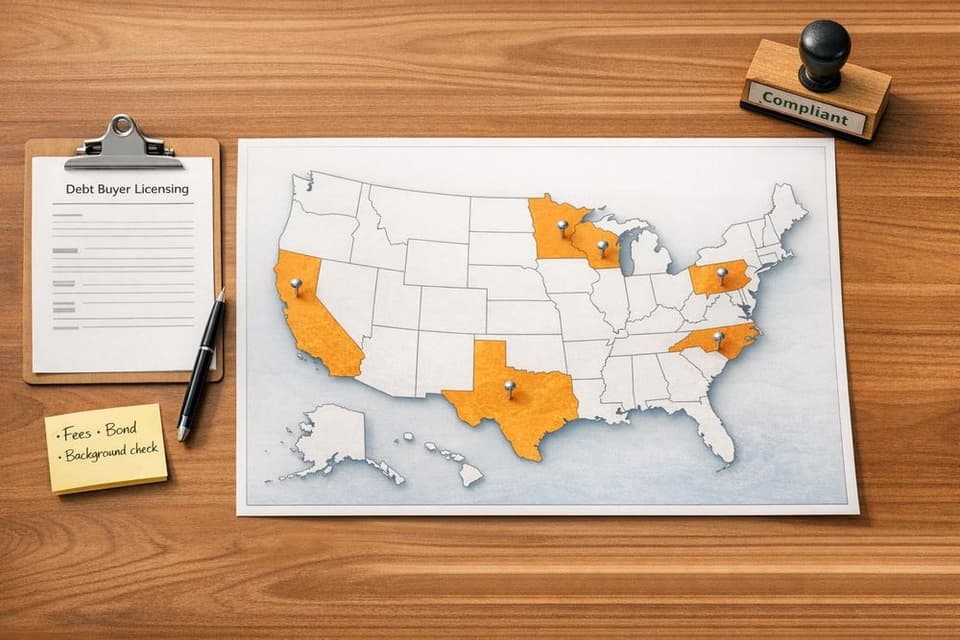
If you're buying debt portfolios like credit card balances or medical bills, some states require a debt buyer license to operate legally. Without this, you risk fines, lawsuits, and losing the right to collect. Licensing rules differ widely by state, with requirements such as fees, surety bonds, and background checks. States like California, Colorado, Minnesota, Texas, and New York have specific regulations, while others may not require a license at all. Here's a quick breakdown:
- California: Requires a license under the Debt Collection Licensing Act (DCLA). Fees include a $350 application fee and $150 investigation fee.
- Minnesota: Needs a surety bond between $50,000–$100,000 and a $1,000 application fee.
- Texas: Requires a collection agency license and a $10,000 surety bond.
- New York: Mandates a collection license, with unlicensed collection activities deemed void.
Penalties for non-compliance include fines, cease-and-desist orders, and legal voiding of collections. Licensing ensures compliance with consumer protection laws, so understanding the specific rules in your target states is essential.
Capital Compliance Group | Jud Phillips Discusses Licensing Updates | Receivables Roundtable Ep. 39
Why Debt Buyers Need Licenses
State licensing laws aim to shield consumers from unfair or abusive collection practices while ensuring debt buyers operate under proper oversight. These laws require companies to meet specific standards before they can legally buy and collect consumer debt.
Consumer Protection and Legal Compliance
Licensing creates a framework to prevent debt buyers from using deceptive tactics. Many states require background checks and fingerprinting for principal officers and owners to ensure only qualified individuals enter the industry. For example, California law mandates that debt collectors include their license number in all digital or written communications, using a font size of at least 12 points. Legal expert Sarah Edwards highlights the importance of this transparency:
"Real debt collectors will give you their license number without hesitation, whereas fake debt collectors will avoid the question and oftentimes even get aggressively defensive about it".
Even after a license is issued, regulatory oversight doesn’t stop. Agencies routinely examine company records to ensure compliance. In California, the Department of Financial Protection & Innovation (DFPI) requires detailed annual reporting and holds the authority to issue cease and desist orders, enforce refunds, and provide restitution to consumers harmed by unlicensed or unethical practices.
These safeguards not only protect consumers but also create a system where violations come with serious consequences.
Penalties for Operating Without a License
The penalties for operating without proper licensing can be severe. In states like Massachusetts and New York, any debt collections conducted without a license are considered legally void, regardless of the debt's legitimacy.
On top of losing the ability to collect, financial penalties can be steep. Many states allow consumers to directly sue debt buyers for violations, including operating without a license. Under the federal Fair Debt Collection Practices Act (FDCPA), violators can face actual damages and statutory damages up to $1,000 per individual case, with class action recoveries capped at the lesser of $500,000 or 1% of the collector's net worth.
State enforcement actions add another layer of accountability. Companies may face license revocation, cease and desist orders, and legal demands to pay damages, refunds, or restitution. Some states go even further, explicitly banning any collection activities against residents unless licensing or bonding requirements are met. Beyond monetary penalties, operating without a license can tarnish a company’s reputation and jeopardize its ability to enforce debt contracts legally.
Which States Require Debt Buyer Licenses
Debt buyer licensing rules differ widely across the United States. Some states have strict licensing requirements, while others may only require a general business registration - or none at all. Whether a debt buyer needs a license often depends on whether they are "active" (managing collections directly) or "passive" (outsourcing collections). In some states, licensing applies to all debt buyers, regardless of their involvement in collection activities.
State-by-State Licensing Requirements
Many states impose specific conditions for obtaining a debt buyer license, including surety bonds, background checks, financial disclosures, and regular reporting. States like California, Colorado, Minnesota, Texas, and New York have detailed licensing requirements. To simplify the process, several states use centralized platforms such as the Nationwide Multistate Licensing System (NMLS).
Here are a few examples:
- Colorado: The Fair Debt Collection Practices Act regulates debt buyers handling defaulted debts. Licensing requires a $500 investigation fee, a $1,500 license fee, and an annual renewal fee of $1,500. Licenses expire on July 1 each year.
- Minnesota: Debt buyers must obtain a corporate surety bond of at least $50,000. This amount increases by $5,000 for every $100,000 collected, up to a maximum of $100,000. Additionally, individual collectors must complete registrations, including background checks.
The following examples from California, Texas, and New York highlight the unique approaches these states take toward licensing.
State Examples: California, Texas, and New York
California operates under the Debt Collection Licensing Act (DCLA), which became effective in 2022. The DCLA defines a debt buyer as any entity that regularly purchases charged-off consumer debts for collection, whether directly or through third parties. Applications are submitted via the NMLS, with fees including a $350 application fee and a $150 investigation fee per applicant. The process typically takes around 90 days, and all principal officers and owners must provide fingerprints for background checks (fingerprints stored in the NMLS for less than three years can be reused). Licensees must also submit an annual report by March 15 and pay a minimum annual assessment of $250, along with a pro rata share based on net proceeds.
Texas requires debt buyers to hold a collection agency license. Additionally, Texas enforces pleading requirements, obliging debt buyers to present specific proof of debt ownership before obtaining court judgments.
New York mandates that debt buyers secure a collection license and adhere to strict documentation requirements during litigation. Without a proper license, any debt collection activity in New York is considered legally void, even if the debt itself is valid.
These examples highlight how states differ in their licensing processes, from fee schedules and bonding requirements to the types of documentation required for compliance.
How to Apply for and Maintain Debt Buyer Licenses
License Application Steps
The process for obtaining a debt buyer license varies by state, and in regulated states, it typically takes around 120–180 days to complete. The first step is determining whether the state you're targeting is "regulated" (requiring a specific debt buyer license) or "unregulated" (only needing general business registration). Many states now use the Nationwide Multistate Licensing System (NMLS) for centralized submissions, though some, like Minnesota, rely on state-specific platforms such as Sircon.
Before applying, you'll need to establish your business entity. This includes preparing articles of formation, obtaining a certificate of good standing, and securing a certificate of authority. Financial requirements differ by state; for example, Texas requires a $10,000 surety bond, while Minnesota mandates at least $50,000, which can rise to $100,000 depending on your collection volume. In Minnesota, the initial fee totals $1,000, split between a $500 license fee and a $500 investigation fee. Additionally, you'll need to complete fingerprinting and criminal history checks for key personnel.
"Licensing is more than just paperwork; it's the foundation of lawful collections." – Tratta.io
After obtaining your license, it's crucial to follow the renewal and compliance guidelines outlined below to ensure uninterrupted operations.
License Renewal and Compliance Requirements
Once your license is in place, staying compliant and renewing on time becomes your top priority. Set reminders at least 60 days before your license expires to avoid any operational disruptions. For example, in Minnesota, renewal applications open in early April and must be submitted by June 30. The annual renewal fee is $400.
Report any changes to executive management, ownership, or business locations within 10 days of the change. In Minnesota, individual collectors are required to undergo annual criminal history checks no more than 60 days before the license expiration date. It's also important to check for additional local requirements. Cities like New York City and certain counties in Florida and California may have their own licensing rules, and failing to comply can result in enforcement actions. Lastly, ensure your surety bonds remain active throughout the license period and submit bond riders to the state within 10 days if your business name or address changes.
These steps highlight the importance of staying diligent with compliance to keep your debt buying operations running smoothly.
How State Licensing Requirements Differ
State-by-State Debt Buyer Licensing Requirements and Fees Comparison
State-by-State Debt Buyer Licensing Requirements and Fees Comparison
State regulations for debt buyers go far beyond just application processes, with fee structures and documentation rules adding layers of complexity that vary widely across the country.
License Fees and Renewal Costs by State
The cost of getting licensed as a debt buyer depends heavily on the state where you operate. For instance, Arizona charges the highest initial filing fee at $1,500, followed by Massachusetts at $1,300 and Wisconsin at $1,200. On the other end of the spectrum, Iowa charges just $10, while New Jersey and Louisiana each require only $25. These differences highlight how fee structures can range from minimal to substantial.
Fees in states like Illinois, Maryland, and North Dakota fall in the middle, hovering around $700–$750. Minnesota charges $1,000 for its initial application fee, split into a $500 license fee and a $500 investigation fee. Maine, on the other hand, sets its initial application fee at $400, with the same amount required annually for renewals. Additional branch fees may also apply; for example, Minnesota imposes a $500 fee per branch, while Maine charges $200 per branch.
Surety bond requirements can add another layer of expense. In Texas, while a formal license isn’t necessary, businesses must secure a $10,000 surety bond, with no state filing fee. Maine mandates a $20,000 bond for direct collectors, while Minnesota’s bond requirements range from $50,000 to $100,000 based on collection volume, which is higher than most states. In some states, like Arizona and North Carolina, both a license and a bond are required. By contrast, Georgia imposes no state-level licensing or bonding requirements.
Required Documents and Legal Obligations
Licensing costs are just one piece of the puzzle; documentation and legal requirements also vary greatly by state, adding further complexity.
Most states that regulate debt buyers require a Certificate of Authority and articles of formation, but the specifics of financial documentation differ. For example, Maine requires financial statements prepared by an accountant, either as a Review Report or an Audited Report, while Minnesota demands detailed financial statements that include bank names and account numbers.
Background checks also differ by state. Minnesota requires a national criminal history search, an attorney licensing search, and a five-year county-level search for initial applications. Renewals are slightly less demanding, requiring only checks for counties where the collector lived in the previous year. Minnesota also mandates agencies to use vendors from the Professional Background Screening Association for these checks. Meanwhile, Maine requires fingerprint cards and privacy act documentation.
Trust account rules provide another example of state-by-state variation. Maine requires a trust account for all funds collected on behalf of its creditors. Minnesota has a similar requirement but offers an exemption for debt buyers who don’t actively engage in third-party collections. This distinction matters because active debt buyers - those who collect debts directly - must typically meet full licensing requirements. In contrast, passive buyers, who outsource collections, may only need to register as a general business.
Navigating these varied documentation and legal obligations is essential for staying compliant, especially given the intricate and state-specific nature of debt-buying regulations.
Conclusion
Navigating debt buyer licensing requirements across the United States requires a close look at the specific rules for each state. Regulations are anything but consistent, with licensing fees, surety bond amounts, and other obligations differing widely depending on the jurisdiction. This guide has highlighted the variety of licensing rules, emphasizing the importance of compliance for long-term success. A key factor is understanding whether your business qualifies as an "active" or "passive" debt buyer, as this distinction often determines your licensing needs.
Operating without the proper licenses is a risky move. Regulators are vigilant, and enforcement actions - such as cease-and-desist orders - can bring operations to a sudden halt.
"Our efforts provide regulatory oversight of the industry to help protect consumers and promote a competitive marketplace." - Minnesota Department of Commerce
These examples make it clear: staying compliant is not optional. It requires ongoing attention to details like license renewals, background checks, and bond maintenance. Tools such as the Nationwide Multistate Licensing System (NMLS) can help streamline the process of managing licenses across multiple states.
FAQs
Do passive debt buyers need a license?
Passive debt buyers usually don’t need a license to purchase charged-off debt. Licensing laws typically apply to those actively involved in collection efforts or to specific state regulations. That said, it’s crucial to check the rules in each state to make sure all requirements are met.
Can I collect if I’m licensed in another state?
To collect debts in a state where you're not licensed, you typically need to ensure that state either recognizes out-of-state licenses or obtain the proper license to operate there. Each state has its own licensing requirements, and many require debt buyers or collection agencies to hold a valid license specific to their jurisdiction. It's crucial to review the regulations for each state to stay compliant and steer clear of potential legal troubles.
What happens if I buy debt without a required license?
Purchasing debt without the proper license can land you in serious legal trouble, including potential lawsuits. Take Washington State as an example - unlicensed debt buyers there have faced legal action for conducting business without the required authorization. To steer clear of these risks, make sure you meet the licensing requirements for every state where you plan to operate.
