

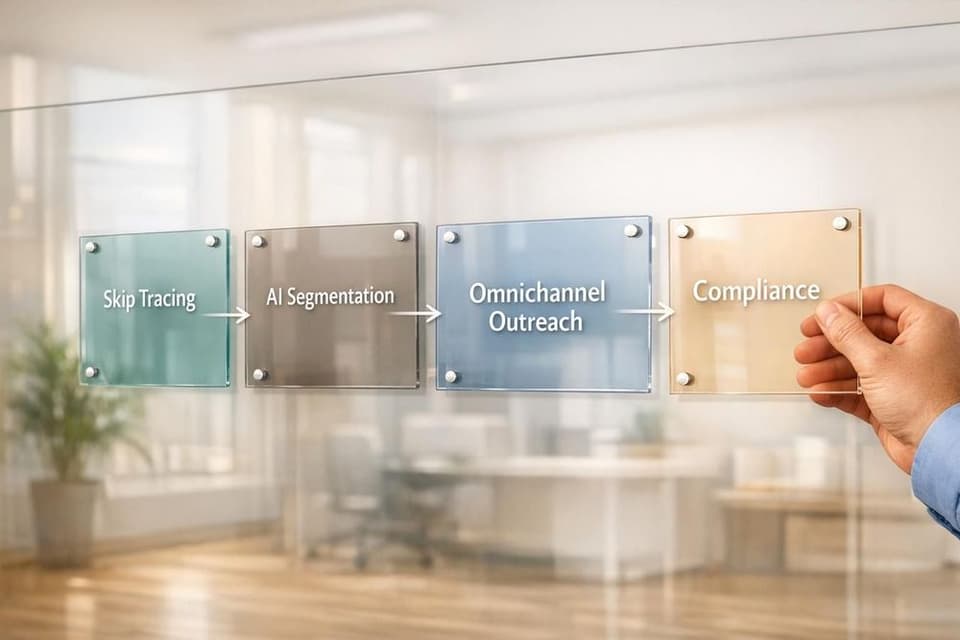
Account Assignment and Recovery Services (AARS) is a process where unpaid debts are transferred from the original creditor to a third-party entity, like a debt collection agency or buyer. This system plays a key role in managing consumer debt, offering creditors a way to recover funds quickly while allowing agencies to purchase debt portfolios at discounted rates.
Key Highlights:
- What AARS Does: Transfers debt ownership to agencies or buyers who recover payments through various strategies, including digital outreach and legal action.
- Market Impact: U.S. consumer debt hit $18.39 trillion in 2025, with 73 million accounts in collections.
- Efficiency Gains: Digital-first approaches improve overdue account resolutions by 25% and reduce costs by 15%.
- Stakeholders: Includes original creditors, debt buyers, collection agencies, law firms, regulatory bodies, and debtors.
How It Works:
- Debt Portfolio Selection: Agencies analyze and purchase delinquent accounts.
- Data Validation: Skip tracing ensures up-to-date contact details.
- Recovery Strategies: AI tools prioritize accounts based on payment likelihood, using methods like email, SMS, and virtual negotiators.
- Monitoring Results: Metrics like collection rates and cost per dollar collected track performance.
Best Practices:
- Choose AARS partners with strong compliance and advanced technology.
- Use predictive analytics for better account prioritization.
- Implement omnichannel communication to engage debtors effectively.
AARS transforms debt recovery into a data-driven, efficient process, benefiting both creditors and debtors while ensuring compliance with regulations.
Revolutionizing Debt Collection | The Power of Self-Service Portals | Ep. 211
How AARS Works: Processes and Strategies
AARS Debt Collection Process: 7-Step Portfolio Assignment and Recovery Workflow
AARS Debt Collection Process: 7-Step Portfolio Assignment and Recovery Workflow
Debt Portfolio Assignment
The process begins with selecting and analyzing debt portfolios. Buyers review available options, using random sampling to estimate potential recovery rates. Factors like the likelihood of non-payment, distribution of nominal values across accounts, completeness of documentation, and the statute of limitations influence valuation.
Next, buyers negotiate terms such as price, payment schedules, and collection parameters. Once both parties agree, they formalize the deal through a debt assignment agreement. Afterward, a Notice of Assignment (NOA) is sent to each debtor.
To ensure accuracy, debtor data undergoes validation and enhancement through skip tracing, which updates contact details and consolidates multiple accounts. Finally, accounts are segmented based on criteria like balance size, delinquency age, risk level, or account type. This segmentation helps determine the most effective recovery strategies.
| Step | Key Actions |
|---|---|
| Selection | Analyzing the market and choosing portfolios |
| Analysis | Estimating risks using random sampling |
| Valuation | Pricing based on account age, balance, and documentation |
| Negotiation | Agreeing on price and collection constraints |
| Transfer | Signing agreements and issuing NOAs |
| Enrichment | Updating data via skip tracing |
| Segmentation | Categorizing accounts by risk and delinquency stage |
Once the debt is assigned and segmented, agencies can implement targeted recovery methods.
Recovery Tactics and Tools
Armed with segmented account data, AARS employs advanced recovery strategies. AI-powered segmentation prioritizes accounts by analyzing factors like payment likelihood, risk, and debtor behavior. This is further refined through Next Best Action (NBA) optimization, which uses predictive modeling to identify the most effective communication methods - whether email, SMS, or phone - and the ideal timing for outreach.
"NBA must integrate non-linear optimization to respect communication preferences and business constraints." – Masood Akhtar, Global Portfolio Marketing Manager, Experian
Automated systems like PowerCurve® Collections eliminate manual errors by selecting recovery approaches based on real-time data. Omnichannel engagement integrates tools like chatbots, virtual negotiators, and self-service portals, enabling debtors to manage payments at their convenience. This method increases engagement, as digital communication can boost payment rates by up to 30% for debtors who prefer these channels.
Skip tracing tools, such as TrueTrace™, improve right-party contact rates by 10% compared to traditional methods. Additionally, Collection Triggers notify collectors of significant changes in a debtor's financial situation, such as new employment or credit inquiries, signaling a better ability to pay. For example, OppLoans, an online fintech lender, achieved a 134% return on investment by using Experian's Tax Season Payment Indicator™ to focus recovery efforts during tax refund periods when debtors had more liquidity.
These strategies ensure a data-driven and efficient recovery process.
Monitoring and Reporting
The success of recovery tactics relies on thorough performance monitoring. AARS operations track key recovery metrics to evaluate effectiveness. The Collection Rate measures the percentage of total debt recovered, while the Liquidation Rate focuses on the recovery percentage of eligible debts, excluding uncollectibles. The Recovery Rate accounts for amounts recovered through sales and legal actions.
Operational efficiency is assessed through metrics like Cost per Dollar Collected, which evaluates profitability, and the Right-Party Contact (RPC) Rate, which measures the success of skip tracing and data validation efforts. Predictive tools like Propensity to Pay (PtP) scores help prioritize accounts with higher recovery potential and validate AI models.
Transparency is enhanced with cloud-based dashboards and performance scorecards that monitor debtor behavior across channels. Automated systems ensure compliance with regulations such as the FDCPA and TCPA, using ownership monitoring to avoid violations. Behavioral tracking tools, like Collection Triggers, provide updates on debtor status changes, allowing for immediate adjustments to recovery strategies.
These metrics guide both debt assignment and recovery strategies, ensuring continuous refinement.
| Metric | Description | Purpose |
|---|---|---|
| Collection Rate | Percentage of total debt recovered | Evaluates overall effectiveness and revenue generation |
| Liquidation Rate | Percentage of eligible debt recovered | Assesses method quality on viable accounts |
| Cost per Dollar Collected | Ratio of collection costs to recovered amount | Measures profitability and ROI |
| Right-Party Contact (RPC) | Percentage of attempts reaching the debtor | Gauges data accuracy and skip tracing efficiency |
| Propensity to Pay (PtP) | Likelihood of a debtor settling the debt | Helps prioritize accounts and refine strategies |
Best Practices for Using AARS
Choosing the Right AARS Partner
When selecting an AARS (Accounts Receivable and Recovery System) partner, it’s crucial to focus on compliance, data quality, and advanced technology to avoid issues with regulations like FDCPA, TCPA, and Regulation F. A good system should automatically scrub contact lists against the National Do-Not-Call Registry and track consumer communication preferences in real time. Platforms with audit trails and clear electronic opt-out processes are essential.
Access to robust data is another priority. Partners offering extensive consumer databases and real-time skip-tracing tools can deliver more accurate results. For instance, advanced tools like TrueTrace™ have shown a 10% improvement in right-party contact rates compared to traditional methods. Additionally, the system should flag sensitive statuses, such as bankruptcy, deceased individuals, or active military personnel, to help avoid legal missteps.
Technology is what sets top-tier partners apart. Providers that utilize machine learning to prioritize accounts based on payment likelihood - rather than outdated age-based metrics - can significantly improve outcomes. For example, machine learning models have achieved an 85.5% accuracy rate in predicting debt recovery success. Omnichannel communication options, such as SMS, email, and IVR (Interactive Voice Response), are also critical for engaging debtors effectively.
| Selection Criterion | Key Features to Look For |
|---|---|
| Technology | AI-driven decision-making, predictive prioritization, and machine learning |
| Communication | Omnichannel support (SMS, Email, IVR) and self-service payment portals |
| Compliance | Automated checks for FDCPA, TCPA, and Regulation F; secure audit trails |
| Data Access | Real-time skip tracing, alternative financial data, and daily collection triggers |
| Reporting | Real-time dashboards, performance tracking, and custom analytics |
Make sure digital portals comply with ADA/WCAG standards and that the platform offers API access for seamless integration with existing CRM or ERP systems. Cloud-based solutions are also a smart choice, as they can scale up to handle fluctuating account volumes without requiring additional staff. A partner with these capabilities not only ensures compliance but also supports a more efficient and effective recovery strategy.
Improving Debt Recovery Outcomes
Moving away from age-based collection strategies to predictive analytics and NBA (Next Best Action) optimization can significantly boost payment rates while cutting costs. Digital-first approaches, for example, have been linked to a 25% increase in resolving accounts over 30 days past due and a 15% reduction in collection costs. Notably, 73% of customers contacted through digital channels make at least a partial payment, compared to just 50% contacted by traditional phone calls.
Automated monitoring tools that track life events - like new employment or credit inquiries - can alert you to changes in a debtor’s financial situation, making it easier to reprioritize accounts with a higher likelihood of payment. Self-service portals and virtual negotiators also empower debtors to manage their accounts on their own schedule, increasing payment arrangements by as much as 40%.
For routine cases, automated workflows can handle the workload, freeing up live agents to focus on more complex negotiations. Early-out programs, which engage consumers before accounts become critically delinquent, can help preserve positive relationships while improving recovery rates. Testing different communication methods and frequencies can also help fine-tune your approach to align with changing consumer preferences.
Using Technology with AARS
Advanced technologies are transforming how AARS functions, driving better recoveries and streamlining processes. Some systems report a recovery boost of up to 65% thanks to AI and machine learning. These tools analyze historical payment data and consumer behavior to pinpoint high-value accounts, allowing resources to be allocated where they’ll have the most impact. Performance data can also guide adjustments to outreach campaigns in real time.
Speech and sentiment analytics take this a step further by monitoring phone conversations to detect emotional cues or financial challenges. This allows for on-the-spot adjustments to repayment plans, potentially preventing defaults. Virtual agents, available 24/7, provide automated interactions that can cut collection costs by 50% while maintaining consistent engagement. Interestingly, only 11% of debt collection companies currently use AI in their daily operations, giving early adopters a competitive edge.
For online payment portals, security is non-negotiable. Ensure they are equipped with Transport Layer Security (TLS) and encrypted firewalls to protect sensitive data. Integration with financial platforms like NetSuite, SAP, or Salesforce creates a unified system for managing invoice data. Additionally, cloud-based scalability allows systems to adapt during peak collection periods without requiring local infrastructure upgrades. In specialized areas like healthcare collections, automated follow-ups have been shown to increase cash collections for bad debt resolution by 25%.
Case Study: AARS Implementation
This case study highlights how AARS was effectively applied to overcome operational challenges in a demanding environment.
Background and Challenges
In July 2024, a Polish debt collection firm managing large volumes of receivables from industries like telecommunications, energy, and streaming services faced mounting obstacles. Their reliance on manual, standardized decision-making processes drained resources on low-value debts while overlooking accounts with higher recovery potential. Legacy systems failed to incorporate alternative data signals, leading to poor forecasting and ineffective prioritization. Collectors were stretched thin, spending excessive time on accounts unlikely to yield results, which contributed to growing employee burnout and high turnover rates.
AARS Solutions Applied
Researchers from AGH University stepped in with a rule-based AARS model powered by decision tree machine learning. By analyzing historical data across various portfolio types, they developed 16 decision rules to automate the choice between negotiation and legal action. This automated decision engine replaced manual strategy selection, enabling the firm to segment accounts based on actual recovery probabilities instead of outdated metrics like account age.
This approach blended automation with human oversight, reducing unnecessary collector involvement while easing workplace stress. It also demonstrated how pairing technology-driven systems with automated workflows can transform operational strategies.
"The classification accuracy of the decision tree... proved to be the highest among the tested machine learning methods, with an accuracy rate of 85.5%." - Rafał Jankowski and Andrzej Paliński, Researchers, AGH University
The automated decision-making process laid the groundwork for measurable improvements, as seen in the results.
Results and Key Takeaways
The implementation delivered an 85.5% classification accuracy rate, allowing the firm to route accounts to the most effective recovery strategies automatically. This eliminated guesswork, enabling collectors to focus on high-value negotiations while routine cases were managed through automated workflows. The system's ability to distinguish between accounts needing human attention and those fit for automation addressed the burnout issue directly.
This case underscores how data-driven automation can replace outdated, one-size-fits-all methods to improve debt recovery outcomes while fostering a healthier, more efficient work environment for collection teams.
Conclusion
Key Insights on AARS
AARS transforms debt collection by making it smarter and more efficient. This technology enhances financial outcomes, improves operational workflows, and supports workplace well-being. By automating routine tasks and focusing on actual recovery probabilities - rather than outdated metrics like account age - teams can concentrate on accounts that truly need human involvement.
For example, digital-first strategies powered by AARS result in a 25% increase in resolving overdue accounts (over 30 days) while reducing overall collection costs by 15%. Additionally, machine learning models used in these systems boast an impressive 85.5% classification accuracy when routing accounts to the best recovery strategies. AARS also helps reduce employee burnout by cutting down unnecessary interactions on low-priority debts.
Compliance is baked into the system, with regulations like the FDCPA and HIPAA integrated directly into workflows. Plus, real-time dashboards provide clear insights into account status, communication history, and recovery progress, ensuring transparency and control.
Next Steps for Professionals
To make the most of AARS, professionals can take several practical steps. Start by incorporating rule-based models to identify hard-to-recover debts early. This enables informed decisions on whether to pursue amicable collection or escalate to legal action, saving time and resources on low-recovery accounts. Also, consider using skip-tracing services, as nearly 40% of collection delays stem from outdated contact information.
Another key move is adopting flexible payment solutions. Chatbots and virtual negotiators can offer personalized repayment plans, reducing the workload for agents. For accounts likely to self-resolve, automated reminders are a cost-effective alternative to live agent follow-ups. These strategies not only streamline recovery efforts but also create a balanced framework that aligns financial goals with employee satisfaction and compliance requirements.
FAQs
Is AARS a debt buyer or a collection agency?
AARS is a debt collection agency that acts on behalf of creditors to recover unpaid debts. Unlike debt buyers, AARS does not purchase debt portfolios. Instead, it concentrates solely on collecting debts owed directly to creditors.
What happens after I receive a Notice of Assignment (NOA)?
When you receive a Notice of Assignment (NOA), it means your debt has been transferred from the original creditor to a third-party collection agency or creditor. This notice informs you of the change and provides details on how to handle the debt moving forward. From this point, payments should be made directly to the new creditor or collection agency, as they now manage your account.
How does AARS stay compliant with FDCPA, TCPA, and Regulation F?
Account Assignment and Recovery Services (AARS) operates within the boundaries of key regulations like the FDCPA, TCPA, and Regulation F by sticking to strict guidelines designed to safeguard consumers and uphold lawful practices. This involves several critical steps:
- Communication Rules: Ensuring all interactions with consumers follow legally approved methods and timings.
- Obtaining Consent: Securing proper authorization before initiating contact.
- Avoiding Harassment: Maintaining respectful and professional communication, free from undue pressure or repeated calls.
- Clear Disclosures: Providing transparent and easy-to-understand information about debts and consumer rights.
To stay compliant, AARS invests in thorough staff training, utilizes tools designed to meet legal standards, and keeps detailed records of interactions. Additionally, they regularly monitor and refine their practices to align with changing regulations, ensuring they remain both effective and lawful.
