

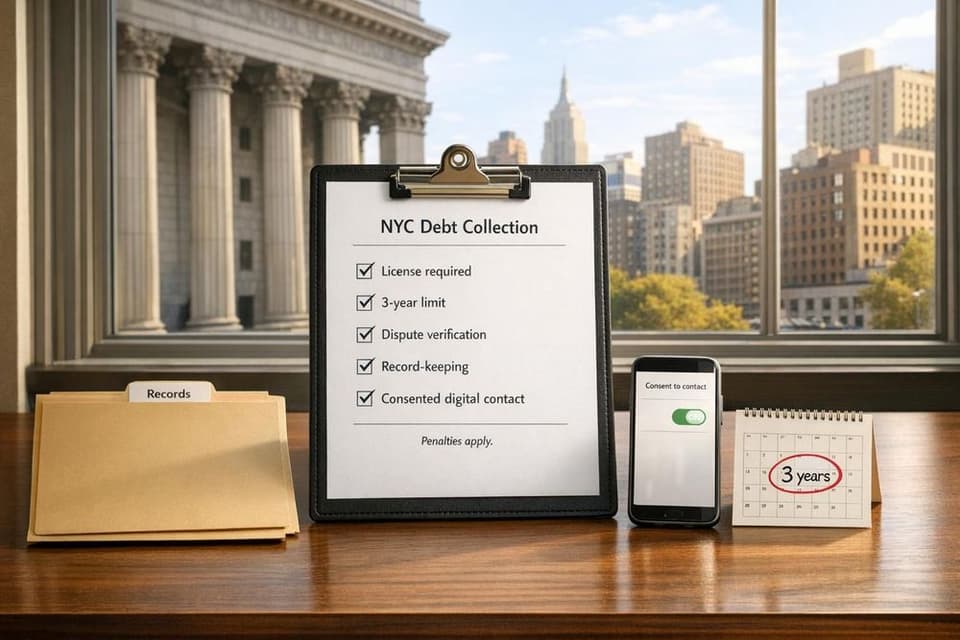
Debt collection in New York City operates under some of the strictest regulations in the U.S., overseen at the municipal level by the Department of Consumer and Worker Protection (DCWP). Here’s what you need to know:
- Licensing: All debt collectors, including first-party creditors and debt buyers, must have a local license to operate.
- Expanded Definition: Since April 1, 2025, first-party creditors are classified as debt collectors in NYC.
- Communication Rules: Starting October 1, 2025, explicit consumer consent is required for email or SMS communication.
- Statute of Limitations: The time limit for pursuing consumer credit debt is three years, and making payments does not reset this period.
- Record-Keeping: Collectors must maintain detailed monthly logs of communications, disputes, and complaints.
- Consumer Protection: Collectors must provide written verification for disputed debts and cannot pursue collection on unverified debts.
Non-compliance can lead to fines up to $3,500 per violation, making it critical for collectors to follow NYC’s unique rules. Technology, such as automated systems, can help manage compliance and streamline operations in this regulated market.
NYC Debt Collection Compliance Requirements and Key Regulations
NYC Debt Collection Compliance Requirements and Key Regulations
NYC Debt Collection Laws and Regulations
NYC Department of Consumer and Worker Protection (DCWP) Rules
Department of Consumer and Worker Protection
The NYC Department of Consumer and Worker Protection (DCWP) enforces the Consumer Protection Law under Administrative Code Title 20, Chapter 5, which outlines specific rules for debt collectors in New York City. Collectors are required to send a written notice within five days of first contacting a consumer. This notice must include details such as the original debt amount, any accrued interest or fees, consumer rights, and types of income that are protected (like Social Security or disability benefits).
For debts that are unverified or outdated, the law mandates that debt buyers must have proper documentation of the debt’s history before starting any collection attempts. Additionally, starting April 1, 2025, collectors must maintain monthly logs of all communications, including contact attempts, complaints, and disputes, even if these actions are handled by third-party contractors.
Statute of Limitations and Time-Barred Debt
NYC law also sets strict rules for handling older debts. The Consumer Credit Fairness Act has shortened the statute of limitations for consumer credit transactions in New York from six years to three years. Collectors are prohibited from pursuing legal action on debts that are time-barred. If a debt is too old to be pursued legally, collectors must inform consumers of this fact and clarify that they are not required to acknowledge or pay the debt.
The New York City Bar Legal Referral Service explains:
The law changes the statute of limitations on lawsuits filed by creditors from six years to three years. Also, making payments on the debt does not restart the statute of limitations.
While making a payment on a time-barred debt does not reset the limitation period in New York, collectors must warn consumers that acknowledging or promising payment could restart it. Collectors who are subject to both NYC DCWP and New York State DFS rules can use a single disclosure to satisfy these requirements. These regulations aim to protect consumers while ensuring collectors follow proper procedures.
Prohibited Practices and Consumer Protection Laws
NYC law also prohibits deceptive practices to protect consumers' rights. This includes banning false advertising, hidden terms in debt settlements, and other misleading trade practices. Debt collectors are specifically barred from reporting medical debt to consumer reporting agencies, regardless of the debt’s nature.
If a consumer disputes a debt, collectors must provide written verification and issue a "Notice of Unverified Debt" before selling or transferring the debt. They must also pause collection efforts until verification is complete. Consumers can dispute a debt in writing, verbally, or electronically. Once a dispute is filed, collectors have 60 days to provide verification and may need to pause collection activities for up to 45 days. Mayer Brown explains:
A debt collector is not permitted to collect a debt that is subject to a Notice of Unverified Debt.
Other obligations for collectors include confirming settlements in writing within five days, providing quarterly statements for payment plans, and issuing payoff confirmations within 20 days of the final payment. If collectors fail to substantiate a debt within 60 days of a consumer’s request, they face additional violations under state rules. These regulations underscore NYC’s focus on consumer protections while ensuring debt collection practices remain compliant and transparent.
Debt Collection Strategies for NYC
Working with NYC's Economic and Demographic Factors
New York City’s unique mix of people and its challenging economic environment call for debt collection strategies that are both thoughtful and adaptable. With the city’s high cost of living and income disparities, rigid or aggressive tactics often fall flat. Instead, offering flexible payment plans tends to yield better results. Plus, with 80% of consumers now favoring a fully digital banking experience, aligning collection efforts with these preferences is becoming a must.
Focusing on newer accounts and establishing trust with consumers can also make a big difference. Within NYC’s strict regulatory environment, approaches that prioritize the consumer’s perspective are far more effective than confrontational ones.
Using Technology for Compliance and Operations
In a city with strict debt collection regulations, technology is a game-changer for staying compliant and efficient. For instance, automated platforms can simplify NYC’s demanding recordkeeping rules by maintaining detailed logs of communications, disputes, complaints, and cease-communication requests. This ensures compliance with local laws and reduces the risk of penalties. With the October 1, 2025 rule requiring explicit consumer consent for emails or texts, these systems also make managing digital permissions much easier.
Digital communication is proving to be a powerful tool for recovery. Consumers contacted through digital channels are 12% more likely to make payments. Among them, 59.5% prefer email for debt-related communications, and 25% engage with these emails during off-peak hours. Meanwhile, with 80% of consumers blocking unknown phone numbers, relying solely on calls leaves a lot of potential untapped.
Automation doesn’t just help with outreach; it also handles critical tasks like generating quarterly statements for payment plans, monitoring the 60-day window for dispute substantiation, and flagging time-barred debts. These features help avoid costly violations, which can run up to $3,500 per repeated offense. By combining legal compliance with operational efficiency, automated systems pave the way for more personalized and effective recovery strategies.
Consumer-Focused Recovery Methods
Debt collection in NYC works best when it prioritizes the consumer’s needs, emphasizing clear and fair communication. Transparent agreements and prompt confirmations reduce the likelihood of disputes. Providing quarterly statements that outline payments made and remaining balances also helps consumers stay on track without feeling undue pressure.
According to TrueAccord, email notifications are less intrusive than phone calls.
When a debt is disputed, pausing collection efforts for 45 days while providing verification shows both good faith and compliance with NYC guidelines. If verification isn’t possible within 60 days, sending a "Notice of Unverified Debt" and stopping collection activities protects both the consumer and the collector. This approach reflects NYC’s focus on substantiating claims rather than using aggressive tactics, fostering better outcomes for everyone involved.
NYC Debt Collection Compliance Checklist
Record-Keeping and Documentation Requirements
In New York City, debt collectors must adhere to strict record-keeping rules. For instance, collectors are required to maintain substantiation records, which detail the amount and dates of prior settlement agreements with consumers. If you're handling debts after charge-off, you’ll need to provide an itemized breakdown. This includes accrued interest, additional fees, and all payments made since the charge-off date.
For consumers on payment plans, you must issue quarterly statements. These statements should clearly show interest, fees, and how payments are allocated between principal and other charges. Automating this process can help ensure you meet these quarterly requirements without fail.
If you’re managing child support debts, there are additional rules to follow. You’ll need to keep copies of specific disclosure forms and standard contracts as outlined in NYC Administrative Code §20-494.1(e) and §20-492(c). Moreover, all debt collection agencies are required to secure a $5,000 Surety Bond, naming the City of New York as the Certificate Holder, along with a receipt proving full payment. Note that NYC debt collection licenses are valid for two years and expire on January 31 of odd-numbered years.
"A debt collector cannot collect a debt until substantiation is provided." - New York State Department of Financial Services
Before initiating any collection efforts, confirm that you can substantiate the debt. Alternatively, ensure the creditor can extinguish the debt if substantiation is requested but cannot be provided.
Finally, make sure your debt validation and dispute processes align with these record-keeping standards.
Debt Validation and Dispute Procedures
When a consumer disputes a debt or requests verification, you have 60 days to provide substantiation. During this time, all collection activities must stop until the necessary documentation is provided.
Disputes, whether made orally, in writing, or electronically, should be treated as formal substantiation requests. Collection efforts must pause immediately upon receiving such a request. To comply, you’ll need to provide specific documentation, including the original contract or application (or a document from the original creditor if the original is unavailable), the charge-off statement, details of the debt’s chain of title, and records of prior settlements.
After a settlement or final payment, confirm the agreement in writing within the legally required timeframe.
Communication Standards and Consumer Rights
NYC has clear rules for how debt collectors should communicate with consumers. Within five days of initial contact, specific disclosures must be provided. While the requirements of the NYC Department of Consumer and Worker Protection (DCWP) and the New York State Department of Financial Services differ slightly, you can combine them into a single disclosure document. Just make sure all the required language is included.
For time-barred debt, collectors must inform consumers that suing to collect such debt violates the Fair Debt Collection Practices Act (FDCPA). They must also disclose that acknowledging or promising to pay the debt could restart the statute of limitations. This disclosure must be given before accepting any payment on time-barred debt. In New York, the statute of limitations for consumer credit transactions is three years, and making a payment does not restart this period.
If a consumer has legal representation for the debt, all communications and notices must go directly to their attorney. Additionally, email communication is allowed only if the consumer has explicitly provided written consent to use a specific email address for this purpose. Ensure that all disclosures are easy to read, prominently displayed, and placed near related information.
These measures are designed to protect consumers while ensuring compliance with NYC’s regulations.
License and Bond Requirements
Debt collection agencies in NYC must meet specific licensing and bonding requirements. The license fees are as follows:
| License Duration | Fee |
|---|---|
| Full 24 months | $150 |
| 12-18 months | $113 |
| 6-12 months | $75 |
| Less than 6 months | $38 |
In addition to licensing fees, businesses primarily engaged in collecting personal or household debts from NYC residents must obtain a $5,000 Surety Bond. A 2% nonrefundable credit card convenience fee applies to DCWP payments.
Using Debexpert for NYC Debt Portfolio Trading
Debexpert Features for NYC Debt Trading
Debexpert offers a suite of tools designed specifically to simplify the complexities of NYC debt portfolio trading. One of its standout features is the ability to securely share encrypted documents - such as original contracts, detailed account statements, and chain of title records - ensuring compliance with NYC's stringent legal requirements.
The platform's portfolio analytics are particularly helpful in identifying "zombie debt", or accounts that are no longer collectible under NYC's three-year statute of limitations. This feature helps buyers avoid purchasing accounts that could lead to legal complications.
Another key advantage is real-time notifications about updates to NYC DCWP (Department of Consumer and Worker Protection) regulations. The DCWP recently postponed its planned regulatory changes, originally scheduled for October 2025, but has committed to providing at least three months' notice before implementing any updates. Debexpert ensures you stay informed so you can adapt to any regulatory shifts without missing a beat.
NYC Debt Trading Success Examples
Debexpert provides sellers with multiple auction format options, including English, Dutch, Sealed-bid, and Hybrid auctions. These options allow sellers to present their NYC debt portfolios in ways that best suit their needs. The platform also features presale marketing tools that let sellers showcase compliance-ready portfolios, complete with all necessary documentation. This makes the portfolios more appealing to buyers who are well-versed in NYC's strict verification standards.
For buyers, the real-time chat feature is a game-changer. It allows them to clarify details about the chain of title and other key documentation before placing a bid. This direct communication minimizes the risk of purchasing portfolios that lack critical information, such as itemized debt amounts, accrued interest, or payment histories, all of which are required under NYC law.
Getting Started with Debexpert in NYC
To get the most out of Debexpert, it's essential to complete the compliance verification process before trading NYC debt portfolios. This step ensures adherence to the Debt Collection Agency License requirements.
Debexpert offers tailored plans for both buyers and sellers, with pricing based on trading volume. Sellers gain access to tools like portfolio analytics, auction setup features, and secure file-sharing capabilities. Buyers, on the other hand, benefit from real-time bidding, portfolio evaluation tools, and secure communication channels. Both plans emphasize compliance to protect all parties involved in NYC debt trading.
When uploading portfolios, sellers should use the portfolio analytics feature to ensure that any debt lacking written verification after a consumer dispute is flagged with a Notice of Unverified Debt. As Mayer Brown highlights:
A debt collector is not permitted to collect a debt that is subject to a Notice of Unverified Debt.
This level of transparency helps buyers make informed decisions, reducing the risk of acquiring accounts that cannot legally be collected.
Ultimate Guide to Debt Collection Law in New York
Conclusion
Debt collection in NYC revolves around strict legal standards, consumer-focused practices, and the smart use of technology. The city enforces some of the toughest debt collection regulations in the country, requiring all collectors to follow detailed recordkeeping and communication rules.
Staying compliant isn’t optional - it’s the foundation of lawful debt recovery. Collectors must provide proper verification to continue pursuing debts, and NYC’s three-year statute of limitations on consumer debt adds another layer of complexity. Any debt older than three years must include specific disclosures and careful handling. Violations can result in fines of up to $3,500 per offense, and collectors are held accountable for the actions of their third-party contractors.
Technology plays a key role in navigating these regulations. Automated systems can help manage critical timelines, like the 60-day window for debt substantiation, while ensuring disputes are handled properly. As the New York State Department of Financial Services states:
A debt collector cannot collect a debt until substantiation is provided.
Beyond compliance, technology also supports clear and efficient communication with consumers. Tools like Debexpert flag time-barred accounts, enable secure document sharing, and deliver real-time updates on regulatory changes, keeping operations both smooth and compliant.
In NYC’s demanding debt collection environment, success requires a balance between effective recovery and respectful, transparent consumer interactions. As regulations continue to evolve, businesses that prioritize proper licensing, meticulous recordkeeping, and tech-driven compliance will be best equipped to succeed in this complex market.
FAQs
Do I need an NYC DCWP license if I’m collecting my own debts?
No, you don’t need an NYC DCWP license to collect debts that you personally own. The licensing rules only apply to debt collection agencies and third-party collectors, not individuals handling their own debts.
What proof do I need to verify a disputed debt in NYC?
If you're dealing with a disputed debt in NYC, you have the right to request specific verification from the debt collector. Ask them to provide proof of your agreement with the original creditor, the final account statement, and a detailed breakdown of the total amount owed, including the principal and any interest. Once you've made this request, the collector is required to pause all collection efforts until they supply the requested verification.
How should I handle a debt that’s over 3 years old in NYC?
In New York City, debts older than three years are typically considered time-barred, thanks to the Consumer Credit Fairness Act of 2021. What does this mean for you? Debt collectors are legally prohibited from suing you over these types of debts. Even if you make a payment after the three-year mark, it won’t reset the clock on the debt.
However, don’t be surprised if collectors still reach out. They are allowed to contact you, but they’re required to inform you if the debt is time-barred. Plus, they must comply with the city’s strict regulations when communicating with you. If a collector attempts legal action on a time-barred debt, you can use this as a defense to protect yourself.
