

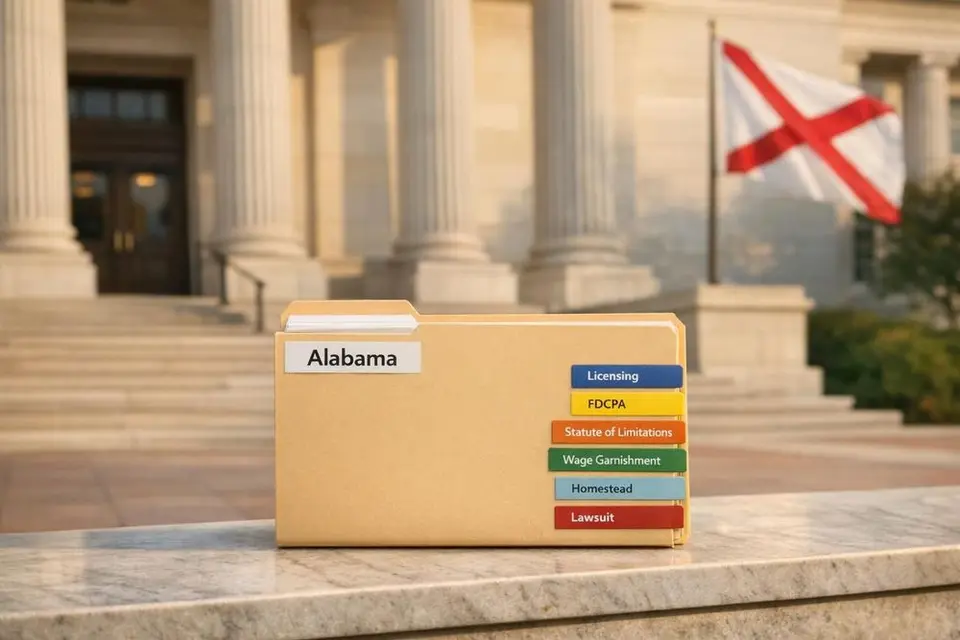
In Alabama, debt collection is regulated by federal laws like the Fair Debt Collection Practices Act (FDCPA) and state-specific rules, including licensing requirements and statutes of limitations. Here's what you need to know:
- Licensing: Debt collectors must be licensed annually by the Alabama State Banking Department, with fees based on the municipality's size.
- Statutes of Limitations: Legal timeframes for debt collection vary:
- Open accounts (e.g., credit cards): 3 years
- Written contracts: 6 years
- Court judgments: 10–20 years
- Consumer Protections:
- Collectors cannot harass, deceive, or use unfair tactics.
- Wage garnishment is capped at 25% of disposable income.
- Homestead exemptions protect up to $15,000 in equity for primary residences.
- Mandatory Notices:
- A 15-day demand letter is required before certain lawsuits.
- Validation notices must be sent within 5 days of initial contact.
Alabama also enforces specific exemptions for debt buyers and original creditors under the Alabama Deceptive Trade Practices Act (DTPA). Violations of these laws can result in penalties, including statutory damages of up to $1,000.
Debt professionals and consumers alike should understand these laws to navigate the legal landscape effectively.
Licensing Requirements and Regulatory Framework
Collection Agency Licensing Requirements
In Alabama, the State Banking Department requires all in-state debt collectors to obtain an annual license. This is outlined under AL Code § 40-12-80, which classifies the license as a business tax rather than a conventional regulatory permit.
Alabama law broadly defines a collection agency as any individual or organization employing agents to solicit claims for collection from individuals or firms within the state. The license fees are based on the size of the municipality where the agency operates. Agencies in municipalities with populations of 20,000 or more pay an annual fee of $100, while those in smaller areas pay $25 annually [10, 11]. Additionally, counties impose a fee equal to 50% of the state fee, making the total license cost range between $38.50 and $151.
Licenses expire every year on September 30, and renewal applications must be submitted by October 31 to maintain compliance. Alabama’s administrative requirements for licensing are straightforward - there is no need for surety bonds, background checks, individual registrations, or resident managers.
Out-of-state agencies that only solicit accounts via letters or phone calls and do not have physical agents or retain Alabama-based attorneys are usually exempt from obtaining a local business license. However, hiring an Alabama-licensed attorney or establishing any form of local representation triggers the licensing requirement.
It’s worth noting that Alabama law provides distinct exemptions for certain debt buyers.
Debt Buyer Exemptions
Under Alabama law, debt buyers are not subject to the collection agency license tax. AL Code § 40-12-80 explicitly states that this tax does not apply to entities excluded from the definition of "debt collector" under the federal Fair Debt Collection Practices Act (FDCPA) (15 U.S.C. § 1692a) [11, 4].
"Each person who shall employ agents to solicit claims for collection from persons, firms, or corporations in the state shall be deemed a collection agency within the meaning of this section. This section shall not apply to any person who is excluded from the definition of the term 'debt collector' under the federal Fair Debt Collection Practices Act." - AL Code § 40-12-80
Because the FDCPA excludes entities collecting their own debts - such as debt buyers who acquire accounts either before or after default - these companies are typically exempt from Alabama’s collection agency license tax, provided they do not operate under a name that implies third-party collection. That said, debt buyers should consult legal counsel to ensure their specific business model meets the criteria for this exemption.
Fair Debt Collection Practices Act (FDCPA) Protections
Fair Debt Collection Practices Act
What the FDCPA Covers
The Fair Debt Collection Practices Act (FDCPA) establishes federal guidelines to ensure ethical practices in consumer debt collection, offering Alabama residents the right to challenge alleged debts. These rules apply to third-party debt collectors - businesses or individuals primarily engaged in collecting debts for others. This group includes collection agencies, debt buyers, and law firms involved in debt recovery.
The FDCPA is specific to consumer debts, meaning it covers obligations like medical bills, credit card balances, auto loans, and mortgages - debts incurred for personal, family, or household use. However, it does not extend to business-related debts or investment expenses. Additionally, the act generally excludes original creditors collecting their own debts under their own name, although these creditors might still fall under Alabama's Deceptive Trade Practices Act.
Under the FDCPA, collectors must provide a validation notice within five days of their initial contact. This notice should include the total debt amount, the creditor's name, and details about the consumer's right to dispute the debt within 30 days. If the consumer disputes the debt in writing during this period, the collector must pause all collection efforts until they verify the debt. The next section outlines prohibited practices under the FDCPA.
Banned Collection Practices
The FDCPA explicitly forbids harassment, deception, and unfair tactics in debt collection. Harassment includes threats of violence, using offensive language, making repeated calls to annoy, or publishing lists to shame debtors. Collectors are also restricted from contacting consumers before 8:00 a.m. or after 9:00 p.m. local time.
Deceptive practices are also off-limits. These include impersonating an attorney or government official, misrepresenting the debt's amount or status, and making false threats of arrest or wage garnishment without a valid court judgment. Unfair methods, like charging unauthorized fees or interest, mailing postcards that could expose private debt information, or cashing post-dated checks before their date, are similarly prohibited.
If a collector violates these rules, consumers can seek statutory damages of up to $1,000 per lawsuit, even if they haven't suffered financial harm. Legal actions must be filed within one year of the violation. For class action cases, the collector's liability is capped at the lesser of $500,000 or 1% of their net worth. Additionally, successful plaintiffs can recover attorney's fees and court costs from the collector.
“What is the Statute of Limitation on an old credit card debt in Alabama?”
Statute of Limitations for Debt Collection
Alabama Debt Collection Statute of Limitations by Debt Type
Alabama Debt Collection Statute of Limitations by Debt Type
Time Limits by Debt Type
Alabama law sets specific deadlines for filing collection lawsuits, and these timeframes depend on the type of debt involved. Here's a helpful breakdown:
| Debt Type | Statute of Limitations | Relevant Alabama Code |
|---|---|---|
| Open Accounts (Credit Cards, Medical) | 3 Years | AL Code § 6-2-37 |
| Breach of Contract (Sale of Goods) | 4 Years | AL Code § 6-2-36 |
| Oral/Verbal Contracts | 6 Years | AL Code § 6-2-34 |
| Simple Written Contracts (Unsealed) | 6 Years | AL Code § 6-2-34 |
| Formal Written Contracts (Under Seal) | 10 Years | AL Code § 6-2-33 |
| Court Judgments | 10–20 Years | AL Code § 6-9-211 |
The clock on these limitations starts ticking either from the date of the last payment or when the account officially goes into default. However, certain actions - like making a partial payment or acknowledging the debt in writing - can reset this clock, restarting the legal timeframe for collection. Additionally, if the debtor leaves Alabama, the time spent out of the state is typically excluded, pausing the countdown until they return.
Knowing these deadlines isn't just important for consumers but also for those involved in debt collection, as explained below.
How Time Limits Affect Debt Buyers
For debt buyers, these legal deadlines play a key role in shaping their collection and litigation strategies. Once the statute of limitations expires, the debt becomes "time-barred", which means collectors lose the ability to secure a court judgment. This limitation forces debt buyers to carefully plan their actions to avoid violations under the Fair Debt Collection Practices Act (FDCPA).
Consumer protection attorney John Watts notes that debt buyers often wait to file lawsuits, typically between three and six years after a default. This timing is often an attempt to reclassify three-year open accounts under the six-year statute for written contracts, effectively extending their collection window. However, pursuing a time-barred debt in court is an FDCPA violation and could lead to statutory damages. Even though expired debts can't be enforced through court judgments, collectors may still attempt to recover payments through phone calls or letters.
To avoid legal issues, debt buyers must verify the date of the last activity and confirm the debtor's residency within Alabama to ensure the debt is still enforceable.
Filing Collection Lawsuits in Alabama
Required Documentation and Chain of Title
Alabama law simplifies the process of filing lawsuits but emphasizes the importance of proper documentation. According to Ala. Code § 12-21-111, plaintiffs can use a Verified Statement of Account - an affidavit-backed, itemized record of the debt. This shifts the burden of proof to the defendant, who must file a counter-affidavit to challenge the accuracy of the account.
For debts tied to written agreements, you'll need the original contract or promissory note to prove the debtor's obligations and justify any claim for fees. For an "account stated" claim, you must show evidence that a billing statement was sent and went undisputed within a reasonable time. If the defendant disputes a Verified Statement of Account and the court determines the denial lacked good faith, the defendant may face an additional 5% penalty on the final judgment.
The formal litigation process also requires filing a summons and complaint in the correct court based on the amount in dispute. Small Claims Court handles amounts up to $6,000, District Court covers claims up to $20,000, and Circuit Court takes on cases exceeding $20,000. Deadlines for the defendant's response vary: 14 days for Small Claims and District Court, and 30 days for Circuit Court.
15-Day Written Demand Letter
Before filing certain lawsuits, Alabama law mandates sending a written demand letter at least 15 days in advance, especially for claims under the Alabama Deceptive Trade Practices Act (ADTPA). This step isn't optional - skipping it can lead to your case being dismissed immediately.
"In several practice areas, it [a demand letter] is a statutory prerequisite. Failing to provide proper written notice can result in the dismissal of a claim." - Burress Law
The 15-day notice gives the debtor a chance to resolve the issue before litigation adds further expenses. However, keep in mind that sending this letter does not stop the statute of limitations clock. Ensure the 15-day waiting period doesn't push you past the filing deadline for your complaint. If you fall under the "debt collector" category as defined by the Fair Debt Collection Practices Act (FDCPA), your demand letter must include specific FDCPA disclosures to avoid violating federal laws.
Homestead Exemptions and Judgment Enforcement
Assets Protected Under Alabama Law
When pursuing collection lawsuits, understanding property exemptions is crucial for gauging the likelihood of recovery.
In Alabama, a debtor's primary residence is protected under the homestead exemption, which shields up to $15,000 in equity per individual and covers as much as 160 acres of land, including mobile homes used as primary residences. This protection applies regardless of how the property is owned - whether outright, jointly, or as a partial interest. For married couples who jointly own their home, the exemption doubles, allowing up to $30,000 in equity to be protected.
The exemption remains valid as long as the owner occupies the property as their primary residence. If the property is no longer the primary home, this protection may no longer apply. Importantly, the exemption also extends to a surviving spouse and minor children after the primary owner's death.
While the homestead exemption prevents creditors from immediately seizing the property, it doesn’t eliminate their rights entirely. Creditors can file a certificate of judgment in the county where the property is located, creating a lien. This lien, lasting 10 years and renewable for an additional 10 years, doesn’t force a sale but must be resolved when the property is sold or refinanced.
Certain exceptions allow creditors to bypass these protections altogether. These include:
- Mortgaged properties where the property was pledged as collateral
- Pre-existing liens established before the property became a homestead
- Unpaid state or local taxes
- Mechanic's liens for property improvements
- Federal tax liens
Impact on Debt Portfolio Valuation
The homestead exemption plays a major role in determining the collectability of debts tied to residential properties. For debts secured by real estate in Alabama, this exemption can significantly lower the recovery potential. If a debtor’s equity falls below the exemption threshold - $15,000 for individuals or $30,000 for jointly owned properties - a forced sale becomes ineffective.
Debt professionals need to carefully calculate recoverable amounts by subtracting outstanding mortgages and liens from the property’s market value. Only the equity exceeding the exemption is available for collection.
For debts incurred before June 11, 2015, lower exemption amounts may apply, potentially increasing the collectible value. Even when immediate collection isn’t possible, judgment liens remain valuable. They secure the creditor’s position, capturing future equity increases and ensuring repayment if the debtor sells or refinances the property within the lien’s 10-year (or renewable 20-year) timeframe.
Prohibited Deceptive Collection Practices
Alabama Code Prohibitions
In Alabama, consumer protection against deceptive collection practices is enforced through the ADTPA (Alabama Deceptive Trade Practices Act) and the FDCPA (Fair Debt Collection Practices Act). One key distinction of the ADTPA is that it extends its protections to original creditors, like banks, in addition to third-party debt collectors.
Both laws strictly prohibit misleading or deceptive actions during debt collection. For instance, collectors cannot falsely claim to be an attorney or a government official, misrepresent the amount or legal standing of a debt, or make baseless threats of arrest, criminal charges, wage garnishment, or property seizure. Using a fake identity or providing false information to credit bureaus is also forbidden. Under the ADTPA, consumers have the option to address disputes by sending a pre-lawsuit demand letter, which gives creditors a chance to resolve issues before legal proceedings begin. Violations of the FDCPA may result in statutory damages of up to $1,000 per violation, along with compensation for actual damages and attorney’s fees.
These deceptive practices not only breach legal standards but also undermine consumer trust.
"They [debt collectors] harass and lie and threaten because it makes them money... They just want your money and are willing to go to any means necessary to get your money." – John Watts, Alabama Consumer Protection Lawyer
Scope and Limitations
While these laws provide strong protections, the ADTPA has specific exemptions that limit its effectiveness in certain cases. For example, under Section 8-19-7, the ADTPA does not apply to certain transactions, such as mortgage foreclosures and loans governed by other state or federal regulations. Court rulings have reinforced these exemptions, restricting the Act’s reach primarily to unsecured consumer debts. This means individuals with debts tied to real estate, like mortgages, have fewer remedies under the ADTPA. In such cases, the FDCPA serves as the main layer of protection, though it applies exclusively to third-party collectors and not to original lenders.
Conclusion
Main Points to Remember
Debt collection in Alabama largely follows federal FDCPA guidelines since the state does not have its own fair debt collection law. Collectors must secure a license from the Alabama State Banking Department under AL Code § 40-12-80, with licenses expiring on September 30 and renewals due by October 31. The statute of limitations for debt collection varies: 3 years for open accounts, 6 years for written contracts, and 10 years for judgments, which can be renewed for another decade.
Alabama's Deceptive Trade Practices Act (DTPA) offers additional protections by covering original creditors, unlike the FDCPA. Collectors are restricted to contacting debtors between 6:00 a.m. and 9:00 p.m.. Post-judgment remedies include wage garnishment (limited to 25% of disposable income), bank levies, and property liens. However, homestead exemptions - $15,000 per individual and up to 160 acres - help shield certain assets.
These regulations create a foundation for compliance, but practical strategies can help debt professionals navigate Alabama's legal landscape more effectively.
Practical Recommendations for Debt Professionals
To stay compliant and improve collection outcomes, consider the following:
- Check statute of limitations: Ensure debts are within the allowable timeframe before pursuing collection. Attempting to collect time-barred debts can result in FDCPA violations, with penalties reaching $1,000 in statutory damages, plus actual damages and attorney fees.
- Send validation notices promptly: Within five days of initial contact, provide written notice detailing the debt amount and creditor's name. If the debtor disputes the debt within 30 days, pause all collection efforts until verification is provided.
- Choose the right court for claims: For debts between $6,001 and $20,000, decide whether the streamlined District Court process or the more formal Circuit Court procedures better fit your case.
- Use verified statements of account: Under Ala. Code § 12-21-111, filing a lawsuit with a verified statement shifts the burden of proof to the debtor, who must file a counter-affidavit to contest the debt.
- Keep thorough records: Maintain documentation to prove compliance during audits. Ensure any collection costs or interest were clearly outlined in the original contract.
- Understand municipal license taxes: Annual fees vary by location - $100 for cities with 20,000+ residents and $25 for smaller towns.
- Be mindful of exemptions: Social Security benefits and most retirement funds are protected from garnishment for consumer debts, so avoid pursuing these sources for payment.
FAQs
Does making a small payment restart Alabama’s statute of limitations?
In Alabama, making a small payment on a debt doesn’t usually restart the statute of limitations. For most written contracts, this period is six years, while for credit card debts, it’s three years. While a partial payment or acknowledgment of the debt could potentially reset the clock, a minor payment by itself typically doesn’t have this effect.
Can a collector still contact me about a time-barred debt in Alabama?
Yes, debt collectors in Alabama are allowed to contact you regarding a time-barred debt. However, once the statute of limitations has expired, they lose the legal right to sue you over it. While they may still try to collect the debt through communication, their ability to enforce repayment is restricted by law.
What happens if I dispute a debt within the 30-day validation window?
If you challenge a debt within the 30-day validation period, the debt collector is required to pause all collection efforts until they provide proper verification of the debt. You can also request evidence proving the debt’s legitimacy, ensuring no further action occurs until the debt is confirmed.
