

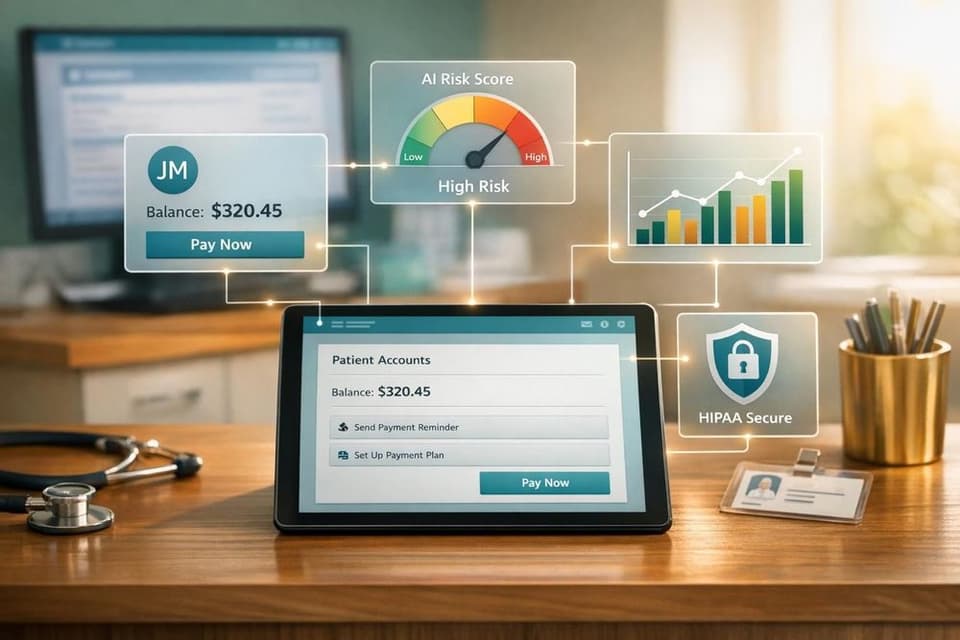
Healthcare debt collection software simplifies the process of recovering unpaid medical bills while ensuring compliance with healthcare regulations like HIPAA and FDCPA. It integrates with Electronic Health Records (EHR) and practice management systems, automates workflows, and uses predictive analytics to prioritize accounts for collection. This software offers features like self-service portals, flexible payment plans, and advanced reporting tools, benefiting both healthcare providers and patients.
Key Benefits:
- Higher Recovery Rates: AI-driven tools improve collections by 10–15%.
- Lower Costs: Automation reduces operational expenses by up to 60%.
- Improved Patient Communication: Multi-channel outreach and self-service options enhance engagement.
- Compliance: Built-in safeguards ensure adherence to strict regulations.
- Analytics: Real-time dashboards provide actionable insights for better decision-making.
Quick Stats:
- Average medical debt per American in 2025: $3,100 (up from $2,000 in 2024).
- Hospitals lose 15–20% of self-pay revenue without efficient tools.
- UC San Diego Health increased collections by 250% using automation.
This software is essential for healthcare organizations looking to recover revenue efficiently while maintaining ethical patient interactions.
Healthcare Debt Collection Software: Key Statistics and Benefits 2025
Healthcare Debt Collection Software: Key Statistics and Benefits 2025
Core Features of Healthcare Debt Collection Software
Automation and Workflow Management
Healthcare debt collection software takes the hassle out of manual processes by relying on smart automation. For instance, PatientDial handles multi-channel contact attempts - like SMS, email, IVR, and automated dialing - without human intervention. This approach has a massive impact. Dayton Children's Hospital, for example, saw its daily call volume jump from just 50–60 calls to an impressive 600 calls after adopting automated dialing systems.
The software also uses predictive scoring and automated workflow triggers to prioritize high-yield accounts for collectors while managing uncollectable ones with no-touch strategies. It even ensures broken payment commitments are promptly followed up on.
Self-service portals integrated with real-time EHR synchronization further streamline operations. These portals cut down on redundant data entry and reduce manual tasks by as much as 60% to 85%, all while keeping financial records up-to-date.
"Having phone call reminders and self-pay options through a payment IVR helps increase collections by giving patients additional options that they can use when convenient for them", says Alex Liao, Product Manager at Experian Health.
These automation-driven features not only enhance efficiency but also ensure compliance with strict regulatory standards.
Compliance Management Tools
Debt collection in healthcare is subject to rigorous regulations, and specialized software ensures organizations stay compliant with laws like HIPAA, FDCPA, TCPA, and Regulation F. Key safeguards include data encryption, role-based access controls, and detailed audit logs that track every interaction with timestamps and user IDs.
Automated workflows also enforce compliance by restricting contact during "quiet hours", limiting outreach frequency, and honoring consumer preferences, such as "do not call" requests. Cloud-based platforms are kept current with regular updates to meet evolving federal and state-specific regulations. This automated compliance approach not only cuts operational costs by 40% to 60% but also boosts recovery rates by 10% to 15%, striking a balance between efficiency and ethical patient engagement.
Analytics and Reporting Capabilities
Advanced analytics take things a step further by turning data into actionable insights that improve recovery strategies. Real-time dashboards provide a clear view of payment trends, segment performance, and channel ROI. Propensity-to-pay scores - derived from credit, behavioral, and demographic data - help identify which accounts are worth pursuing and which are likely uncollectable early in the process.
Full-funnel tracking ensures every interaction, from initial contact to final payment, is documented, creating clear audit trails. For organizations working with external collection agencies, reporting tools simplify vendor performance monitoring. Financial reconciliation features make it easy to align transaction data with bank records, while forecasting tools help predict revenue based on payment schedules - valuable insights for decision-making in debt trading environments.
Jason Thompson, Chief of Staff at Accelerated Receivables Solutions, highlights the benefits: "The reporting is faster, way more accurate, and it's saved our team a ton of time. We're getting insights we didn't have before, and that's helping us make better decisions faster".
These analytics tools can help organizations avoid losing at least 6% of patient collections - a common issue for those without data-driven strategies. Key metrics tracked include Days Sales Outstanding (DSO), right party contact rate, promise kept rate, and recovery rate by vintage.
Benefits of Healthcare Debt Collection Software
Higher Recovery Rates
Healthcare organizations using specialized debt collection software often see a noticeable boost in the percentage of debts they recover. These platforms leverage AI to prioritize accounts based on factors like payment history, account balances, and behavioral trends. By categorizing debtors into "delinquency archetypes", the software helps distinguish between those who have the capacity to pay and those who are ready to engage with the process.
The numbers back this up. In 2025, a Regional Medical Center managing $2.3 million in patient balances partnered with Midwest Service Bureau to integrate workflows with the Epic EHR system. The result? A 27% increase in recovery rates compared to Epic's standard tools, along with a 4.2x return on investment in just the first quarter - all while maintaining 100% compliance during audits. Similar results were seen with other EHR platforms, with Cerner showing a 24% improvement and Meditech achieving a 28% boost in recovery rates.
AI-driven personalization also plays a big role. By optimizing contact timing and communication channels, recovery rates can double, and response rates improve by 3–5 times compared to traditional collection methods. Some platforms even use AI agents to resolve debts in an average of just 20 days, compared to months with older approaches. On average, organizations using modern software experience a 10–15% increase in recovery rates over manual methods.
These advanced tools not only enhance recovery rates but also streamline processes, cutting costs and speeding up operations.
Lower Costs and Faster Processing
Automation is a game-changer for healthcare debt collection. It removes tedious tasks like printing and mailing notices, data entry, and routine follow-ups. This shift significantly boosts efficiency, reducing the need for live agents by as much as 60–85%. The freed-up resources allow staff to focus on complex cases instead of repetitive work.
The financial impact is just as impressive. Modern debt recovery software can cut operational costs by 40–60% while simultaneously improving recovery rates. In 2021, for example, PatientDial's automated dialer saved clients 900,000 labor hours. Its voicemail automation alone saved over 1.5 minutes per message compared to manual efforts.
"You have a significant portion of the population that won't answer their phone... With a solution like PatientDial we can automate these contact attempts, so collectors don't have to spend time dialing and leaving voicemail messages." – Alex Liao, Product Manager at Experian Health
Faster recovery cycles - thanks to automated reminders and flexible payment options - improve cash flow and reduce Days Sales Outstanding (DSO). For organizations trading debt portfolios, these efficiencies lead to better portfolio valuations and quicker transactions. On top of cost savings, the software enhances communication, creating a collection process that’s more responsive and patient-friendly.
Better Patient Communication
Effective communication is crucial for successful debt recovery, and modern software transforms how healthcare providers interact with patients. Multi-channel outreach - via SMS, email, interactive voice response (IVR), automated calls, and physical mail - ensures patients are contacted through their preferred methods at the best times. This approach increases the chances of engagement.
Self-service portals are another major benefit. They give patients 24/7 access to billing details, invoices, and payment plan options. Mobile-first payment links sent via SMS allow for instant, one-click payments, making the process as convenient as possible. As a result, some platforms report that 80% of customers prefer managing their accounts independently.
This focus on compassionate and transparent communication also helps maintain trust between patients and providers. Screening tools identify patients who qualify for financial assistance or charity programs, ensuring unnecessary collection efforts are avoided and guiding those in need toward support. Additionally, systems enforce "quiet hours", respect contact frequency limits, and manage consent to keep outreach compliant and respectful.
"We have seen that when patients are provided with the right options, they typically do want to pay. But life gets in the way." – Alex Liao, Experian Health
The results speak volumes. In 2021, PatientDial helped clients collect over $50 million, with an average of $176 per transaction. By combining better communication with convenient payment options, healthcare organizations can achieve strong financial outcomes while adhering to ethical standards in debt collection.
How Healthcare Debt Collection Software Supports Debt Trading
Managing Debt Portfolios Efficiently
Healthcare debt collection software is transforming how medical debt portfolios are managed, benefiting both buyers and sellers. These platforms are designed to handle intricate account structures, including parent-child relationships across invoices, placements, and portfolios. This setup ensures that responsibilities and balances are clearly traceable throughout the trading process.
Sophisticated segmentation tools allow users to categorize accounts based on factors like risk profiles, delinquency patterns, and likelihood of payment. Machine learning enhances this by analyzing over 100 variables tied to overdue balances. The result? Advanced risk profiling and predictive valuation that rank accounts by their expected returns. This helps sellers justify pricing while giving buyers a clearer picture of potential recoveries.
Additionally, inventory reconciliation features identify discrepancies and duplicate entries, ensuring the accuracy of the debt being traded. Automated audit tools further refine valuations, enabling sellers to adjust pricing and buyers to focus on high-priority accounts. These capabilities make auctions and transactions more efficient and reliable.
Supporting Auctions and Transactions
Beyond portfolio management, modern platforms simplify the transactional aspects of debt trading. Secure document hosting ensures that essential files - like vendor letters, validation notices, and judgment copies - are readily accessible for due diligence.
Integration with Electronic Health Records (EHR) keeps patient financial and medical records updated during ownership transitions. Standardized APIs connect with practice management systems to maintain accurate financial records. Tools like vintage reporting and netback views provide insights into long-term performance and post-fee recoveries, giving stakeholders a comprehensive understanding of account value.
"We typically get the information we need the same day. It's been a great customer experience." – Clint Knisal, Director of Risk Management and Collections, Multi Service Fuel Card
Maintaining Security and Transparency
Security is a cornerstone of debt portfolio transactions. These platforms use robust encryption and detailed audit trails to protect data both at rest and in transit. Transactions are conducted through secure channels like encrypted portals or SFTP, and role-based access control ensures that only authorized personnel can access sensitive information.
Audit trails track every action, query, and export, creating a transparent record for audits or legal purposes. Data loss prevention measures block unauthorized actions like downloading, printing, or forwarding sensitive information. Reconciliation tools verify file counts and hashes, ensuring data integrity throughout the transfer process.
One healthcare recovery platform reported impressive results: a 35% increase in net collection rates and a 25% drop in bad debt write-offs, all while maintaining zero HIPAA breaches. When accounts are placed with a collector, Business Associate Agreements (BAAs) ensure compliance with HIPAA security standards. The software also adheres to the "minimum necessary" standard, sharing only essential data - like identifiers, service dates, and balances - while excluding clinical narratives or diagnostic details.
Conclusion
Key Takeaways
Healthcare debt collection software has reshaped how medical providers and portfolio managers address unpaid balances, streamlining recovery efforts while maintaining ethical patient interactions. Automation eliminates time-consuming tasks, and built-in compliance tools help ensure adherence to regulations like HIPAA, FDCPA, and TCPA, safeguarding patient data and minimizing legal risks. Advanced analytics allow teams to focus on accounts with the highest likelihood of repayment, while routing others appropriately. These modern systems have proven to boost recovery rates and cut costs.
A patient-first approach remains critical. Features like self-service portals, compassionate messaging, and flexible payment options foster trust and encourage patients to resolve their debts voluntarily. When paired with seamless integration into Electronic Health Records (EHR), these platforms create a single source of truth for financial and medical data, reducing errors and simplifying reconciliation.
Looking ahead, the future holds exciting advancements in AI-powered solutions that promise to take efficiency, compliance, and patient engagement to the next level.
The Future of Healthcare Debt Collection Software
The shift toward AI-driven platforms is accelerating. By 2034, the AI debt collection software market is expected to grow from $3.34 billion in 2024 to $15.9 billion. Additionally, over 75% of U.S. health systems plan to expand AI-driven Revenue Cycle Management automation by 2026.
Emerging platforms will rely on autonomous AI to manage tasks across systems, adapt to evolving payer policies, and learn continuously from outcomes. This will improve efficiency while reinforcing compliance and patient trust. Behavioral science will also play a more prominent role, with platforms using principles like loss aversion and social proof to design more effective engagement strategies. Conversational AI and advanced chatbots will handle routine inquiries and payments, while open banking integration will enable real-time verification of patients' income and payment capacity, allowing for more tailored payment plans.
These advancements signal a new era of smarter, more adaptive solutions for healthcare debt collection.
Practical Next Steps
Start by evaluating your organization’s specific requirements. Look for platforms with standardized APIs that integrate effortlessly with your existing billing systems and EHRs to eliminate manual processes. Testing workflows on a smaller scale before full implementation can ensure a smoother transition.
For organizations involved in healthcare debt trading, platforms like Debexpert provide specialized tools to streamline portfolio management and trading. Features such as secure document hosting, portfolio analytics, auction functionality, and real-time communication simplify transactions. Tracking metrics like Days Sales Outstanding (DSO), promise-kept rates, and recovery rates by vintage can help refine strategies and maximize returns over time.
FAQs
How does it integrate with my EHR?
The healthcare debt collection software connects directly with your EHR, enabling real-time data sharing. This integration eliminates the need for duplicate data entry, reduces administrative mistakes, and simplifies workflows. The result? A more efficient revenue cycle and smoother handling of medical debt portfolios.
How does it stay HIPAA and FDCPA compliant?
Healthcare debt collection software is designed to align with HIPAA and FDCPA regulations by embedding these requirements directly into its features and workflows. By automating compliance, the software safeguards patient privacy and ensures all communications during the collection process are both lawful and respectful. Every interaction is structured to uphold strict legal and ethical standards.
What metrics should I track to prove ROI?
To show a return on investment (ROI), focus on tracking essential metrics like patient collection rates, recovery rates, reductions in bad debt, operational cost savings, and the time it takes to achieve ROI. These numbers offer a straightforward way to gauge how well healthcare debt collection software improves financial performance.
