

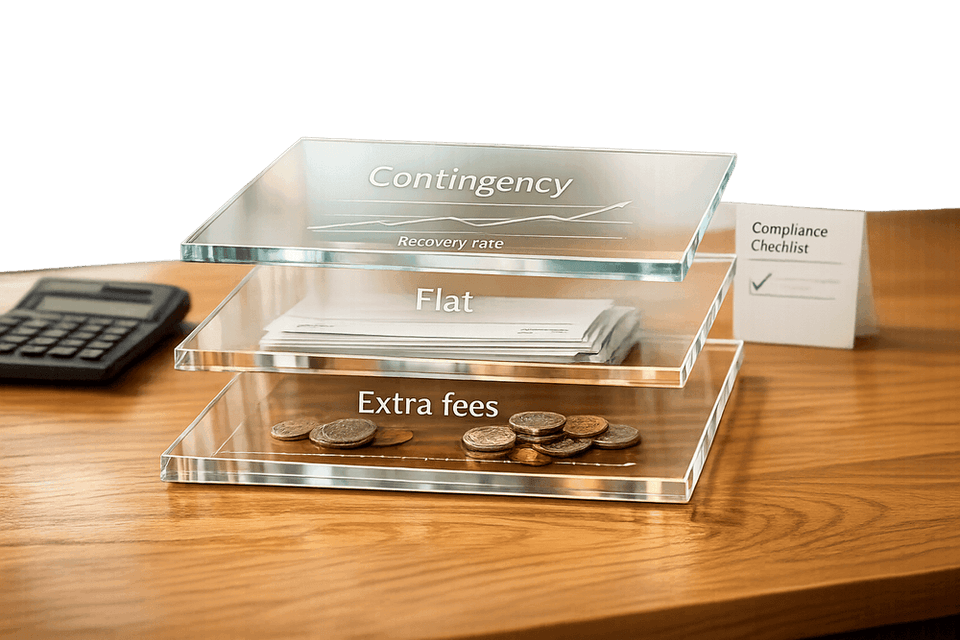
Debt collection agencies charge fees to recover overdue accounts, which can significantly impact how much money you actually get back. Here’s what you need to know:
- Contingency Fees: Agencies typically charge 20%-25% of the amount collected for newer accounts. For older or more difficult debts, fees can rise to 50%.
- Flat Fees: Fixed costs range from $10 to $50 per account, but they don’t guarantee results.
- Additional Costs: Legal fees ($100-$400), skip-tracing ($0.05-$350), and process server fees ($40-$200) can add up quickly.
- Recovery Rates: Newer debts (under 90 days) recover 40%-60%, while debts over two years recover only 10%-15%.
- State Variations: Fees vary by location. States like California and New York average 20%-35%, while less-regulated states like Texas and Florida can reach 50%.
To maximize returns, focus on net recovery (what you keep after fees) rather than just low percentages. Negotiating fees, using technology, and organizing debt portfolios effectively can help reduce costs. Always vet agencies for compliance to avoid hidden risks and penalties.
Debt Collection Agency Fee Structures and Recovery Rates Comparison
Debt Collection Agency Fee Structures and Recovery Rates Comparison
The REAL Cost of a Collection Agency (A 10-Min. Guide)
Common Fee Structures Used by Collection Agencies
Collection agencies use various pricing models based on the type of debt and the likelihood of recovery. These models help creditors estimate costs and choose the best agency for their needs. Understanding these structures is crucial for optimizing returns on your debt portfolio.
Contingency Fees
With a contingency fee model, agencies only get paid if they successfully recover the debt. They take a percentage of the recovered amount, which typically ranges from 20% to 25% for standard accounts. Fresh accounts (less than 90 days old) may have lower rates, starting at 10%, while older debts (over six months) can see fees climb to 30% to 50%.
Smaller balances under $500 often come with higher fees of 35% to 45%, while larger accounts over $10,000 might see rates drop to 20% to 30%. If legal action is required, fees can go as high as 50%.
"The contingency model eliminates financial risk for creditors while ensuring maximum agency effort on each account." - Southwest Recovery Services
This model aligns the agency’s interests with your success: no recovery means no fee. However, some agencies prefer a flat fee approach, which works differently.
Flat Fees
Flat fee structures involve a fixed cost per account, regardless of whether the debt is recovered. These fees generally range from $10 to $50 per account, though specialized services can cost between $50 and $300. Some agencies offer bundled services, such as $500 for 25 collection calls or $800 for 150 collection letters.
While this model provides predictable costs, it doesn’t incentivize agencies to prioritize successful recovery since their compensation isn’t tied to results.
Administrative and Miscellaneous Charges
Beyond the main fee structures, additional charges may apply for specialized services. For example, skip-tracing costs range from $0.05 to $0.15 per batch match, while individual searches can cost $50 to $350 or more. Legal actions may introduce process server fees of $40 to $200 per service, and attorney fees for collection-related work typically fall between $150 and $400 per hour.
Some agencies also charge upfront setup or initiation fees to cover administrative expenses. Other smaller fees might include charges for credit reporting, payment portals, or international collections. It’s essential to request a detailed breakdown of all potential charges before committing to an agency.
How Costs Vary by State
State regulations heavily influence what collection agencies charge. Around half of U.S. states require B2B debt collection agencies to be licensed, bonded, or registered, which adds to their overhead costs - expenses that are often passed on to creditors. These regulatory differences create notable fee variations across the country.
For example, in states like California and New York, fees generally fall between 20% and 35%. California agencies face specific requirements, such as maintaining a $25,000 bond, obtaining NMLS licensing, and including their license numbers in communications using at least 12-point type. Similarly, in New York, agencies may charge additional fees amounting to 33% to 50% of the principal debt. While these regulations increase operational costs, they tend to keep fee percentages relatively moderate. This demonstrates how local rules shape the fee structures for debt collection.
"About ½ of all states require that B2B commercial collection agencies be licensed, bonded and/or registered to collect from debtors in their states." - Dean Kaplan, President, The Kaplan Group
On the other hand, states with fewer restrictions often have higher fees. In less-regulated regions like Texas and Florida, contingency fees typically range from 35% to 50%. Regional averages highlight these differences further: in the Midwest (e.g., Illinois), fees range from 25% to 40%; in the Northeast (e.g., Massachusetts), they range from 20% to 35%; and in the West (e.g., Arizona), fees are between 30% and 45%.
State rules also impact litigation and enforcement costs. Court filing fees can vary widely, from $100 to $400, depending on the jurisdiction. In Connecticut, for instance, debt buyers must provide specific evidence when pursuing legal action, which increases both administrative and legal preparation expenses. Additionally, violations of collection regulations - whether state or federal - can result in penalties of up to $1,000 per violation, along with legal fees. For agencies operating across multiple states, maintaining compliance is essential, as these costs directly affect the profitability of debt portfolios.
Hidden Costs and Compliance Risks
When evaluating debt recovery, it's crucial to account for hidden costs and compliance risks, as these can significantly eat into your net recoveries. One of the biggest culprits? Legal action fees. If standard collection methods fall short, agencies might suggest pursuing lawsuits. This step comes with hefty price tags: attorney fees ranging from $150 to $400 per hour, court filing fees between $100 and $400, and process server fees. For smaller debts, these costs can quickly outstrip their value, directly shrinking your portfolio returns.
Another factor to consider is skip-tracing expenses. While basic debtor location services are typically included in standard fees, more advanced searches can add up. For instance, simple matches might cost $0.05 to $0.15 each, while intensive searches can run over $350. For older debt portfolios, where debtors may have changed addresses multiple times, these costs can stack up fast, further chipping away at recovery rates.
Compliance risks also introduce financial vulnerabilities. Regulatory violations, especially under strict rules from the Consumer Financial Protection Bureau (CFPB), can lead to substantial penalties. For example, the CFPB explicitly prohibits pay-to-pay fees - those extra charges for making payments online or by phone - unless they're clearly authorized by the original debt agreement or by law:
"FDCPA section 808 and Regulation F... prohibit debt collectors from collecting pay-to-pay or 'convenience' fees, such as fees imposed for making a payment online or by phone, when those fees are not expressly authorized by the agreement creating the debt or expressly authorized by law." - Consumer Financial Protection Bureau
Other compliance issues include violations related to time-barred debts. Threatening legal action on debts beyond the statute of limitations is a direct breach of Regulation F. Agencies must also notify consumers before reporting debts to credit bureaus to avoid penalties for "passive collection". Each misstep can result in fines, legal fees, and reputational damage, potentially transforming a profitable portfolio into a financial liability.
To safeguard your portfolio returns, it's essential to thoroughly vet collection agencies. Ensure they have clear protocols for litigation approval, fee transparency, and regulatory compliance. This proactive approach can help you avoid unexpected costs and compliance pitfalls.
How Collection Costs Affect Debt Portfolio Returns
Agency fees have a direct impact on your bottom line by cutting into gross recovery, which in turn lowers portfolio profitability. When agencies charge contingency fees ranging from 25% to 50%, a substantial portion of every dollar recovered is lost to fees. Ultimately, what matters most is your net return - the actual cash you receive after those fees are deducted.
Here’s an example to illustrate: an agency charging a 35% fee but recovering 45% of your portfolio generates better net returns than one charging 25% but recovering only 20%. For a $10,000 portfolio, the first scenario leaves you with $2,925, while the second yields just $1,500. This highlights the importance of assessing both recovery rates and fee structures when managing your portfolio.
The age of debt also plays a critical role in determining net returns. Accounts that are less than 90 days old typically come with lower fees of 15% to 25% and higher recovery rates between 40% and 60%. In contrast, debts older than two years see fees climb to 40% to 50%, while recovery rates drop significantly to just 10% to 15%.
Similarly, small-balance accounts come with their own challenges. Recovering a $500 debt often requires nearly the same effort as collecting a $5,000 debt, which is why agencies charge higher fees - usually between 35% and 45% - for debts under $500. This makes it harder to profit from low-value portfolios, as the economics of collection can quickly become unworkable.
For portfolios made up of older or low-balance accounts, selling the portfolio outright can be a better option. Instead of dealing with contingency fees as high as 40% to 50% and uncertain recoveries, selling your portfolio provides immediate cash flow. This approach eliminates the risks associated with additional fees and offers a straightforward way to secure liquidity.
How to Reduce Collection Agency Costs
Cutting down on collection costs doesn’t have to mean sacrificing recovery performance. By focusing on smarter negotiations, adopting modern technology, and organizing your debt portfolios effectively, you can achieve savings while maintaining results.
Negotiating Better Fee Arrangements
Understanding how collection fees work is just the start - you can go further by negotiating strategically. Agencies value high-volume clients because they bring operational efficiencies. If you’re placing a significant number of accounts, you might secure contingency fees as low as 15–25%, compared to the usual 25–50%.
Debt age also plays a big role. Accounts placed within 90 days past due often qualify for lower fees, around 10–25%, whereas older debts or those considered more challenging can cost 40–50%. Similarly, accounts with balances exceeding $50,000 may lead to reduced fees, sometimes as low as 10–15%, due to the larger recovery amounts involved.
Consider negotiating a tiered pricing model, where fees adjust based on the age or size of the debt. And always push for a "no collection, no fee" agreement to avoid upfront costs like onboarding or administrative charges.
Using Technology to Cut Intermediary Costs
Technology can dramatically lower the expenses tied to traditional debt collection. Platforms like Debexpert allow direct transactions between debt buyers and sellers, cutting out intermediary fees. This streamlined process not only reduces costs but also increases pricing transparency.
Automation is another game-changer. Agencies using automated tools - like reminders, follow-ups, and self-service portals - reduce their internal expenses, and these savings often benefit clients. Self-service portals are especially effective, letting debtors handle payments, set up installment plans, and resolve disputes on their own. This speeds up collections and minimizes manual effort.
AI-powered tools can further optimize costs by segmenting accounts based on repayment likelihood. Agencies can focus their resources on the more complex cases while automating simpler ones. When choosing an agency, look for features like real-time tracking, secure payment portals, and advanced analytics to ensure they’re leveraging technology to its fullest potential.
Organizing Portfolios for Better Recovery
The way you structure your debt portfolios can significantly impact both recovery rates and collection costs. Start by categorizing debts by age and balance. Fresh debts (less than 90 days old) typically have recovery rates between 40% and 60% with fees in the 15–25% range. On the other hand, small-balance accounts (under $1,000) often come with higher fees, sometimes reaching 50%.
Industry-specific segmentation can also make a difference. For example, business-to-business debts often recover at rates between 30% and 70%, while healthcare debts usually fall in the 15–25% range. Matching portfolios with agencies that specialize in your industry can lead to better recovery outcomes and lower costs.
Consolidating accounts into bulk placements instead of submitting them individually can strengthen your negotiating position, helping you secure lower contingency rates. Additionally, applying risk scoring and prioritization ensures your resources are focused on high-probability accounts. This targeted approach not only reduces expenses but also boosts overall recovery performance.
Key Takeaways
Here’s a summary of the fee structures and strategies to manage costs effectively:
Contingency fees generally range from 10% to 50%, depending on factors like the age and complexity of the debt. For high-volume, early-stage collections, flat fees are often used, especially when automated outreach is sufficient.
Additional expenses and legal risks can add up quickly. For instance, court filing fees range from $100 to $400, process servers cost between $40 and $200, and skip-tracing fees can vary widely - from $0.05 to over $350. To avoid unexpected costs cutting into your returns, always request a full fee breakdown upfront.
Recovery rates are more important than fee percentages when evaluating an agency’s performance. Agencies that recover 30% to 70% of B2B debts typically yield better results. For accounts less than 90 days old, recovery rates often fall between 40% and 60%.
"The total amount recovered matters more than the percentage retained, making agency performance the primary selection criterion rather than fee levels alone".
Leverage technology and strategic organization to reduce costs. Direct transaction platforms can eliminate intermediary fees, while AI-powered tools help agencies focus on accounts with the highest potential returns. Submitting accounts early, consolidating placements for volume discounts, and categorizing portfolios by age and industry are proven ways to keep costs low without sacrificing recovery performance.
Compliance is critical - not just for legal reasons but for cost savings too. Adhering to FDCPA guidelines helps avoid expensive litigation. Make sure any agency you work with is properly licensed in the states where your debtors are located and follows all regulatory requirements to safeguard both your finances and reputation.
FAQs
What’s the cheapest way to hire a collection agency?
When it comes to keeping costs low, a contingency fee arrangement is often the best choice. With this setup, you pay a percentage of the debt that’s successfully recovered. Typically, these fees fall between 15% and 25%, though they can climb as high as 50% for older debts or those that are tougher to collect. The key advantage? You only pay if the agency manages to recover the debt.
How do I calculate net recovery after all fees?
To figure out your net recovery, start by subtracting all applicable fees from the total amount recovered. Here's a quick example: if you recover $10,000 and the fee is 20%, calculate the fee first ($10,000 × 0.20 = $2,000). Then, subtract that fee from the total recovery ($10,000 - $2,000). The result? Your net recovery is $8,000 after fees.
When does it make more sense to sell the debt instead?
Selling debt can be a smart move when you need cash quickly, want to sidestep the hassle and costs tied to collections, or are dealing with older, harder-to-recover accounts. It offers an immediate boost in liquidity while cutting out the ongoing expenses of chasing down payments, making it a straightforward way to handle challenging or overdue debts.
