

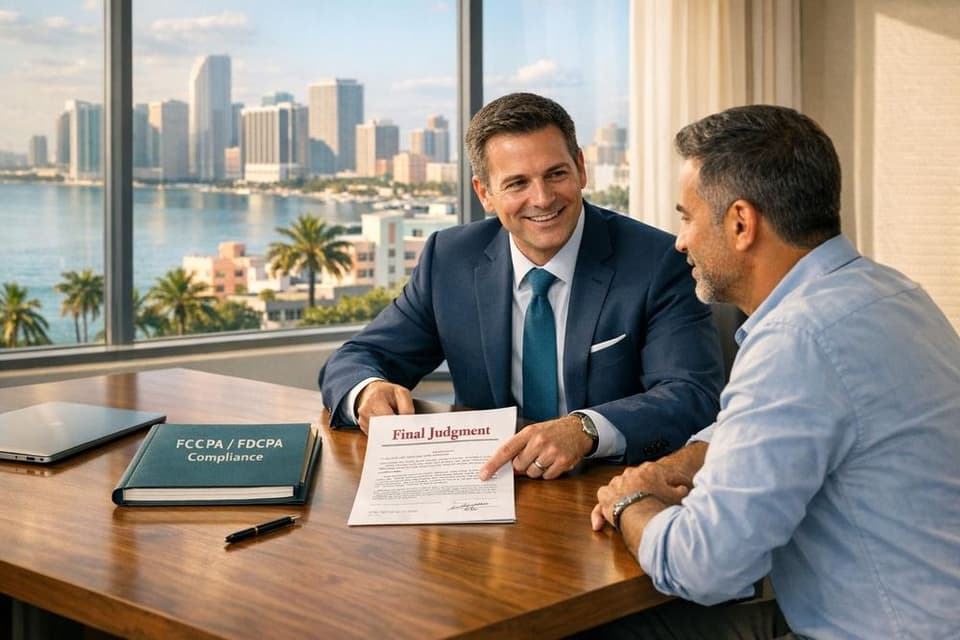
If you’re trying to recover unpaid debts in Miami, hiring a debt collection attorney is often the smartest move. Florida has strict debt collection laws, including the Florida Consumer Collection Practices Act (FCCPA), which applies to both original creditors and third-party collectors. Mistakes like calling outside allowed hours or failing to register as a collector can lead to fines up to $10,000. Moreover, Florida’s debtor-friendly laws, such as homestead exemptions and wage garnishment limits, make it hard to recover funds without legal expertise.
Key Takeaways:
- Florida Laws: FCCPA is stricter than federal laws (FDCPA), regulating all creditors and allowing $1,000 statutory damages per violation.
- Challenges: Asset protections like homestead exemptions make enforcement tough.
- Attorney Role: Attorneys can file lawsuits, enforce judgments (e.g., wage garnishments, liens), and ensure compliance with the law.
- Fee Structures: Options include contingency fees (no recovery, no pay), fixed fees, or hourly rates.
Debt collection attorneys in Miami handle everything from negotiations to enforcing judgments, ensuring compliance with Florida’s complex legal framework. Acting quickly and hiring the right legal partner can save time, reduce risks, and increase the chances of recovering what you’re owed.
Debt Collection Live Q&A [replay] Florida lawyer Mike Wasylik answers your questions
Florida Debt Collection Laws Explained
FDCPA vs FCCPA: Key Differences in Florida Debt Collection Laws
FDCPA vs FCCPA: Key Differences in Florida Debt Collection Laws
Florida's debt collection laws are shaped by both the Florida Consumer Collection Practices Act (FCCPA) and the Fair Debt Collection Practices Act (FDCPA). While both aim to safeguard consumers, the FCCPA is broader in scope and imposes tougher penalties compared to its federal counterpart.
Main Debt Collection Rules in Florida
The FCCPA covers a wider range of collectors, including original creditors, lenders, and debt buyers, whereas the FDCPA primarily regulates third-party debt collectors. Attorney Adam B. Brandon highlights this distinction:
"The FCCPA is broader than the federal Fair Debt Collections Practices Act (FDCPA), which only regulates the behavior of third-party 'debt collectors'".
Under Section 559.72 of the Florida Statutes, 19 specific practices are prohibited. These include impersonating officials, making threats, contacting employers before a judgment is finalized, and revealing debt details to unauthorized individuals. Collectors are also restricted from contacting debtors between 9:00 p.m. and 8:00 a.m. in the debtor's local time zone. If a debtor is represented by an attorney, direct contact must stop immediately.
Florida also requires most debt collectors to register with the Florida Office of Financial Regulation, though attorneys, banks, and original creditors are exempt. Collectors who operate without registration risk administrative fines of up to $10,000. The FCCPA provides consumers with a two-year window to file lawsuits for violations, doubling the FDCPA’s one-year limit. However, statutory damages are capped at $1,000 per action, with class action damages limited to the lesser of $500,000 or 1% of the violator's net worth.
| Feature | Federal FDCPA | Florida FCCPA |
|---|---|---|
| Who it regulates | Third-party debt collectors and some debt buyers | "Any person", including original creditors and lenders |
| Statute of Limitations | 1 year | 2 years |
| Communication Hours | Generally 8 a.m. to 9 p.m. | Strictly 8 a.m. to 9 p.m. in the debtor's time zone |
| Registration | No federal requirement | Mandatory state registration for most collectors |
| Damages | Actual and statutory ($1,000) | Actual, statutory ($1,000), and potential punitive damages |
A recent case, Nina Quinn-Davis vs. TrueAccord Corp. (Case No. 1:23-cv-23590), decided by the U.S. District Court for the Southern District of Florida in November 2024, clarified an important point about digital communication. The court ruled that sending an email after 9:00 p.m. does not violate the FCCPA if the debtor hasn’t opened or read the message yet. This decision emphasizes that timing restrictions apply to when a debtor interacts with the communication, not when it is sent.
These detailed rules underscore the importance of understanding Florida’s specific legal framework.
Why Local Legal Knowledge Matters
Florida courts often rely on FDCPA interpretations when applying the FCCPA. However, in cases of conflict, the law that offers the most protection to the consumer takes precedence. This creates a challenging legal environment for collectors, where even small mistakes can lead to significant penalties.
Austin T. Hamilton, Esq. of Jimerson Birr explains the stakes:
"Consumer attorneys will use these technical violations to shake down businesses for a settlement. It is a lucrative business for consumer attorneys as defending against FCCPA claims often costs more than making a nominal offer".
Florida’s laws are designed to favor debtors, with strong protections like the Homestead Exemption and the "Head of Household" wage garnishment exemption, making it difficult to recover assets after a judgment. A skilled Miami-based debt collection attorney, familiar with these nuances, can help navigate the complexities, avoid costly errors, and identify effective strategies for asset recovery. Local expertise is essential in ensuring compliance while maximizing the chances of successful debt collection.
What Debt Collection Attorneys Do in Miami
Debt collection attorneys in Miami provide a wide range of services tailored to businesses and individuals. Their work goes far beyond drafting demand letters. These legal professionals handle everything from filing lawsuits and managing discovery to negotiating settlements and representing clients in court. They aim to resolve disputes efficiently, often seeking payment plans or settlements to avoid the costs and delays of extended litigation.
Attorneys also address specialized cases, including fraudulent transfers to recover hidden assets, replevin actions to repossess secured goods, and supplementary proceedings to locate concealed property. For those facing collection lawsuits, Miami attorneys offer defense services while ensuring compliance with the Fair Debt Collection Practices Act (FDCPA). Many firms work on a contingency fee basis, meaning clients pay only if the attorney recovers funds. Initial consultations are often free, giving clients a chance to evaluate the likelihood of success. From pre-litigation efforts to complex asset recovery, these services align with Florida's legal standards.
Enforcing Judgments and Recovering Assets
Once a judgment is obtained, Miami attorneys employ various tools to enforce it. These include writs of garnishment to seize wages or bank funds, property levies (including vehicles), and real estate liens [19,20]. In Florida, money judgments can be enforced for up to 20 years, offering creditors an extended window for collection efforts.
If a debtor's assets are unknown, attorneys use post-judgment discovery tools, such as subpoenas, to uncover financial details. However, Florida's protective laws, like homestead exemptions and head-of-household wage protections, make asset recovery particularly difficult. This is why local expertise is crucial. As Paul A. Humbert of the Law Offices of Paul A. Humbert, P.L., warns:
"'Do it yourself' may work well at Home Depot, but it could prove catastrophic in the complicated Florida collections attorney law labyrinth".
Commercial vs. Consumer Debt Cases
While the tools for asset recovery are similar, the strategies differ between commercial and consumer cases. Commercial debt cases often involve business loans, lines of credit, contract breaches, and commercial evictions [20,23]. Speed is critical in these cases - securing assets quickly prevents other creditors from taking priority. Attorneys may employ aggressive tactics to protect business relationships, using remedies like commercial foreclosures, merchant loan recovery, and asset levies [19,6].
Consumer debt cases, on the other hand, deal with obligations like credit card balances, medical bills, auto loans, and personal loans. These cases are governed by the FDCPA and must navigate Florida's strong debtor protections. Attorneys focus on persuading debtors to settle, emphasizing that resolving the matter early is less burdensome than prolonged legal action. As McCarthy Law explains:
"A credit card lawsuit should not be ignored because a default judgment can allow your creditors to garnish your wages, among other scary remedies".
| Feature | Commercial Debt Collection | Consumer Debt Collection |
|---|---|---|
| Primary Focus | Business loans, lines of credit, contract breaches, and evictions | Credit cards, medical bills, auto loans, and personal loans |
| Key Strategy | Securing assets quickly | Encouraging settlement to avoid lengthy litigation |
| Regulatory Framework | Governed by contract law and business statutes | Strictly governed by the FDCPA |
| Common Remedies | Commercial foreclosure, asset levies, merchant loan recovery | Wage garnishment, bank account levies |
Enforcing Out-of-State Judgments in Florida
Miami attorneys also specialize in enforcing judgments from other states. To do this, the judgment must first be "domesticated" under the Florida Enforcement of Foreign Judgments Act (FEFJA). This involves filing a certified copy of the foreign judgment, along with an affidavit that includes the debtor's last known address and, if available, their Social Security number, with the Clerk of the Circuit Court [27,29]. As business attorney Andrew Pascale explains:
"Domestication of a foreign judgment allows the holder of a judgment to legally enforce it against a judgment debtor who may have property, bank accounts or other assets in Florida".
After the judgment is recorded, the debtor has 30 days to contest it or request a stay [27,29]. In Miami-Dade County, judgments under $30,000 are handled in County Court, while larger amounts go to Circuit Court. Once domesticated, the judgment is enforceable in Florida for up to 20 years - or until it expires in the originating state, whichever comes first [26,24]. Miami attorneys guide clients through this process, manage disputes during the 30-day period, and use enforcement tools like writs of garnishment or execution after domestication [26,28].
How to Select a Debt Collection Attorney
Finding the right debt collection attorney in Miami is essential for effective judgment enforcement and asset recovery. A poor choice can lead to wasted time, higher costs, and disappointing results. To make an informed decision, focus on key factors like their credentials, fee structure, and communication practices.
Checking Experience and Qualifications
Start by evaluating the attorney's professional ratings and ethical standards. An "AV Preeminent" rating from Martindale-Hubbell is a strong indicator of excellence in communication, ethics, and legal expertise, as rated by peers. In Miami, top-rated collections attorneys typically have an average rating of 4.6 out of 5 based on client and peer reviews.
Specialization is another critical factor. Many Miami attorneys focus on areas like condominium or community association law, construction litigation, international debt, or commercial real estate. If your case involves cross-border collections or Latin American creditors, bilingual attorneys fluent in English and Spanish are highly advantageous. Some of Miami’s top debt attorneys also hold additional qualifications, such as being Certified Public Accountants (CPA), licensed realtors, or Board Certified Civil Trial Lawyers.
Ensure the attorney is admitted to practice in the U.S. District Court for the Southern District of Florida, as many debt cases involve federal law or bankruptcy. Additionally, ask about their experience with advanced post-judgment tools like financial disclosures, private bank account searches, and collaboration with private investigators or the Sheriff’s office. Since over 95% of cases are resolved through negotiation or mediation, look for a firm that emphasizes out-of-court settlements but retains strong trial experience for cases that escalate.
Attorney Fee Arrangements
Understanding fee structures is crucial to avoid unexpected costs and to align expenses with recovery potential. Miami’s legal environment, with its debtor-friendly laws, makes transparency in fees particularly important.
-
Contingency Fees: These operate on a "no collection, no pay" basis, where the attorney takes a percentage of the recovered debt. As Paul A. Humbert from the Law Offices of Paul A. Humbert, P.L., explains:
"If we don't collect on your judgment, you will not owe a penny of attorney's fees".
-
Fixed Fees: These provide predictable costs for specific tasks, such as drafting demand letters or contracts. Fixed-fee quotes can sometimes be up to 60% cheaper than traditional hourly rates.
-
Hourly Rates: While these are common for complex litigation, they can result in higher costs if the case drags on - especially since civil lawsuits in Florida can take over a year when parties refuse to settle.
Some firms offer flexible payment plans or zero down payment options to accommodate clients facing financial constraints. Under Florida law, all contingent fee agreements must be in writing and signed by the client, as per Rule 4-1.5(f) of the Rules Regulating the Florida Bar. Always request a written agreement and inquire whether your contract or Florida statutes allow the losing party to cover your attorney’s fees upon a successful judgment. Free consultations offered by many Miami firms can help you assess the likelihood of success and associated costs.
| Fee Type | Impact on Upfront Cost | Risk Level for Client | Best For |
|---|---|---|---|
| Contingency | Low/None | Low (No pay if no recovery) | Judgment enforcement and high-volume claims |
| Fixed Fee | Moderate (Set price) | Moderate (Predictable cost) | Specific tasks like drafting demand letters |
| Hourly Rate | High (Retainer required) | High (Costs can exceed recovery) | Complex litigation with uncertain recovery |
Communication and Availability
Clear and consistent communication is a cornerstone of successful debt recovery. Confirm whether you’ll interact directly with the attorney or be handed off to paralegals and administrative staff. Knowing who will manage your case from start to finish ensures consistency and accountability.
A good attorney should provide regular updates and consult with you before making major decisions or changing strategies. They should also explain Florida’s complex debt laws in plain, understandable terms. Timely responses to urgent legal notices or collection actions are another critical factor.
For example, in a case handled by Schatzman & Schatzman, P.A., attorney Jeff Schatzman was praised for being "always available" while recovering the full judgment amount and legal fees for his client. This level of accessibility can make or break a case.
Many Miami firms now offer video conferencing, which is especially helpful for out-of-state creditors enforcing judgments in Florida. Membership in certain legal plans can also provide discounts of up to 25% on standard hourly rates for ongoing matters. Finally, check the attorney’s standing with the local Bar Association to ensure no past complaints about ethics or communication. Strong communication skills and responsiveness are essential for navigating Miami’s challenging debt collection landscape.
Staying Compliant and Avoiding Legal Problems
Navigating debt collection in Miami comes with a maze of federal and state regulations that carry serious legal risks. A skilled debt collection attorney can help you steer through these rules, reducing the chances of costly penalties or lawsuits. Both the federal Fair Debt Collection Practices Act (FDCPA) and Florida's Consumer Collection Practices Act (FCCPA) impose strict liability, meaning even small errors can lead to legal trouble. Losing a debt collection lawsuit could mean paying the debtor's attorney fees and court costs - expenses that might even exceed the debt you’re trying to recover.
The FCCPA is particularly tricky because it applies to everyone, including original creditors collecting their own debts, not just third-party agencies. Attorney Brendan A. Sweeney explains:
The biggest distinction is that the FCCPA is broader in its application of the prohibited acts, the FDCPA only applies to 'debt collectors,' the FCCPA applies to all 'persons'.
This means businesses managing their own collections face the same legal challenges as professional agencies. Violations can result in statutory damages of up to $1,000 per incident, with class action penalties reaching $500,000 or 1% of the company’s net worth. Staying on top of these compliance rules is critical, and that's where a specialized attorney becomes invaluable.
Following the Fair Debt Collection Practices Act (FDCPA)
Fair Debt Collection Practices Act
Your attorney will ensure that every interaction complies with the FDCPA right from the start. For example, initial calls must include a "mini-Miranda" notice, informing the debtor that the caller is a debt collector. Additionally, a written validation notice - detailing the debt amount and original creditor - must be sent within five days.
One of the more complex compliance hurdles is the "least sophisticated consumer" test used by courts in the 11th Circuit. This standard evaluates whether your communication could mislead or confuse someone with minimal understanding, rather than a "reasonable person." Attorney Barbara A. Sinsley highlights the importance of clear communication:
A debt collector's letter should not lead a consumer to ignore the right to take 30 days for the verification of the debt by putting conflicting language within the letter.
This issue, often called "overshadowing," occurs when urgent payment demands overshadow the debtor’s 30-day right to dispute the debt.
Timing is another critical area. Calls and messages must only occur between 8:00 a.m. and 9:00 p.m. in the debtor’s time zone. If a debtor disputes a debt, you’re required to disclose that dispute when reporting to credit agencies and provide verification upon request. A written "cease and desist" request must be honored immediately, with further contact limited to notifying the debtor of legal actions. Attorneys in Miami ensure these protocols are followed to prevent violations.
Preventing Illegal Collection Practices
Adhering to FDCPA standards is just the start. Avoiding practices that could lead to additional legal claims is equally important. For instance, you cannot contact a debtor’s employer without written permission prior to a final judgment. Similarly, avoid using envelope designs or language intended to embarrass the debtor or simulate legal documents. Harassment, such as frequent or profane calls, is strictly prohibited.
Third-party collection agencies operating in Florida must register with the Florida Office of Financial Regulation. Failing to register can lead to administrative fines of up to $10,000. Your attorney will verify that any agency you work with is properly registered and maintains the required three years of records, as mandated by Florida law.
The consequences of non-compliance can be severe. For example, in August 1995, Payco American Corporation - a major debt collection firm - paid a $500,000 civil penalty to settle federal FDCPA charges. Attorney Austin T. Hamilton of Jimerson Birr points out:
Consumer attorneys will use these technical violations to shake down businesses for a settlement. It is a lucrative business for consumer attorneys as defending against FCCPA claims often costs more than making a nominal offer to resolve the FCCPA claim.
It’s also critical to avoid pursuing debts that have passed Florida's statute of limitations: four years for oral agreements and five years for written contracts or credit card accounts. Trying to collect time-barred debts can lead to additional claims of unfair practices. With the FCCPA allowing a two-year statute of limitations for violations (compared to one year under the FDCPA), debtors have more time to file lawsuits. A Miami debt collection attorney will help structure your recovery efforts to reduce risks and focus on legitimate opportunities.
The Debt Recovery Process: Step by Step
Debt recovery typically unfolds in three distinct phases, each requiring tailored legal strategies. Knowing how an attorney can assist at each stage helps you decide when to escalate efforts and avoid wasting time on ineffective methods. This structured approach highlights the importance of having an experienced Miami attorney to guide you from negotiation to enforcement.
Pre-Litigation Approaches
Before taking the matter to court, attorneys often try to recover debts through demand letters and negotiations. These demand letters, issued by a law firm, carry far more weight than standard collection notices because they signal the possibility of legal action. This added pressure often encourages debtors to respond quickly to avoid public records and additional costs.
During this phase, attorneys may also negotiate payment plans or settlements. Some use a "good cop, bad cop" tactic to maintain business relationships while securing payment. The objective here is to reach a practical resolution that avoids the time and expense of court proceedings. Since most disputes are resolved before trial, this stage is critical.
Filing Lawsuits and Court Proceedings
When pre-litigation efforts fail, the next step is filing a lawsuit. This process involves four main stages: Pleadings (defining the dispute), Discovery (exchanging documents and taking depositions), Motions (potentially seeking summary judgment to avoid trial), and Trial. Discovery, often the most time-intensive and costly phase, can last anywhere from 6 to 18 months depending on the complexity of the case.
In Florida, court filing fees range from $400 to $500, with additional costs for depositions ($500–$1,500 per witness) and expert witnesses ($200–$500 per hour). If your contract or Florida law permits, you may recover these costs from the debtor upon winning the case. As McCarthy Law notes:
A credit card lawsuit should not be ignored because a default judgment can allow your creditors to garnish your wages, among other scary remedies, and you pay substantially more in the end.
To expedite the process, attorneys may file for summary judgment if the facts are undisputed, allowing the court to resolve the case without a full trial. Once the court issues a judgment, the focus shifts to enforcement.
Collecting After Judgment
Securing a judgment is just the beginning. Enforcing it requires precise legal steps to ensure payment.
Attorneys use several methods to compel payment. Wage garnishment, under Chapter 77 of Florida Statutes, allows creditors to collect a portion of the debtor’s paycheck directly from their employer. Bank levies can freeze and seize funds from the debtor’s accounts. For physical assets like vehicles or equipment, attorneys can work with the sheriff to seize and auction these items through a writ of execution under Chapter 56.
Liens can also be placed on real estate or personal property, with enforcement periods of 10 years and 5 years respectively. If the debtor attempts to hide or transfer assets fraudulently, attorneys can initiate supplementary proceedings under Florida Statute §56.29 to reverse those actions. Additionally, attorneys may conduct discovery in aid of execution, compelling debtors to disclose their financial details, including assets and income, under oath.
In Florida, money judgments remain enforceable for 20 years, providing ample time to pursue collection. However, recovery isn’t always guaranteed - especially if the debtor lacks assets or files for bankruptcy. Each year, over 18,000 companies in the U.S. file for bankruptcy, which can complicate or halt collection efforts. To navigate such challenges, skilled attorneys often use creative strategies, such as monitoring public records for new business activities or construction projects, which may reveal third parties owing money to the debtor.
Conclusion
Hiring a debt collection attorney in Miami provides you with legal authority that collection agencies cannot match. Attorneys have the power to file lawsuits, obtain court judgments, and enforce collections through tools like wage garnishments, bank levies, and property liens. Their demand letters, issued on official law firm stationery, often compel debtors to settle quickly, avoiding the hassle of court proceedings.
Another key benefit is compliance protection. Miami attorneys ensure every step adheres to the Fair Debt Collection Practices Act (FDCPA) and the Florida Consumer Collection Practices Act (FCCPA), safeguarding you from penalties that can reach $10,000 for violations. As Barbara A. Sinsley of Harris, Barrett, Mann & Dew points out, "The FDCPA is a strict liability statute and only a few defenses are applicable", meaning even minor errors can lead to serious legal consequences.
Local expertise is also a major advantage. Miami-based attorneys are well-versed in the procedures of the Miami-Dade County Courthouse and Florida-specific laws, which helps expedite cases. They can also domesticate out-of-state judgments, granting them the same enforcement power as local rulings. Given Florida's five-year statute of limitations on written contracts, acting promptly is crucial - the longer you wait, the harder it becomes to recover your debts.
Statistics reinforce the value of hiring a Miami collections attorney. Over 95% of cases settle before trial, and creditors often recover their legal fees when they win. Miami attorneys boast an average rating of 4.6 out of 5.0 from 175 peer and client reviews, with many achieving "AV Preeminent" status - the highest professional ranking available. Whether you're dealing with commercial debt, consumer accounts, or real estate notes, the right attorney can turn a complicated recovery process into an efficient and legally sound solution.
FAQs
When should I hire a debt collection attorney in Miami?
If you're struggling to recover debts in Miami, it might be time to hire a debt collection attorney. Whether you're dealing with unpaid consumer debts, real estate notes, or foreclosure issues, an attorney can step in to handle the legal complexities for you. They’re also invaluable when disputes, lawsuits, liens, or asset recovery become part of the equation. Plus, they'll ensure everything is done in line with Florida laws, safeguarding your rights every step of the way. If the owed amount is substantial or third-party claims are involved, their expertise can make a big difference.
What assets can I collect after a Florida judgment?
After obtaining a judgment in Florida, there are several ways to collect assets from the debtor. For instance, you can place judgment liens on real estate, which may allow you to claim proceeds if the property is sold. Bank accounts can be accessed through garnishment or writs of execution, enabling you to recover funds directly from the debtor's accounts. Additionally, personal property like vehicles or other tangible items may also be seized, depending on what the debtor owns.
The process varies based on the type of asset and requires careful adherence to Florida's legal procedures. Following these laws is crucial to ensure successful recovery while avoiding potential legal complications.
How can I collect in Florida if my judgment is from another state?
To enforce a judgment from another state in Florida, you need to go through a process known as "domesticating" the judgment under Florida law. This involves filing a certified copy of the judgment with a Florida court, notifying the debtor about this action, and adhering to the procedures outlined in the Florida Statutes, particularly those under the Uniform Enforcement of Foreign Judgments Act. Following these steps ensures the judgment is officially recognized and enforceable within Florida.
