

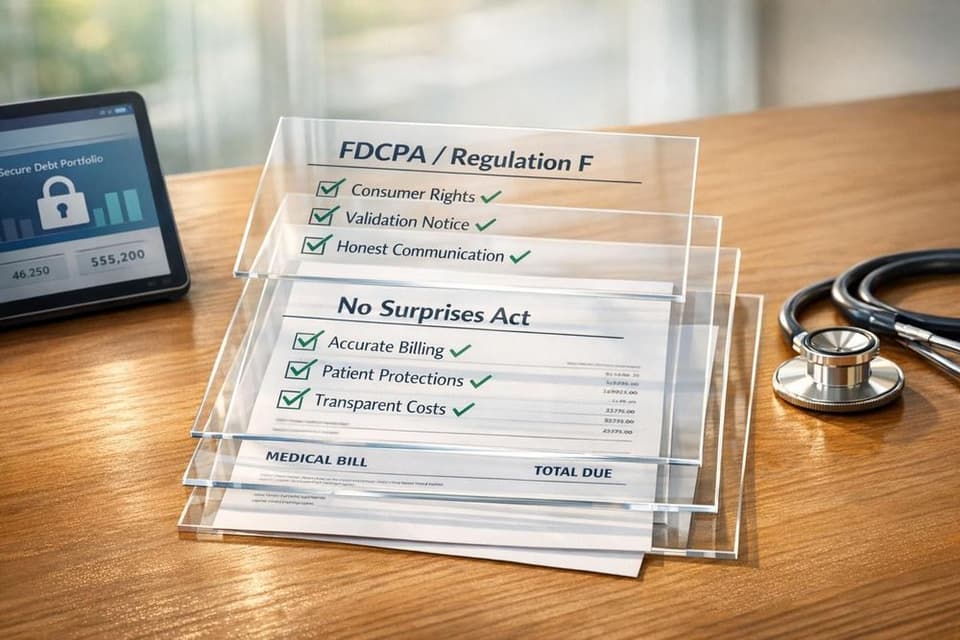
Medical debt collection agencies recover unpaid healthcare bills for providers like hospitals and clinics. They follow strict laws, including HIPAA, the FDCPA, and the No Surprises Act, to protect patient data and ensure fair practices. These agencies use two main approaches:
- Contingency-based collection: They collect on behalf of providers and take a percentage of recovered funds.
- Debt buying: Agencies purchase unpaid accounts at a discount and assume all risks.
Medical debt is a major issue in the U.S., with $88 billion in collections affecting 1 in 5 Americans. Agencies play a key role in healthcare revenue by using tools like data analytics, automated systems, and early-out programs to recover funds while reducing administrative burdens.
Compliance with federal and state laws is critical. For example:
- Medical debts under $500 are no longer reported to credit bureaus.
- Nonprofit hospitals must screen patients for financial aid before pursuing collections.
- Some states ban medical debt from credit reports or limit interest rates.
For effective collections, agencies need accurate data, compliance with laws, and patient-friendly communication. Buyers and sellers of medical debt portfolios rely on tools like predictive modeling and platforms such as Debexpert for secure, HIPAA-compliant transactions.
Medical debt collection is complex but essential for maintaining healthcare operations while ensuring patient protections.
Medical Debt Collection in the U.S.: Key Statistics and Compliance Overview
Medical Debt Collection in the U.S.: Key Statistics and Compliance Overview
How Medical Debt Collection Agencies Work
Acquiring Medical Debt Portfolios
Medical debt collection agencies typically acquire portfolios through two main approaches. The first is the contingency model, where healthcare providers keep ownership of the debt, and the agency collects payments on their behalf in exchange for a percentage of the recovered funds. The second is the debt buying model, where agencies purchase the debt outright at a significant discount, taking on both the ownership and the risk.
The value of a portfolio depends on factors like how old the debt is, payment history, regional economic conditions, and the ratio of insured to uninsured patients. For instance, debts less than a year old are priced higher, while debts over two years old often sell for just 5% to 10% of their original value. Portfolios with partial payments from insured patients in economically stable areas are considered more valuable than older, unpaid accounts from uninsured individuals.
Accurate valuation depends heavily on data quality. Agencies need detailed patient information, such as Social Security numbers, dates of birth, guarantor details, billing histories, and service dates. Missing or outdated information can lead to inaccurate valuations and lower recovery rates.
"Data analytics has become an indispensable tool... offering insights that go far beyond basic financial assessments." - Premium Asset Recovery Corporation (PARC)
Once portfolios are evaluated, agencies develop targeted strategies for recovering the debt.
Methods for Recovering Medical Debt
To recover outstanding balances, agencies use a mix of methods. Common approaches include sending collection notices, making phone calls, and using digital communication channels like email and text messages. A multi-channel strategy often leads to better patient engagement and higher response rates.
Some agencies also implement early-out programs, which are proactive efforts to manage accounts before they turn into bad debt. These programs emphasize customer service and financial counseling, helping patients understand their bills and set up payment plans early on. By addressing accounts before they become severely delinquent, these programs improve recovery rates and reduce the financial strain on patients.
Offering payment plans and counseling services also helps patients manage their bills more effectively. This approach acknowledges that medical debt usually stems from unexpected emergencies rather than an unwillingness to pay, making it a more patient-friendly strategy.
Technology Used in Medical Debt Collection
Modern debt collection agencies rely heavily on data analytics and predictive modeling to streamline their processes. Advanced algorithms analyze patient behavior and payment histories to predict the likelihood of recovery. This allows agencies to focus their efforts where they’re most likely to succeed.
Real-time tracking tools provide continuous updates on collection performance. Agencies can monitor trends, adjust strategies based on economic changes, and generate detailed reports for healthcare providers. This level of transparency helps both parties make informed decisions about managing debt portfolios.
Automated communication systems also play a big role in improving efficiency. These systems handle outreach across multiple channels, track patient interactions, and ensure compliance with regulations like the FDCPA and Regulation F. By automating these tasks, agencies can manage a larger volume of accounts while reducing administrative workloads.
"Utilizing these technologies can make the debt collection process more efficient, accurate, and less time-consuming." - Premium Asset Recovery Corporation (PARC)
Legal and Compliance Requirements
Federal and State Laws
Medical debt collection agencies operate under strict guidelines set by the FDCPA and Regulation F. These rules explicitly forbid the use of false or misleading claims about the character, amount, or legal status of a medical debt. Harassment, oppressive behavior, and unfair collection practices are also off-limits under these laws.
The Fair Credit Reporting Act (FCRA) adds another layer of oversight by requiring agencies to ensure "maximum possible accuracy" when reporting debts to credit bureaus. Recent changes have significantly altered the landscape for medical debt reporting. As of April 11, 2023, major credit reporting agencies removed all medical collections under $500 from reports, and unpaid medical bills now need to be at least one year old before they appear on credit reports.
The No Surprises Act (NSA) shields patients from unexpected bills for emergency services provided by out-of-network providers. Debt collectors break federal law if they try to collect amounts that exceed NSA limits. Patients also have the right to dispute debts in writing, which halts collection efforts until the debt is verified.
"Medical debt collectors may violate federal law when they attempt to collect bills that are not actually owed or are the wrong amount." - Consumer Financial Protection Bureau
State laws add even more complexity. For example, fourteen states completely ban medical debt from appearing on credit reports, while thirteen states limit or prohibit interest charges on medical debt. Arizona, for instance, caps interest rates at 3%. Agencies face strict liability for collecting amounts that violate state laws, such as debts covered by workers' compensation or charges exceeding state-defined "reasonable" rates. Federal rules generally defer to these more protective state-level restrictions.
| Law/Regulation | Primary Function | Key Patient Protection |
|---|---|---|
| FDCPA | Regulates third-party collection practices | Prohibits harassment and misrepresentation of debt amounts |
| FCRA | Ensures accuracy in credit reporting | Limits reporting of small or recent medical debts |
| No Surprises Act | Restricts out-of-network billing | Prevents surprise bills for emergency services |
| Regulation F | Updates FDCPA enforcement | Clarifies rules against deceptive collection practices |
Nonprofit hospitals, in particular, face additional compliance responsibilities beyond these federal and state regulations.
Rules for Nonprofit Hospitals
Nonprofit hospitals must adhere to extra rules designed to protect low-income patients. Federal and state laws mandate that these hospitals maintain Financial Assistance Policies (FAPs), which provide free or reduced-cost care for eligible patients. Before initiating any collection actions, nonprofit hospitals are required to screen patients for financial assistance eligibility and confirm the accuracy of the bill.
State laws often go even further. Twenty-one states have their own financial assistance standards, many of which require hospitals to determine eligibility before pursuing collections. Violations of these policies can lead to legal consequences, as state laws impose strict liability for improper collection practices.
"Debt collectors must have a reasonable basis for asserting that the debts they collect are valid and the amounts correct. Debt collectors may be able to satisfy this requirement by obtaining... records of a hospital's compliance with any applicable financial assistance policy." - Consumer Financial Protection Bureau
The CFPB has also issued guidance to address "upcoding", a practice where healthcare providers bill for more complex or expensive services than were actually performed. This issue, which accounts for 5% to 10% of U.S. healthcare expenditures, can lead to invalid debts. Collectors must verify the accuracy of these charges, as collecting on upcoded services violates the FDCPA.
How Compliance Affects Operations
These legal and regulatory standards directly impact how collection agencies operate. Agencies are required to verify the validity of debts with proper documentation, including proof that healthcare providers have complied with their legal obligations, such as financial assistance policies. This often involves obtaining detailed records from hospitals before initiating any collection efforts.
State-specific rules further complicate the process. For instance, nineteen states offer wage garnishment protections that are stricter than federal guidelines, which cap garnishment at 25% of disposable income. Additionally, five states - Nevada, New York, North Carolina, Maryland, and Virginia - completely ban liens and foreclosures for medical debt. Homestead exemptions, which protect a portion of a debtor's home value, also vary widely, ranging from $5,000 to the full value of the home.
Communication practices are another heavily regulated area. Patients can dictate when and where collectors can contact them, such as prohibiting calls at work if their employer disallows them. The CFPB has also clarified that collectors generally cannot charge "pay-to-pay" or convenience fees. These rules shape how agencies interact with patients and manage their collection strategies.
How to Select a Medical Debt Collection Agency
What to Look for in an Agency
Choosing the right medical debt collection agency involves assessing factors that directly influence recovery rates and ensure compliance with legal standards. It's critical to prioritize agencies with robust substantiation processes to verify debt validity. This includes checking payment records, insurance adjustments, and hospital financial assistance documentation to avoid pursuing debts that have already been paid or are legally uncollectible.
"Debt collectors are strictly liable under the FDCPA and Regulation F... for collecting an amount not owed because it was already paid." – Consumer Financial Protection Bureau
Another key consideration is whether the agency can integrate seamlessly with healthcare billing systems like Epic or Cerner. Such integration allows real-time access to billing updates and tracks changes in insurance coverage or financial assistance eligibility. Be sure to ask how the agency handles partial payments and insurance adjustments within their system.
Look for agencies with third-party certifications such as SOC II, HIPAA HITRUST, and PCI compliance. Membership in reputable trade associations like ACA International, HFMA, MGMA, or AAHAM is another indicator of their commitment to regulatory standards. Request references from healthcare providers of similar size to gauge the agency’s effectiveness and reputation. Reviewing sample collection letters is also a good practice to ensure they maintain a professional tone and align with legal requirements.
The agency’s staff should have a solid understanding of medical billing nuances, including the differences between technical and professional billing components. Avoid agencies that offer flat recovery percentages without considering factors like patient demographics, account age, or prior recovery efforts. Additionally, ensure the agency has strong cyber liability insurance and includes a "hold harmless" clause in contracts to protect your organization from potential lawsuits stemming from their actions.
Once you've confirmed these criteria, you can work with the agency to develop strategies tailored to maximize recovery rates.
Improving Returns with Customized Plans
Beyond selecting the right agency, implementing tailored strategies can significantly improve collection outcomes. Agencies that employ data-driven segmentation analyze patient payment histories, demographics, and the age of debts. This allows them to focus their efforts on accounts with the highest likelihood of recovery while avoiding overly aggressive tactics on accounts that qualify for financial assistance.
Tiered recovery strategies can further optimize results across different stages of the debt lifecycle. Early-out programs, which engage patients within the first 60 days, often achieve high success rates while preserving the patient-provider relationship. For older accounts - those over a year past due - secondary placement strategies can recover revenue as patients’ financial situations stabilize.
A compelling example of effective agency selection and strategy is Patriot Ambulance. In August 2025, their RCM Director, Theresa MacIntosh, reported a dramatic improvement after switching to Revenue Cycle Associates (RCA). The new agency surpassed the previous agency's total annual collections in just one month.
"In just one month of bad debt recovery, RCA surpassed our previous agency's total collections for the entire year. We are amazed by their remarkable performance." – Theresa MacIntosh, RCM Director, Patriot Ambulance
Agencies leveraging AI tools can further enhance recovery rates. These tools help identify patients most likely to pay, predict the best times to contact them, and even uncover missed insurance coverage that could resolve debts without requiring patient payment. Additionally, offering flexible payment solutions, such as customized installment plans and user-friendly online portals, can help patients manage financial strain while ensuring consistent cash flow.
Trading Medical Debt Portfolios
The Medical Debt Trading Process
Medical debt portfolios are bought and sold in a structured marketplace where sellers list accounts, and buyers assess potential returns. Sellers typically provide datasets that include patient identifiers, account details, and service dates. Buyers then rely on predictive models to evaluate the likelihood of recovery, using historical payment data and current economic trends to guide their decisions.
The age of the debt is often the most critical factor in determining a portfolio's value. For example, debt older than 24 months usually sells for only 5%–10% of its original face value. Other factors influencing pricing include patient demographics, the region's economic stability, and the percentage of insured versus uninsured patients. These elements are closely tied to legal and compliance considerations, which play a significant role in this process.
HIPAA compliance adds another layer of complexity. A direct sale of medical receivables containing identifiable Protected Health Information (PHI) typically requires patient authorization. To sidestep this requirement, many sellers structure transactions as "placements", where the buyer acts as a business associate under a Business Associate Agreement (BAA). This approach keeps the transaction within HIPAA’s "payment" framework.
Another challenge is ensuring data accuracy. Medical billing systems often update balances due to insurance adjustments or financial aid decisions, leading to potential discrepancies. These inaccuracies can result in pursuing debts that may already be resolved. To address this, secure transmission methods like encrypted SFTP or secure portals are essential. Contracts should also clearly define credit reporting criteria, dispute resolution timelines, and audit rights.
| Valuation Factor | Impact on Portfolio Value |
|---|---|
| Age of Debt | Older debts (2+ years) reduce value to 5-10% of face value |
| Payment History | Consistent partial payments increase portfolio value |
| Insurance Status | Higher uninsured rates correlate with lower recovery rates |
| Data Quality | Accurate records and itemized billing boost buyer confidence |
| Geography | Economic stability in the debtor's region improves recovery prospects |
Tips for Buyers and Sellers
For sellers, maintaining accurate and complete patient data is crucial. This includes detailed billing histories, demographic information, and a solid legal basis for sharing the data. Structuring transactions as placements under a Business Associate Agreement helps ensure compliance with HIPAA and avoids restrictions on selling PHI.
Buyers should focus on thorough due diligence to minimize risks. This means verifying balances and insurance status before purchase to avoid future disputes or compliance issues. It’s also essential to confirm that the portfolio excludes debts that are legally uncollectible, such as those covered under state workers’ compensation laws or the Nursing Home Reform Act. Buyers should demand documentation that supports the validity of each claim under state law.
Using data analytics is key to segmenting portfolios effectively. This helps identify areas with high recovery potential and avoid riskier segments. Geographic factors should also be evaluated - portfolios from economically stable regions tend to yield better results. Additionally, portfolios with a high percentage of uninsured patients often pose greater challenges for recovery.
Using Debexpert for Debt Trading
Debexpert
Debexpert simplifies the complexities of medical debt trading with its secure, data-driven platform. It ensures HIPAA-compliant data sharing through end-to-end encryption and offers sellers a choice of auction formats - English, Dutch, Sealed-bid, or Hybrid - to fit their sales strategy.
The platform includes portfolio analytics tools that allow buyers to assess the quality of debt before placing bids. Sellers can monitor real-time buyer activity to gauge interest and adjust their approach as needed. A built-in real-time chat feature makes it easy for buyers and sellers to communicate, clarify data issues, or negotiate terms directly within the platform.
Buyers benefit from custom notifications for debt types that match their investment preferences, ensuring they don’t miss relevant opportunities. With both mobile and desktop access, users can stay updated on auctions and respond to inquiries quickly. After a sale, Debexpert provides post-sale services to ensure smooth completion of transactions, offering clear documentation and secure transfer protocols that align with regulatory standards.
I Used to Collect Medical Debt // How to Settle It
Conclusion
Medical debt collection agencies play a critical role in recovering approximately $88 billion in unpaid medical bills. Their efforts help healthcare providers maintain financial stability while ensuring compliance with regulations like the FDCPA and Regulation F, which impose strict accountability for pursuing invalid debts. These legal standards shape every aspect of the recovery and trading process.
The quality of data directly affects recovery success. For example, medical debt portfolios that are 24 to 36 months old typically sell for just 5% to 10% of their original value. By leveraging predictive models and analytics, agencies can segment portfolios based on factors like payment history, demographics, and local economic conditions. This approach helps identify high-potential accounts while steering clear of debts that are legally uncollectible. Considering that medical collections make up 57% of all collection tradelines on consumer credit reports, accurate data and precise portfolio valuation are essential.
For those involved in buying and selling medical debt, Debexpert offers a HIPAA-compliant platform designed to simplify transactions. With tools like portfolio analytics, flexible auction formats, and real-time notifications, the platform fosters transparency and efficiency. Buyers receive tailored updates, while sellers can track bidding activity as it happens. Post-sale services ensure transactions are completed seamlessly, with secure documentation and transfer processes that meet regulatory requirements.
From initial acquisition to recovery and trading, the medical debt collection process hinges on strict compliance, precise data management, and focused strategies. Success in this field requires balancing proactive recovery methods with unwavering adherence to regulations. Agencies and platforms that excel in these areas achieve better outcomes throughout the entire process.
FAQs
Can a collector contact me by text or email?
Yes, debt collectors are allowed to contact you via text or email, but they must adhere to the Fair Debt Collection Practices Act (FDCPA) and Regulation F. These laws are in place to ensure that their communication is neither false, deceptive, nor misleading. Additionally, they are required to interact with you in a respectful manner and comply with all legal guidelines designed to safeguard your rights.
How can I dispute a medical debt and stop collections?
To challenge a medical debt, start by collecting all relevant documents, such as medical bills, insurance explanations of benefits (EOBs), and any payment records. Then, draft a formal dispute letter addressed to the debt collector or the healthcare provider. In the letter, clearly explain why you believe the debt is incorrect and request validation of the debt under the Fair Debt Collection Practices Act (FDCPA).
Once your dispute is submitted, collection efforts must pause while the debt is under review. If the debt is found to be inaccurate or cannot be verified, it must be removed from your credit report, and any collection attempts must cease.
What documents prove a medical debt is valid?
Proof of a valid medical debt typically involves documentation like the original billing statement from the healthcare provider, itemized bills, or official notices. These records outline the amount owed and detail the services provided, helping to confirm the debt's legitimacy and offering key information for verification.
