

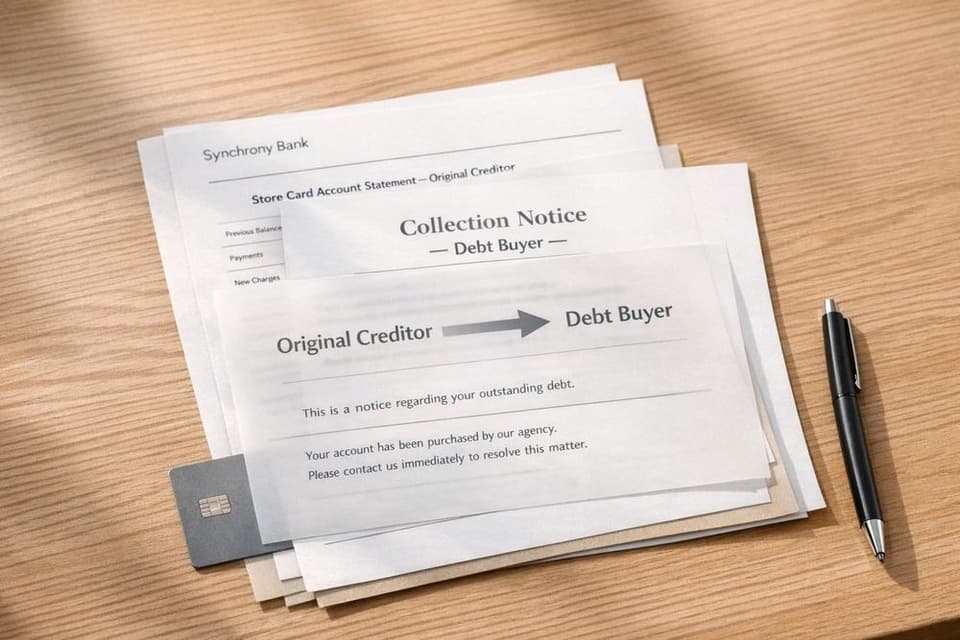
When it comes to store credit cards, Synchrony Bank plays a dual role: it primarily acts as the initial creditor, issuing credit directly through partnerships with major retailers like Lowe’s, Amazon, and Gap. However, it also operates as a debt buyer, acquiring delinquent accounts or portfolios from other entities.
Here’s what you need to know:
- As an initial creditor, Synchrony originates and manages credit accounts from start to finish. This includes payment processing, collections, and maintaining account records.
- As a debt buyer, Synchrony purchases existing portfolios and integrates them into its systems. It often sells non-performing accounts to third-party buyers after attempting to collect.
For consumers, this means that if you owe money to Synchrony, they typically have detailed records of your account. If your debt is sold, you’ll deal with a third-party collector, which changes how consumer protection laws apply. Synchrony’s dual role also impacts its financial strategies and relationships with retailers and debt buyers.
Understanding these roles helps you navigate credit agreements, collections, and potential disputes more effectively.
1. Synchrony Bank as Initial Creditor
Synchrony Bank
Debt Ownership
Synchrony Bank plays a major role in the world of private-label credit cards by partnering with well-known retailers, healthcare providers, and manufacturers. When you apply for a store credit card at places like Lowe's, Amazon, or Gap, it’s Synchrony Bank, not the retailer, extending the credit. This has made Synchrony the largest issuer of private-label credit cards in the U.S..
Once these accounts are set up, Synchrony transfers the receivables to its subsidiary, Synchrony Card Funding, LLC. This isn’t a loan but a sale or contribution, which allows Synchrony to use the receivables as collateral for securitized financings. These financings are carried out through specialized trusts, such as the Synchrony Card Issuance Trust (SYNIT). For instance, in March 2024, Synchrony sponsored a $500 million note series backed by receivables from major retailers like Sam's Club (27.6%), TJX (20.9%), Lowe's (14.0%), Amazon (12.5%), and PayPal (10.0%).
This setup not only supports Synchrony’s financing activities but also ensures the bank retains control over its collection processes.
Collection Practices
Even after transferring receivables for funding, Synchrony continues to handle customer relationships. The bank remains the primary point of contact for consumers, managing account records and servicing accounts directly. So, when you call about your account or receive collection notices, you’re still dealing with Synchrony.
Unlike some creditors who quickly sell off delinquent accounts, Synchrony is known for actively pursuing legal action to recover defaulted credit card debt. The bank oversees the entire process - from account origination to collections and, if necessary, charge-offs. For context, in the third quarter of 2018, Synchrony reported over-30-day loan delinquencies at 4.59% of period-end loan receivables, with a net charge-off rate of 5.67% for the first nine months of that year.
Consumer Implications
For consumers, working directly with Synchrony Bank means dealing with a federally regulated institution. Synchrony is subject to oversight by agencies like the Office of the Comptroller of the Currency (OCC), the Federal Deposit Insurance Corporation (FDIC), and the Federal Reserve Board. This regulatory oversight provides protections that may not apply if your debt is sold to a third-party buyer.
Synchrony’s credit products often include deferred-interest plans, with a minimum interest charge of $2.00 when applicable. However, the bank’s history hasn’t been without regulatory challenges. In 2014, when it was still GE Capital Retail Bank, Synchrony was ordered to provide $225 million in relief for deceptive marketing and discriminatory practices. By May 2025, the bank had completed this program, paying out at least $259 million to affected consumers and a $3.5 million civil penalty.
Legal and Financial Responsibilities
As the initial creditor, Synchrony takes on significant legal and financial responsibilities for its credit programs. This includes complying with laws like the Bank Secrecy Act, Anti-Money Laundering (AML) regulations, and Anti-Corruption laws. The bank is also required to maintain an allowance for credit losses (CECL) to manage potential defaults while carefully setting credit limits and underwriting standards.
Synchrony also has financial agreements with its retail partners, such as "retailer share" arrangements. Under these agreements, the bank shares a portion of program profits if certain economic performance thresholds are met. For example, in the third quarter of 2018, Synchrony paid $871 million to retail partners through these arrangements. Additionally, the bank implements strict safeguards to protect cardholder data, including encryption and tokenization.
2. Synchrony Bank as Debt Buyer
Debt Ownership
Synchrony Bank isn’t just a credit originator - it also purchases debt portfolios, adding another dimension to its operations. While its primary role is as an initial creditor, Synchrony actively acquires outstanding credit portfolios, focusing on revolving private-label and co-branded accounts. By June 30, 2023, the bank managed a massive $89.3 billion credit card portfolio. Just a few months later, in November 2023, it raised $500 million through the SYNCT series 2023-2 and was overseeing $92.1 billion in total credit. When acquiring these portfolios, Synchrony evaluates accounts based on specific criteria, like ensuring they are payable in U.S. dollars and not classified as closed-end accounts. This acquisition strategy shapes how the bank handles collections and interacts with consumers.
Collection Practices
Synchrony manages collections internally for both debts it originates and those it acquires. It takes an assertive approach when dealing with defaulted accounts, often pursuing legal action to recover balances. For accounts that remain unpaid over time, the bank frequently sells these non-performing portfolios to other debt buyers, such as Portfolio Recovery Associates, Midland Funding, and Cavalry Portfolio.
In settlement scenarios, Synchrony typically aims to recover around 40% of the outstanding balance. However, consumers should be aware that the bank often delays providing written settlement agreements until after a payment plan is recorded in their system.
Consumer Implications
When Synchrony acquires a credit program, consumers may notice a change in who services their account. If the debt enters collections, it could stay on a consumer’s credit report for up to seven years. Before making any payments on a collection account, it’s crucial for consumers to confirm that the debt is indeed theirs. Making a payment could be interpreted as acknowledgment of the debt.
Consumers may also explore options like requesting a "pay-for-delete" or "goodwill deletion" agreement if they’ve paid the debt in full. However, Synchrony is only legally required to update the status to "paid". Keeping detailed records of settlement discussions is essential, as written agreements are often issued only after payment plans are set up.
Legal and Financial Responsibilities
Synchrony’s practices as a debt buyer must align with federal laws and regulations. The bank adheres to the FDCPA, FCRA, Regulation V, GLBA, and ECOA, which ensure accuracy, protect consumer privacy, and promote fair treatment.
"Under the FDCPA, 'debt collector' is defined broadly to generally encompass debt buyers working on behalf of original creditors, including banks." - OCC Bulletin 2014-37
As of January 31, 2022, Synchrony’s trust portfolio included approximately $7.27 billion in transferred receivables, spread across 6,719,218 designated accounts. The average account age in this portfolio was 76 months.
Debt Buyers -- why they must prove they own the debt -- illustration of Apple v Samsung
Pros and Cons
Synchrony Bank: Initial Creditor vs Debt Buyer Comparison
Synchrony Bank: Initial Creditor vs Debt Buyer Comparison
Looking at Synchrony Bank's dual roles as both an originator and a debt buyer, there are clear advantages and challenges that affect both consumers and the financial industry. The table below highlights these differences for easy comparison.
As an originator, Synchrony has full control over credit agreements and transaction histories, which allows for better access to records and greater transparency. According to SVP Anita Chalkley, Synchrony's "Prism" technology "is able to rapidly ingest hundreds of disparate data sources and, as a result, Synchrony has significantly expanded the number of data points assessed in credit decisioning to give a more holistic view of a customer's creditworthiness." This approach supports better lending decisions and enhances the customer experience.
On the other hand, as a debt buyer, Synchrony relies on electronic records transferred from the original creditor, which limits flexibility. This role also requires the bank to immediately account for potential losses. For example, when Synchrony acquired the U.S. PayPal Credit program in July 2018, it added $7.6 billion in loan receivables but had to increase its loss provisions right away. By September 30, 2018, the bank's allowance coverage ratio stood at 7.11%.
| Aspect | As Initial Creditor | As Debt Buyer |
|---|---|---|
| Ownership | Originates debt directly through partner programs like Lowe's and Amazon; owns from inception | Acquires existing receivables from other entities (e.g., PayPal, Ally); relies on transferred rights |
| Collection Methods | Uses internal servicing with proprietary technology; Autopay enrollment shows 4x better credit loss performance | Integrates acquired portfolios into existing systems; must immediately establish loss reserves |
| Consumer Impact | Direct relationship from account opening; seamless experience with rewards programs | Consumers may experience servicer changes; relationship mediated through prior originator's records |
| Documentation | Maintains original servicing records, credit agreements, and full payment histories | Depends on account schedules and coded electronic records from the seller |
The difference in performance is particularly noticeable when it comes to collections. For accounts originated by Synchrony, the use of Autopay has led to up to 4x better credit loss performance among enrolled customers compared to those who aren't enrolled. However, with acquired portfolios, Synchrony faces challenges in achieving this level of optimization since it must work within the framework of account structures and consumer behaviors established by the previous creditor. These operational differences influence how Synchrony handles risk and serves its customers across its portfolio.
Conclusion
Understanding who owns your debt - whether Synchrony Bank is the original creditor or a debt buyer - can significantly influence your approach to negotiation and defense. Synchrony primarily acts as an original creditor, issuing retail and store credit cards for major brands like Amazon, Lowe's, and Sam's Club, serving 70.2 million active customer accounts. However, Synchrony also steps into the role of a debt buyer when market conditions align, adding to its $92.1 billion in managed receivables.
For consumers, identifying the legal owner of your debt is critical. It impacts your rights and how you can negotiate. If Synchrony Bank is suing you, they typically possess complete records, from the account's opening to its charge-off. This comprehensive documentation makes them a more challenging adversary in court compared to debt buyers, who often lack detailed account histories. As consumer defense attorney Brian Parker explains:
"You may owe a debt, but that does not mean you owe it to the party suing you. If they cannot prove ownership, the lawsuit cannot proceed".
When Synchrony sells charged-off accounts to companies like Midland Credit Management or LVNV Funding, the Fair Debt Collection Practices Act (FDCPA) provides consumers with protections, including the right to challenge the chain of title.
These distinctions also matter in the debt market. Synchrony’s dual role as both a creditor and a buyer shapes opportunities for debt buyers and sellers. With a $92.1 billion portfolio and a gross charge-off rate of 4.5% as of September 30, 2023, Synchrony-originated portfolios are noteworthy. Buyers should consider that only 85% to 87% of receivables in some trusts come from accounts at least four years old, which analysts describe as "relatively unseasoned". For sellers, Synchrony’s capacity as a large-scale buyer of receivables offers unique advantages.
FAQs
How can I tell if Synchrony Bank owns my debt or just services it?
To determine whether Synchrony Bank owns your debt or is simply servicing it, review your account agreement or any documents you received when the account was opened. If the agreement specifies that Synchrony owns the debt, they are the original creditor. However, if you've received notices stating the debt has been sold or assigned to another party, Synchrony is likely just managing the account for that third party.
What changes if my Synchrony account is sold to a third-party debt buyer?
If your Synchrony Bank account is sold to a third-party debt buyer, the ownership of your debt shifts to the buyer, making them your new creditor. This means Synchrony Bank no longer has any claim to the debt, and going forward, all communications, payments, or disputes will need to go through the debt buyer instead. Be sure to verify the legitimacy of the debt and familiarize yourself with your rights under the Fair Debt Collection Practices Act (FDCPA).
What should I ask for before paying or settling a Synchrony collection account?
Before making a payment or settling a Synchrony collection account, it's important to first request verification of the current debt owner. Additionally, ask about settlement options, including pay-for-delete agreements. This step helps confirm who holds the debt and allows you to explore ways to address it more effectively.
