

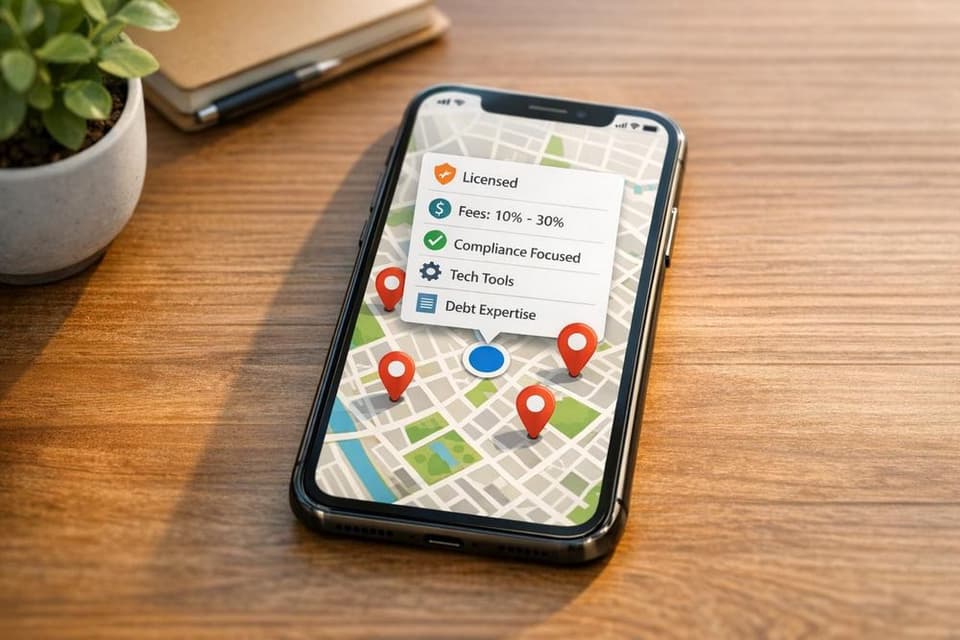
When you're searching for a debt collection agency, the goal is simple: recover unpaid debts effectively and within legal boundaries. Here's what you need to know:
- Local vs National Agencies: Local agencies understand state-specific laws and offer direct accountability, while national agencies bring advanced tools and broader expertise.
- How to Find Agencies: Use search engines, trusted directories like BBB.org, or professional networks like CLLA to locate licensed agencies near you.
- Check Credentials: Verify state licensing, certifications, and compliance with laws like the FDCPA. Use tools like the NMLS Consumer Access portal for verification.
- Specialized Expertise: Match the agency to your debt type (e.g., medical, B2B, consumer) to ensure they have the right skills and knowledge.
- Fee Structures: Agencies typically charge contingency fees (15%-50%) or flat fees ($50-$300 per account). Focus on net recovery, not just fees.
- Technology and Reporting: Choose agencies offering real-time updates and secure online portals for transparency.
How to Find Debt Collection Agencies in Your Area
Search Engines and Online Directories
Start your search with terms like "debt collection near me" or "local collections agency", then verify the results using trusted directories. The Better Business Bureau (BBB.org) is a great tool, allowing you to filter agencies by their rating (ranging from A+ to F), distance, and service area - even down to the county level. For instance, Recheck, Inc., based in Wichita, Kansas, holds an impressive A+ rating from the BBB.
If you want a broader look, the Money.com Debt Collectors Directory tracks over 250 major U.S. debt collection firms. It lets you search by company name or phone number to confirm an agency's legitimacy. For those needing specialized services or wanting to submit Requests for Proposals (RFPs) to multiple agencies, DebtLink.com provides a marketplace with high ratings, including a 5-star average based on 27 professional reviews. Adam Dobberstein, a law firm managing partner who uses DebtLink, shared:
"Since listing our law firm with DebtLink, our Company has connected with several new creditors in our target niche with interest in placing accounts."
For state-specific needs, CollectionAgencies.com organizes agencies by state, making it easier to ensure compliance with local licensing laws.
Local Business Networks and Chambers of Commerce
Professional organizations like the Commercial Law League of America (CLLA) and Commercial Collection Agencies of America (CCA of A) are excellent resources. They maintain directories of vetted agencies by region. These networks enforce strict certification standards, including annual operational audits performed by independent CPAs. CLLA-certified agencies represent about the top 1% of collection agencies and must maintain surety bonds and separate trust accounts.
Chad Haynie, Executive Vice President of Commercial Collection Corporation of NY, highlighted the importance of these networks:
"Through the CLLA, you have collection agencies, collection attorneys and creditors' rights attorneys that are all working together to best serve the credit collection community as a whole."
When researching, look for certification seals from reputable organizations like the CLLA or CCA of A. These seals indicate that the agency has met rigorous standards, including a proven track record of at least four years in business. You can also use their regional maps to locate certified agencies in your area, whether you're in the Northeast, South, Midwest, or Western United States.
Once you've confirmed an agency's credentials, dive into customer reviews to evaluate their performance.
Customer Reviews and Testimonials
Online reviews provide valuable insights into an agency's reputation and effectiveness. Pay attention to testimonials that highlight FDCPA compliance, respectful communication, and contingency-based pricing - where you only pay if the debt is successfully collected. For example, Advanced Collection Bureau in Kansas emphasizes this approach:
"Choosing the best debt collection agency in Kansas is more than just a numbers game. It's about finding a partner who understands local laws, communicates professionally, and delivers consistent results."
Look for reviews that mention the agency's reporting frequency to credit bureaus. Top-tier agencies often report twice a month, compared to the standard once-a-month reporting. Also, check for feedback on their understanding of local laws, like state-specific landlord-tenant regulations or eviction-related collections. Be cautious of agencies flagged for failing to validate debts or using aggressive, legally questionable tactics.
The Smart Creditor’s Guide to Choosing the Right Collection Agency | Connect1 | Ep. 229
Checking Licensing and Accreditation
State Debt Collection Licensing Requirements and Fees Comparison
State Debt Collection Licensing Requirements and Fees Comparison
State Licensing Requirements
Before working with a collection agency, ensure it’s licensed to operate in your state. Most states require agencies to have a professional license and a surety bond, but as of 2026, 14 states - such as Georgia, Ohio, Pennsylvania, and Virginia - don’t mandate state-level licensing. However, in states without these requirements, local jurisdictions might step in. For instance, cities like New York City, Buffalo, and Yonkers have their own licensing rules.
To verify an agency’s credentials, use the Nationwide Multistate Licensing System (NMLS) Consumer Access portal at www.nmlsconsumeraccess.org. This tool lets you confirm license status, contact details, and website information by searching the agency’s name, city, or state. As Sarah Edwards, a legal expert at SoloSuit, points out:
"Real debt collectors will give you their license number without hesitation, whereas fake debt collectors will avoid the question and oftentimes even get aggressively defensive about it."
In California, for example, debt collectors are required to include their license numbers in all communications. The absence of a license number can be a warning sign. California agencies can be verified through the Department of Financial Protection and Innovation (DFPI), which processes applications within about 90 days. The application involves a $350 fee plus a $150 investigation fee. For other states like Washington, check with the Department of Licensing, and in Minnesota, use the Sircon platform, where initial licensing fees are around $1,050.
Here’s a quick breakdown of licensing and bonding requirements across key states:
| State | License Required | Bond Required | Typical Filing Fee | Regulatory Authority |
|---|---|---|---|---|
| California | Yes | No | $500 | Dept. of Financial Protection and Innovation (DFPI) |
| Florida | Yes | Yes | $200–$500 | Office of Financial Regulation |
| Minnesota | Yes | Yes | $1,050 | Department of Commerce |
| New York | No (Statewide) | No (Statewide) | N/A | NYC Dept. of Consumer and Worker Protection |
| Texas | No | No | N/A | Secretary of State (Statutory Bond only) |
| Washington | Yes | Yes | $340 | Department of Licensing |
Professional Organization Membership
Once state licensing is verified, check for additional professional certifications to further assess the agency's credibility. Membership in reputable organizations can be a strong indicator of reliability. For example, the Commercial Law League of America (CLLA) Commercial Collection Agency Certification is highly respected, with only about 1% of agencies achieving this distinction. Certified agencies undergo yearly third-party audits of their trust accounts and maintain surety bonds ranging from $150,000 to $500,000, depending on their gross contingency fees. The CLLA has been certifying agencies since 1975, with an initial application fee of $1,250 and annual fees between $1,100 and $2,700.
Other memberships, like those in the International Association of Commercial Collectors (IACC) or staff certifications such as the "Professional Collection Specialist" designation from ACA International, signal a commitment to industry standards and ongoing training. Leading agencies often hold compliance certifications like SOC 1 Type 2, SOC 2 Type 2, ISO 27001:2013, or HITRUST, which demonstrate a focus on data security and adherence to laws such as the Fair Debt Collection Practices Act, Fair Credit Reporting Act, Telephone Consumer Protection Act, and HIPAA.
Reputable agencies also invest in staff development, requiring annual Continuing Education Units (CEU). In states like Minnesota, top agencies conduct national criminal history and background checks on all collectors. If an agency can’t promptly provide proof of its certifications, it’s best to look elsewhere.
Matching Agencies to Your Debt Type
Common Debt Types and Recovery Challenges
Debt comes in many forms, and it's essential to choose an agency that understands the specifics of your situation. The first key distinction is whether your debt involves business-to-business (B2B) transactions or business-to-consumer (B2C) accounts. Consumer debt - like credit cards, personal loans, medical bills, and auto loans - is regulated by the Fair Debt Collection Practices Act (FDCPA). On the other hand, commercial debt falls under contract and commercial law, not the FDCPA. As Nexacollect explains:
"Commercial debt is not covered by the FDCPA. It is governed by contract and commercial law."
Certain types of debt bring additional complications. For instance, medical debt requires agencies to navigate HIPAA compliance, disputes over insurance billing, and credit reporting rules. Starting in 2026, medical debts under $100 will generally no longer affect a consumer's credit score. Similarly, construction-related debt involves state-specific knowledge of mechanics liens and payment bonds. Recovering auto loans often means dealing with "upside-down" loans, where the amount owed is more than the vehicle's current value. These complexities highlight the importance of selecting an agency with expertise tailored to your specific debt type.
Agency Expertise by Debt Type
With so many unique challenges, it's critical to ensure your agency has the right expertise for your needs. For consumer debt, ask how they comply with the FDCPA and whether they use a "patient-first" strategy for medical accounts to protect your reputation. For commercial debt, look for certifications from organizations like the Commercial Law League of America (CLLA) or the International Association of Commercial Collectors (IACC). The Better Business Bureau can also help confirm whether an agency specializes in "Commercial Collection Agency" or "Medical Collections". Before committing, request a demo of their client portal to ensure you’ll have 24/7 access to real-time updates and collector notes.
| Debt Type | Legal Framework | Required Expertise | Recovery Success Factors |
|---|---|---|---|
| Consumer (B2C) | FDCPA | High-volume compliance, sensitive communication | Compliance-focused, "patient-first" for medical |
| Commercial (B2B) | Contract & Commercial Law | High-touch negotiation, industry knowledge | Relationship preservation, professional mediation |
| Medical | HIPAA, FDCPA | Insurance navigation, co-pay management | Compassionate collection; data security (HITRUST) |
| Construction | State-specific Lien Laws | Mechanics liens, payment bonds | Deep knowledge of state-specific statutes |
Specialized agencies offer more than just legal know-how - they often provide advanced tools like skip-tracing databases and data-driven analytics that generalist agencies may lack. Nexacollect sums it up well:
"The best agency is not simply the nearest one, but the one that fully understands your debt's unique characteristics."
Comparing Fees, Recovery Rates, and Contract Terms
Fee Structures Explained
When choosing a local debt collection agency, it’s not just about verifying credentials - you also need to weigh their fee structures, recovery rates, and contract terms. Most agencies operate on contingency fees, meaning they only get paid if they successfully recover your debt. These fees typically range from 15%–25% for debts that are less than 90 days old and can climb to 40%–50% for older accounts.
Alternatively, some agencies offer flat fee arrangements, where you pay a fixed amount per account. These fees usually fall between $50 and $300. This option is ideal for early-stage "pre-collection" services, like sending demand letters, which might cost around $15 per account - allowing you to keep 100% of any recovered amount.
Be cautious about hidden charges, such as placement fees, membership dues, or cancellation penalties. If legal action is required, factor in additional expenses like court filing fees ($100 to $400) or process server fees ($40 to $200). Advanced skip-tracing services, which track down hard-to-find debtors, can cost anywhere from $50 to $350 per search. Remember, the cheapest option isn’t always the most effective. For example, a 35% contingency fee with a 45% recovery rate is better than a 25% fee with only a 20% recovery rate.
Recovery Rates and Performance Data
On average, collection agencies report success rates of 20% to 30% across industries. However, the age of the debt plays a major role in recovery performance. Accounts less than 90 days old often recover at rates of 40% to 60%. But with each passing day, the value of recoverable debt decreases by 0.5% to 1%. By the time a debt is over two years old, recovery rates drop to just 10%–15%.
For commercial (B2B) debts, recovery rates tend to be higher - ranging from 30% to 70%. To gauge an agency’s effectiveness, request cohort data that breaks down recovery rates by debt age (e.g., under 90 days, 90–180 days, over 180 days) and balance size. Also, ask for at least two client references to confirm their success in your industry.
Focus on net recovery instead of just comparing fee percentages. To evaluate an agency’s true value, subtract their fees from the total recovery amount to determine your projected return.
Contract Terms to Review
Before committing to an agency, take a close look at the contract. Three key provisions stand out. First, ensure there’s a compliance guarantee requiring the agency to follow the Fair Debt Collection Practices Act (FDCPA) and any relevant state laws. This protects your business from potential legal issues. Second, confirm the agency has Errors and Omissions Insurance and ask for written proof. This coverage shields you from liability if the agency’s actions lead to a lawsuit from a debtor. Third, clarify the agency’s settlement authority - do they need your approval before accepting less than the full invoice amount, or can they negotiate independently?
Watch out for exclusivity clauses that may prevent you from hiring another agency for the same debt while the agreement is active. Also, set clear expectations for regular updates on recovery progress, contact attempts, and settlement status reports. Finally, confirm the agency is licensed and bonded in your state, as these requirements vary by jurisdiction.
Before signing any contract, consider sending your own demand letter first, as collectors typically recover only part of the total balance.
Questions to Ask During Consultations
Once you've confirmed the agency's credentials and expertise, the next step is to dive into a consultation. This is your chance to evaluate their operational practices and performance in detail.
Experience and Expertise Questions
Start by asking about the agency's track record with your specific type of debt. For example, B2C debts like medical bills or auto loans require a different approach than B2B transactions. Request detailed performance data and at least two client references from your industry to back up their claims.
If you're dealing with medical debt, confirm their knowledge of HIPAA compliance. For construction-related debts, ask about their experience with mechanics liens and payment bonds. A direct question like, "What is your success rate recovering this specific debt type?" can provide clarity.
It’s also crucial to verify that the agency holds relevant certifications and reports to major credit bureaus like Equifax, TransUnion, and Experian. This reporting capability can act as a strong motivator for repayment due to the potential seven-year credit impact. Additionally, confirm they use skip-tracing techniques to track down debtors who may have moved or changed their contact details.
"The success of debt recovery isn't based on a local agent's ability to drive to an office; it's built on a foundation of specialized expertise, regulatory compliance, and advanced technology."
Compliance and Operations Questions
Compliance is non-negotiable. Confirm the agency adheres to FDCPA and Regulation F, which set strict rules to prevent abusive or deceptive practices. These regulations also limit communication frequency - no calls before 8 a.m. or after 9 p.m., and no more than seven calls within seven days for a specific debt.
Check their state license through the NMLS portal to ensure they're authorized to operate. Ask how they use automated systems to monitor call frequency and avoid litigation risks. Confirm that their staff is trained to leave "limited-content messages", reducing the chance of unauthorized debt disclosures.
Inquire about their process for handling written disputes. Agencies must pause collection efforts until they provide proper debt verification. Also, verify that they honor written "stop contact" requests and avoid publicizing debt information on social media platforms.
"The FDCPA prohibits debt collection companies from using abusive, unfair or deceptive practices to collect debts."
Performance and Reporting Questions
Ask for a live demo of their client portal to see how they provide updates. Ideally, you should have 24/7 online access to real-time information, including account status, payment history, and collector notes. Transparency is key.
Find out whether their reports are generated in real-time or on a delayed schedule, such as weekly or monthly. Ask how they ensure compliance with FDCPA and any industry-specific regulations, such as HIPAA for healthcare-related debts. A lack of real-time access could indicate outdated systems.
"The agency should be a technology partner. Ask to see their client portal. You should have 24/7 online access to real-time reports on every account, payment status, and collector note. If they can't provide this, they are outdated and inefficient."
Using Debexpert for Debt Portfolio Management
Debexpert
Local agencies excel in recovery efforts, but digital platforms like Debexpert bring a modern edge to portfolio management. By centralizing analysis and facilitating debt trading, these platforms simplify decision-making. With performance data and analytical tools, Debexpert helps assess which local agency partnerships are worth pursuing.
Debexpert Features for Debt Trading
Debexpert provides powerful analytics to determine which debts are best suited for local collection and which should be sold through auctions. The platform supports various auction types, including English, Dutch, Sealed-bid, and Hybrid formats. Key features include strong security protocols, real-time chat, and automated alerts, all designed to improve communication between buyers and sellers. This level of automation removes the hassle of manually tracking debt portfolios across countless spreadsheets. By blending digital precision with local expertise, Debexpert enables a more efficient and transparent recovery process.
Combining Local Agencies with Debexpert
The real magic happens when you combine local agency expertise with Debexpert's digital tools. Local agencies are ideal for handling high-value or legally intricate cases. Meanwhile, Debexpert can analyze and trade underperforming accounts through its streamlined auction system. This approach allows local agencies to focus on high-stakes recoveries while Debexpert manages aged or less profitable accounts. Together, this strategy reduces per-account recovery costs and improves overall recovery rates.
Choosing the Right Local Debt Collection Partner
When selecting a debt collection agency, focus on verifiable credentials, clear pricing, and advanced technology. As Richard Hart, Founder of Direct Recovery Associates, Inc., puts it:
"The result of partnering with a debt collection agency will be determined by the caliber of agency you choose to work with".
Your decision plays a critical role in determining how much of your outstanding debt is recovered. The following factors will guide you in evaluating an agency’s performance and cost-effectiveness.
Experience, Compliance, and Transparency
Start by verifying the agency’s licensing and bonding for the jurisdictions they operate in. Look for professional certifications that demonstrate their expertise. Keep in mind that industry-specific knowledge is crucial - recovering healthcare debt involves different challenges compared to B2B manufacturing debt.
Ensure the agency carries Errors and Omissions Insurance to protect your business from potential legal disputes. Check their Better Business Bureau (BBB) rating on BBB.org - reputable agencies typically score between A+ and B+. Additionally, ask for references from businesses similar to yours. As Hart cautions:
"An agency that is not willing to share its process is likely doing something unacceptable, so be sure to call out any agency that attempts to hide behind 'proprietary methods' of any kind".
Request a detailed explanation of their collection process and ensure they offer real-time updates through client portals.
Balancing Cost and Recovery Performance
Don’t let a low contingency fee be your only deciding factor. For example, while a 15% fee might recover $85,000 on a $100,000 debt, a more aggressive agency charging 20% could recover $120,000, leaving you with $96,000 after fees. Always focus on netback, which is the actual amount you receive after fees, rather than just the recovery rate. This approach ensures your financial return is maximized.
Contingency fees typically range from 25% to 45% of recovered funds. Ask for sample reports that show netback calculations and inquire about the agency’s collector-to-account ratio to confirm they have enough staff to handle your accounts effectively.
Using Technology to Improve Results
Modern technology is essential for improving transparency and boosting recovery rates. For example, platforms like Debexpert complement local agencies by using analytics to determine which debts require direct intervention and which are better suited for digital auctions. While local agencies often handle high-value or legally complex accounts, Debexpert’s auction system efficiently manages aged or underperforming accounts. This dual approach can lower recovery costs per account and improve overall results. Before committing, consider testing the agency with a small batch of accounts.
FAQs
How do I tell if a local collection agency is legit?
To ensure a local collection agency is legitimate, start by verifying their credentials. Request essential details such as their company name, address, and professional license number. Then, confirm their licensing status with your state’s attorney general or relevant regulatory agency.
By law, they must provide a debt validation notice, so make sure to ask for it. Additionally, check their reputation through trusted resources like the Better Business Bureau (BBB). Always double-check these details before proceeding with any payments.
What should I ask before placing an account with an agency?
Before handing over an account to a debt collection agency, it's important to ask a few critical questions to ensure they align with your requirements:
- What services do they provide? Find out how they approach collections - do they use calls, letters, emails, or texts? Also, check if they report debts to credit bureaus.
- Are they licensed and follow legal guidelines? Make sure they comply with laws like the FDCPA to avoid any potential legal issues.
- What is their track record and experience in your industry? Look for agencies that have a history of success, particularly in your specific field.
These questions can help you choose the right partner to handle your collections effectively.
Should I hire a local agency or use Debexpert to sell the debt?
When it comes to choosing a collection agency, prioritizing a reputable and licensed agency with a solid track record is often more effective than focusing solely on their local presence. Agencies licensed in your state are typically authorized to operate across the country, which makes their physical location less of a concern. Platforms like Debexpert simplify the process by connecting you with vetted agencies. This ensures you're working with professionals who comply with legal requirements and have a history of successful debt recovery.
