

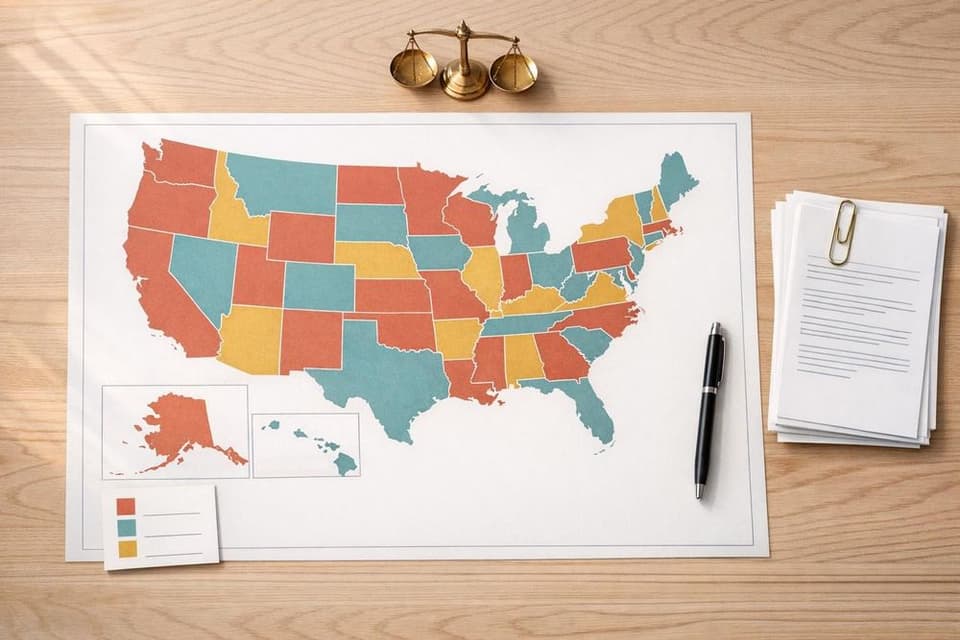
Debt collection in the U.S. is regulated by both federal and state laws, creating a complex landscape for collectors and consumers. While the federal Fair Debt Collection Practices Act (FDCPA) sets baseline protections, state-specific rules often go further, influencing licensing, communication, statutes of limitations, and enforcement practices.
Key Takeaways:
- State-Specific Laws: States like California, Illinois, and Florida impose stricter rules than federal standards. For example, some states regulate original creditors, not just third-party collectors.
- Statutes of Limitations: These vary by state and debt type, typically ranging from 3 to 10 years. Some states, like Maine, extend up to 20 years for certain debts.
- Licensing Requirements: States like Illinois and California require debt buyers and collectors to hold licenses, with non-compliance leading to penalties or invalidated actions.
- Wage Garnishment Rules: Limits and exemptions differ widely. For example, Texas bans wage garnishment for most consumer debts, while Florida protects heads of households earning below $750 weekly.
- Medical Debt Protections: Several states are limiting interest on medical debt or removing it from credit reports altogether.
Understanding these laws is critical for compliance, portfolio valuation, and avoiding legal risks. The article dives deeper into statutes, licensing, and evolving regulations affecting debt collection practices through 2026.
FDCPA vs State Laws: What Debt Collectors Hope You Don’t Know
Statutes of Limitations by State
Debt Collection Statutes of Limitations by State and Debt Type
Debt Collection Statutes of Limitations by State and Debt Type
A statute of limitations determines how long creditors or collectors have to file a lawsuit to recover a debt. Once this time limit expires, the debt can no longer be enforced in court [8, 10]. For debt buyers, this timeline plays a critical role in assessing whether a portfolio can be legally pursued - and its overall value.
Time Limits for Common Debt Types by State
Debt is typically divided into four main categories, each with its own time limits: oral contracts (verbal agreements), written contracts (e.g., medical debt, personal loans), promissory notes (such as mortgages and student loans), and open-ended accounts (credit cards and lines of credit) [8, 11]. For example, medical debt and private student loans are generally considered written contracts. On the other hand, federal student loans and federal taxes are exceptions - they have no statute of limitations, meaning the government can collect them indefinitely [7, 8, 10].
Most states set these limits between 3 and 10 years, although the range can stretch from 2 to 20 years. For instance, in California, oral agreements are limited to 2 years, while Maine allows up to 20 years for promissory notes [12, 10]. Credit card debt often falls into the shorter range. A 2009 Illinois appeals court decision, for example, ruled that credit card agreements don't qualify as written contracts under a 10-year statute. This effectively reduced the collection period to 5 years unless the collector can produce the original signed agreement [8, 9].
Here’s a quick look at how statutes of limitations vary by state and debt type:
| State | Credit Cards (Open Accounts) | Written Contracts (Medical, Personal Loans) | Oral Contracts | Promissory Notes |
|---|---|---|---|---|
| Alabama | 3 years | 6 years | 6 years | 6 years |
| California | 4 years | 4 years | 2 years | 4 years |
| Florida | 4 years | 5 years | 4 years | 5 years |
| Illinois | 5 years | 10 years | 5 years | 10 years |
| New York | 6 years | 6 years | 6 years | 6 years |
| Texas | 4 years | 4 years | 4 years | 4 years |
| Virginia | 3 years | 5 years | 3 years | 6 years |
Note: Arkansas has a 2-year limit for medical debt.
While most states permit collectors to contact individuals about time-barred debt, a few - like Mississippi, North Carolina, and Wisconsin - require all collection efforts to stop once the statute expires. The clock typically starts ticking from the date of the last payment or the first missed payment [10, 13]. However, actions like making a partial payment, acknowledging the debt in writing, or agreeing to a payment plan can reset the clock in many states [7, 8, 10].
These statutes not only shape legal options but also influence the value of debt portfolios in the marketplace.
How Time Limits Affect Portfolio Value
The enforceability of debt - tied to these time limits - directly impacts its market value. Debt that’s past the statute of limitations loses much of its worth because it can no longer be collected through court-ordered methods like wage garnishment or bank account seizures. As industry experts explain:
The age of the debt is based on the last time you made a payment on the debt.
This makes verifying the "last activity" date critical before purchasing a portfolio.
Some collectors focus on "zombie debt" - debt that’s past the statute of limitations, bought at deep discounts in hopes that debtors will unknowingly restart the clock. States like Connecticut and Maine have taken steps to stop this practice by banning lawsuits on time-barred debt and preventing payments from reviving the statute. Additionally, consumer groups like the National Consumer Law Center advocate for a uniform 3-year limitation period across all states. For debt buyers, this means carefully reviewing portfolio activity and understanding which state laws apply. In some cases, "borrowing statutes" may require applying the shorter limitation period between two states [2, 9].
Understanding these nuances is essential for navigating the debt trading market effectively.
Licensing Requirements by State
Debt collection licensing rules differ across the United States, with some states regulating only third-party collection agencies, while others include debt buyers - companies that purchase delinquent accounts to collect for themselves. This distinction is critical because failing to meet state licensing rules can invalidate a collector's actions or open the door to significant consumer claims. To address these complexities, many states have turned to centralized licensing systems.
A growing number of states now use the Nationwide Multistate Licensing System (NMLS) to oversee and track debt collector licenses. This system allows debt traders to verify licensing status in a specific state through the NMLS Consumer Access portal. For instance, in California, applicants must register via NMLS, provide fingerprints, undergo background checks for key personnel, and describe their collection practices. Additionally, most states require a surety bond - California sets a minimum of $25,000 - to cover potential fines or state expenses.
States That Require Debt Buyer Licenses
Several states have updated their laws to include debt buyers under the definition of "debt collector." Illinois and New Hampshire, for example, now explicitly require debt buyers to hold licenses, even if they are collecting on their own behalf. However, starting January 1, 2026, Illinois will adjust its stance with Senate Bill 2457, removing the phrase "on behalf of himself" from the definition of a collection agency. This change means first-party creditors (companies collecting their own debts) generally won’t need a license, while debt buyers will still be required to maintain one.
"The new legislation appears to resolve historical ambiguity related to the statute's application to persons collecting debts that they originated and own ('first-party' collectors)." - Daniel B. Pearson and Krista Cooley, Mayer Brown
Connecticut has broadened its definition of a collection agency to include private collectors of federal tax debts. The state also requires debt buyers to present clear evidence of debt ownership and account history before filing a lawsuit. In California, the Debt Collection Licensing Act mandates licensing for most businesses that regularly collect consumer debts, whether for themselves or others. These businesses must also file annual reports by March 15, detailing the prior year’s collection activities.
Some states impose additional rules for collection practices. For example, Arizona requires collectors to act openly and honestly, prohibiting practices like simulating legal processes. Florida restricts collectors from contacting employers without a final judgment. West Virginia requires collectors to avoid direct contact with consumers if they’ve been notified of attorney representation and more than 72 hours have passed since receiving written notice.
Compliance with these licensing requirements is essential, as violations can negatively impact debt portfolio value and disrupt operations.
License Exemptions and Special Cases
Not all entities involved in debt collection need a license. For instance, Michigan exempts forwarding agencies that send claims to licensed collection agencies on behalf of creditors. Similarly, banks or financial institutions already licensed by the state may not require a separate debt collection license.
Illinois has made notable changes to licensing exemptions starting in 2026. The broad exemption for "financing and lending institutions" has been repealed, meaning these companies must now either secure a new exemption or obtain a license. However, Illinois has introduced exemptions for entities licensed under laws like the Illinois Sales Finance Agency Act, Consumer Installment Loan Act, Interest Act, Consumer Legal Funding Act, and Pawnbroker Regulation Act. For those licensed under the Illinois Residential Mortgage License Act (RMLA), exemptions are now strictly tied to activities explicitly authorized under that Act.
Out-of-state agencies can collect in Illinois without a local license under specific conditions: they must hold a license in their home state, operate solely via interstate communication, and their home state must offer reciprocal privileges to Illinois agencies. Illinois-based companies should carefully review current exemptions to determine if they can relinquish their collection agency licenses.
In Arkansas, the failure to obtain a license results only in civil penalties, described by the state as the "only consequences of and remedy for" such non-compliance. This approach contrasts with other states, where unlicensed collection activity can render a collector's actions legally invalid.
Allowed Collection Practices by State
State Rules on Collection Methods
The Fair Debt Collection Practices Act (FDCPA) sets the groundwork for debt collection practices, including limits on call times and frequency. These federal rules shape daily collection practices and even impact how portfolios are valued. However, many states go further, imposing stricter guidelines. For instance, Georgia bans calls during late-night hours, specifically between 10:00 PM and 5:00 AM. Similarly, Florida, Colorado, and Illinois prohibit calls between 9:00 PM and 8:00 AM. California has additional protections, banning communication at any frequency deemed "unreasonable" or harassing. States like Arkansas, Colorado, and Hawaii also make it illegal to repeatedly ring a phone with the intent to annoy or harass someone.
When it comes to medical debt, protections have grown considerably. Starting in 2025, 14 states will no longer allow medical debt to appear on consumer credit reports. Meanwhile, 13 states have placed limits on or outright banned interest on medical debt. For example, Arizona caps interest at 3%, while Delaware prohibits it entirely. Colorado requires hospitals to offer payment plans with monthly payments no higher than 4% of a person’s gross income, and the debt is forgiven after 36 payments. In Illinois, uninsured patients who can prove they cannot pay are protected from lawsuits.
"Federal medical debt protection standards are vague and rarely enforced. Patient protections at the state level help address key gaps in federal protections." – Commonwealth Fund
Before reporting a debt to a credit bureau, collectors must wait 14 days after sending a validation notice to confirm it wasn’t returned as undeliverable. Violating these rules can lead to penalties and enforcement actions. Beyond communication regulations, states also oversee enforcement methods like wage garnishment.
Wage Garnishment and Other Collection Tools
States regulate more than just call practices - they also impose rules on tools like wage garnishment. Four states - North Carolina, Pennsylvania, South Carolina, and Texas - completely prohibit wage garnishment for most consumer debts. Under federal law, garnishment is capped at the lesser of 25% of disposable earnings or the amount exceeding 30 times the federal minimum wage per week.
Some states offer exemptions for heads of households or primary breadwinners. For example, in Florida, a head of family earning $750 or less per week is entirely exempt from garnishment. Missouri reduces the garnishment limit to 10% for primary earners, compared to the standard 25%. New York caps garnishment at 10% of gross income, while Delaware sets it at 15% and disallows garnishment of bank accounts altogether.
In New Hampshire, creditors must obtain a new court order for each paycheck, prohibiting "continuous" garnishment. Other states use higher multiples of the minimum wage to determine exemptions. For instance, Connecticut, Minnesota, and New Mexico protect income up to 40 times the minimum wage, while Massachusetts, New Hampshire, and West Virginia protect up to 50 times the minimum wage.
"Roughly 1 in 100 workers are subject to wage garnishment and they lose an average of 10% of their gross earnings to creditors." – Jack Caporal, Research Director, The Motley Fool
Garnishments usually last between five and eight months, depending on the type of debt. Judges in states like Arizona and Oklahoma can reduce garnishment rates from 25% to as low as 15% or even 10% if the debtor proves severe financial hardship. Additionally, federal benefits such as Social Security, SSI, and Veterans benefits are generally exempt from garnishment for consumer debts.
2026 Law Changes and Compliance Tips
State Law Changes in 2026
Starting January 1, 2026, Illinois will implement changes to its Collection Agency Act through SB 2457, making the licensing framework permanent. The revised definition of a "collection agency" now excludes most first-party creditors, meaning first-party collections are generally not covered unless they involve debt buying or operate under a fictitious name. Additionally, certain entities - such as licensed student loan servicers, consumer installment lenders, pawnbrokers, and motor vehicle retail sellers collecting their own contracts - are now exempt.
Tennessee will also introduce new licensing requirements for debt resolution services on the same date. Meanwhile, the Illinois Department of Financial and Professional Regulation gains the authority to impose administrative fines of up to $10,000 per violation for specific misconduct. On the federal level, student loan borrowers who haven't made payments for over a year will begin receiving initial default notices.
These legal updates highlight the importance of adapting compliance strategies to align with evolving regulations.
Compliance Strategies for Debt Traders
To stay compliant with the new laws taking effect in 2026, debt traders need to reassess their practices. Businesses should revisit their operational and licensing frameworks to ensure adherence to the updated rules.
For Illinois, review the updated exemptions and ensure your company qualifies under the revised definitions. Out-of-state agencies should confirm whether their home state offers reciprocal licensing privileges before proceeding. In Tennessee, debt resolution and settlement companies must verify compliance with the new licensing and consumer protection standards.
It’s also crucial to develop systems to handle claims related to coerced debt under Illinois' updated regulations. Maintaining accurate and comprehensive records of licensing, exemptions, and reciprocity agreements will help prevent compliance issues.
| State | Change Effective Date | Key Impact |
|---|---|---|
| Illinois | Jan 1, 2026 | Redefines "collection agency"; excludes most first-party creditors; increases fines to $10,000. |
| Tennessee | Jan 1, 2026 | New licensing requirements for debt resolution and settlement services. |
| Federal | Jan 1, 2026 | FCRA disclosure fee raised to $16; increased focus on student loan wage garnishments. |
Debt Collection Laws by Region
Northeast States (NY, MA, MD, RI)
Debt collection laws in the Northeast vary significantly, influencing how debt traders manage risks and adapt their strategies to meet local regulations.
New York: The Consumer Credit Fairness Act reduced the statute of limitations for consumer credit transactions from six years to three years. This change shortens the enforceability period, directly affecting the value of debt portfolios. Collectors are now required to notify consumers when a debt is time-barred and must clarify that pursuing legal action on such debts would violate federal law. Additionally, in New York City, collection activities must pause for 45 days after a consumer disputes the debt, allowing time for verification.
Massachusetts: Massachusetts maintains a six-year statute of limitations for consumer debts. However, it imposes strict contact limits, allowing collectors to reach consumers no more than twice per week. Licensing is mandatory for collection agencies, though "passive debt buyers" who use third-party collectors may qualify for an exemption, as clarified in the case of Dorrian v. LVNV Funding, LLC. Judgments in Massachusetts remain enforceable for up to 20 years.
Maryland and Rhode Island: Maryland stands out for its rigorous oversight of debt collection litigation, supported by detailed litigation analytics. Rhode Island complements federal protections with its own Fair Debt Collection Practices Act, ensuring additional safeguards for consumers.
These state-specific laws in the Northeast highlight how local economic conditions shape debt collection regulations, a trend also evident in the Southern states.
Southern States (VA, TN, NC)
Southern states incorporate federal standards while adding their own measures, which influence collection timelines and portfolio strategies.
Virginia: Virginia enforces the Medical Debt Protections Act (HB1725), set to take effect on July 1, 2026. This law caps interest and late fees on medical debt at 3% annually after a 90-day interest-free period. It also prohibits foreclosures or property liens within 120 days of issuing a final medical invoice.
North Carolina: North Carolina primarily follows federal debt collection guidelines and has not introduced significant state-specific measures at this time.
Tennessee: As of January 1, 2026, Tennessee will require debt resolution service providers to meet new licensing requirements, adding a layer of oversight to the industry.
Further west, states like California, Washington, and Nevada are setting new benchmarks in consumer protection and regulatory practices.
Western States (CA, WA, NV)
Western states are known for their forward-thinking consumer protection laws, creating unique challenges for debt collection and portfolio management.
California: Most debt collectors and buyers in California must now be licensed under the Debt Collection Licensing Act, managed through the NMLS. California has prohibited reporting medical debt to credit agencies under SB 1061, effectively shielding this type of debt from lenders’ view. Additionally, SB 82, effective January 1, 2026, restricts arbitration clauses in consumer contracts to only the specific goods or services covered by the agreement.
California's statute of limitations for written agreements is four years. Collectors must provide proper documentation, including the outstanding balance and the date of the last payment, before contacting consumers. To maintain compliance, annual licensing reports are due by March 15.
Washington and Nevada: Washington has raised its minimum wage to $17.13, while California's is now $16.90. These increases reduce the pool of garnishable wages, impacting collection efforts. Both Washington and Nevada have adopted litigation analytics tools, giving collectors insights into lawsuit trends and enabling more informed strategies.
These regulations in the Western states demonstrate a strong focus on consumer rights, pushing the industry to adapt to evolving compliance standards.
Conclusion
This article has explored the various state-specific debt collection rules that affect both portfolio value and compliance. These state laws play a crucial role in managing debt portfolios effectively. Unlike the baseline protections of the FDCPA, state regulations often go further, covering original creditors and debt buyers who might not fall under federal oversight.
One major challenge is licensing. Failing to meet licensing requirements can lead to serious consumer claims. Before buying or trading a portfolio, it's essential to confirm that every entity involved has the proper state-specific licenses. For example, in Arkansas, civil penalties are imposed if a collection agency operates without the required license.
Statutory deadlines are another key factor influencing the value of debt portfolios. Statutes of limitations differ from state to state and directly impact how collectible a portfolio is. In some states, like Connecticut and Maine, laws prevent the revival of time-barred debts through payments or acknowledgments. This makes older debt portfolios less viable. To navigate these complexities, it's critical to account for state-specific rules and secure proper documentation, such as proof of assignment, before pursuing collection lawsuits.
Post-judgment recovery is also heavily influenced by state law. Rules around wage garnishment limits, bank account exemptions, and property protections determine how much of a debt can actually be recovered after a judgment is obtained. With debt collection lawsuits now making up roughly 25% of all civil court cases in the U.S., staying compliant has never been more important.
To align with evolving state laws through 2026, ongoing monitoring and adjustments are vital. This includes regular audits for licensing compliance, careful examination of borrowing statutes when trading debt across state lines, and updating communication practices to adhere to state-specific contact rules. These steps are essential for preserving portfolio value and reducing legal risks.
FAQs
Which state’s debt collection law applies if the consumer moved?
When a consumer relocates, the debt collection laws that apply are generally tied to the state where the lawsuit is filed. In most cases, the statute of limitations (SOL) from the consumer's current state will govern. However, there are exceptions. For instance, if the SOL in the original state expired before the move, that could impact the case. Additionally, some states have "borrowing statutes" that decide which state's laws apply based on the specifics of the debt.
How do I know if a debt buyer needs a license in a state?
Whether a debt buyer needs a license varies by state, as each has its own set of rules. For instance, states like California, Oregon, and Florida require debt buyers to obtain a license. Meanwhile, states such as New York may regulate debt buyers under different legal frameworks instead of specific licensing requirements. To determine the exact rules, it's best to review the licensing guidelines on official state or regulatory websites or refer to detailed licensing resources.
What actions can restart the statute of limitations?
When it comes to the statute of limitations on debt, certain actions can reset the clock. For example, making a payment, acknowledging the debt in writing, or agreeing to new terms related to the debt can all restart the legal time frame for collection. These steps essentially give creditors a fresh timeline to pursue repayment.
