

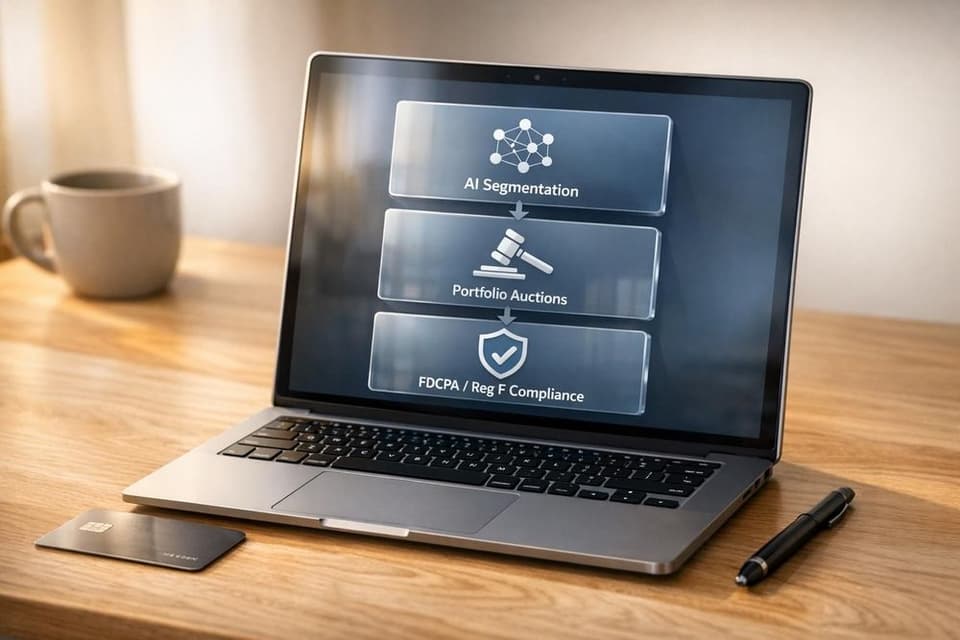
Credit card debt collection is the process of recovering overdue balances from borrowers who miss payments. It involves four main players: original creditors (e.g., banks, retailers), third-party collection agencies, debt buyers, and collection lawyers. Here's how it works:
- Original creditors: Attempt to recover the debt internally.
- Collection agencies: Hired to recover unpaid balances after internal efforts fail.
- Debt buyers: Purchase delinquent accounts at steep discounts and try to collect for profit.
- Collection lawyers: Handle legal enforcement when necessary.
The industry is massive, with U.S. consumer debt exceeding $17 trillion in 2023, and 2.6% of accounts delinquent. Effective strategies like digital outreach and AI-driven tools have improved recovery rates and reduced costs, while compliance with regulations like the FDCPA and CFPB rules ensures ethical practices.
Key takeaways:
- Digital methods outperform traditional approaches, increasing payments by 25%.
- Debt portfolios are sold via marketplaces, auctions, or private sales, with pricing influenced by account quality.
- Compliance is critical to avoid legal risks, focusing on fair communication and secure data handling.
Success in debt collection relies on combining technology, compliance, and empathy to recover unpaid balances while maintaining consumer trust.
Credit Card Debt Collection Industry Statistics and Key Metrics 2023-2025
Credit Card Debt Collection Industry Statistics and Key Metrics 2023-2025
How to Acquire and Evaluate Credit Card Debt Portfolios
How Credit Card Debt Portfolios Are Sold
Credit card debt portfolios are typically bought and sold through three main avenues: online marketplaces, auctions, and direct private sales. Platforms like Debexpert play a key role by connecting sellers with buyers and offering tools like portfolio analytics, secure file sharing, and real-time bidding across various auction formats. For those looking to avoid public exposure, some sellers opt for "Off-Market Private Treaty" deals. In recent years, banks have started favoring direct transactions with pre-vetted buyers over high-fee marketplaces, which can help them recover 15–20% more of the asset’s value. Another common approach is forward-flow arrangements, where financial institutions sell accounts to buyers on a recurring schedule instead of in one-time bulk deals.
The price of these portfolios depends heavily on the quality of the debt. Fresh charge-off credit card debt often sells for $0.03 to $0.10 per dollar of outstanding balance, while performing debt can command $0.25 to $0.45 or more per dollar. Older, out-of-statute accounts are significantly discounted, trading at $0.001 to $0.01 per dollar. As Jeffery Hartman, Director of Portfolio Liquidity & Asset Disposition at DebtLink, explains:
"There's no such thing as 'bad debt,' only bad pricing".
Once a portfolio is purchased, buyers must carefully evaluate its potential using a range of key metrics.
Key Metrics for Evaluating Credit Card Debt
Successful debt buyers rely on detailed analysis to determine whether a portfolio is worth the investment. A critical first step involves examining timeline metrics - these include the account open date, last payment date, charge-off date, and the time gap between the last payment and charge-off. These details reveal patterns in account behavior, which can help predict recovery potential. It’s also essential to break down the portfolio into principal balance, accrued interest, and fees, as sellers often have differing interest accrual policies.
Geographic distribution is another important factor. By analyzing portfolios at the state level, buyers can assess the statute of limitations and determine whether legal recovery methods like garnishments or judgments are feasible. Data quality also matters. Skip trace hit rates and the accuracy of contact information can significantly impact risk and profitability. For example, in Q4 2023, about 8.5% of credit card balances transitioned into delinquency on an annualized basis, with serious delinquencies (90 days or more) increasing across all age groups. Buyers should also check whether the debt was previously worked by an internal team or a third-party agency. Fresh charge-offs generally offer better recovery rates than retrade paper.
After evaluating these metrics, buyers can shift their focus to minimizing risks by thoroughly reviewing documentation and verifying data.
How to Assess Risk Before Buying Credit Card Debt
Risk reduction begins with a close review of the provided documentation. Buyers should confirm that sellers supply a signed contract, the last 12 account statements, an itemized breakdown of principal, interest, and fees, and a clear chain of title to prove legal ownership.
To ensure accuracy, smart buyers perform data scrubs and transactional sampling. High-risk accounts - such as those involving deceased account holders, active bankruptcies, ongoing litigation, or accounts eligible for Servicemembers Civil Relief Act (SCRA) protections - should be excluded. It’s also wise to negotiate retrade clauses for accounts deemed uncollectible. Additionally, buyers should investigate the origins of the debt, including how leads were generated (e.g., SEO versus lead brokers) and the credit scorecard used during the original loan approval process.
As of March 20, 2025, OCC Bulletin 2025-4 eliminated "reputation risk" as a standalone factor in examinations, shifting the focus toward compliance and risk governance. By following these steps, buyers can evaluate portfolios effectively and set the stage for efficient recovery strategies.
Effective Credit Card Debt Collection Strategies
Using Debt Management Software
Debt management software has transformed the way collection agencies handle credit card debt. These tools automate outreach through multiple channels like SMS, email, voice calls, and web portals. By minimizing manual tasks, agencies can lower operational costs by 40–60% while boosting recovery rates by 10–15%.
One of the standout features of these platforms is their use of AI to segment customers. Instead of grouping debtors solely by how much they owe, AI identifies "delinquency archetypes" based on their likelihood to pay. This segmentation helps agencies focus on individuals who either have the means or the willingness to settle their debts. Additionally, self-service portals allow debtors to check their account status, set up payment plans, and pay off balances anytime, which significantly improves digital payment performance.
Compliance is another built-in advantage. These systems automatically adhere to regulatory standards, such as the "7-in-7" rule, which limits contact attempts to seven calls within seven consecutive days. SMS outreach, for instance, is particularly effective - texts have a 98% read rate and generate five times more responses than emails, all at an average cost of just 4¢ per message.
By combining automated outreach with targeted recovery methods, agencies can achieve better results while maintaining compliance.
How to Maximize Recovery Rates
Maximizing recovery rates requires focusing on the right accounts at the right time. Machine learning plays a key role here, optimizing both contact timing and communication channels. This approach can double recovery rates by prioritizing accounts based on their propensity to pay rather than the size of their balance.
Real-time monitoring is equally important. Automated alerts can flag life changes - like new employment or credit activity - that might make previously stagnant accounts more recoverable. For example, in 2019, OppLoans used Experian's Tax Season Payment Indicator to identify customers likely to pay during tax refund season, achieving a 134% return on investment. Digital-first strategies have also been shown to resolve 25% more accounts that are over 30 days past due.
"Recoveries hinge on knowing who can pay, not just who owes." – Experian Thought Leadership
Empathy in communication is another game-changer. Building trust with debtors can lead to better long-term outcomes. Surveys show that 81% of consumers appreciate the ability to choose their payment dates and methods. AI-driven tools not only improve efficiency but can also cut operational costs by up to 40% while enhancing collections.
By combining personalized communication with advanced technology, agencies can improve recovery rates and maintain positive relationships with debtors.
Using Online Auctions for Debt Collection
Online auctions offer a streamlined way to sell credit card debt portfolios, connecting sellers with buyers in a competitive environment. These platforms feature real-time bidding and transaction management tools, enabling financial institutions to quickly convert non-performing assets into cash without the hassle of managing delinquent accounts internally.
Platforms like Debexpert provide portfolio analytics, secure file sharing, and multiple auction formats to ensure efficient liquidation. Competitive bidding often results in fair pricing, but some sellers are now turning to Off-Market Private Treaty Protocols. This method allows them to avoid public exposure and potentially recover 15–20% more in value compared to traditional marketplaces.
"A platform is a commodity. Our Off-Market Protocol is the strategic shield that protects your brand from the auction circus while capturing the connection arbitrage your competitors ignore." – Jeffery Hartman, Managing Member, Fitzgerald Advisors
Before participating in auctions, sellers must conduct thorough due diligence. This includes verifying buyers' IT security, data handling practices, and regulatory compliance. Ensuring buyers meet these standards helps avoid issues like calls being flagged as "Spam Likely" by carriers.
When used alongside advanced digital collection tools, online auctions can enhance the entire debt recovery process, providing both liquidity and efficiency.
Compliance and Legal Requirements
Compliance is a cornerstone of credit card debt collection, ensuring that all recovery efforts align with strict legal and data protection standards. Below, we break down the key regulations, data security protocols, and strategies to steer clear of legal troubles.
FDCPA and CFPB Regulations Explained
FDCPA
The Fair Debt Collection Practices Act (FDCPA) sets the rules for how debt collectors can interact with consumers. Building on this, the Consumer Financial Protection Bureau's (CFPB) Regulation F provides additional guidelines tailored to modern communication methods like email and text messaging.
Here’s what collectors need to know:
- Contact Restrictions: Collectors can only contact consumers between 8:00 a.m. and 9:00 p.m. local time.
- Validation Notice: Within five days of the first contact, collectors must send a notice detailing the debt amount, the creditor's name, and the consumer’s right to dispute the debt within 30 days. The CFPB's Model Validation Notice can simplify compliance.
- Prohibited Practices: Harassment (e.g., repeated calls to annoy), false claims (e.g., misstating the debt amount or pretending to be an attorney), and unfair practices (e.g., charging unauthorized fees) are strictly forbidden.
- Cease Communication Requests: If a consumer submits a written request to stop contact, collectors must comply, except for notifying the consumer about specific legal actions.
"Abusive debt collection practices contribute to the number of personal bankruptcies, to marital instability, to the loss of jobs, and to invasions of individual privacy." - 15 U.S.C. § 1692
Violating these rules can lead to serious consequences. For instance, consumers can claim statutory damages of up to $1,000, while class action lawsuits may result in penalties of up to $500,000 or 1% of the collector's net worth. Legal actions must also be filed in the judicial district where the consumer signed the contract or resides.
Beyond communication rules, secure data handling is equally critical.
Data Privacy and Security Requirements
In today’s digital world, protecting consumer data is just as important as following communication guidelines. Debt collectors must take steps to prevent unauthorized disclosures, especially when using electronic communications. For example:
- Verification of Contact Information: Before sending sensitive information, confirm email addresses and phone numbers. Use addresses the consumer recently used or those verified by the creditor.
- Limited-Content Messages: For voicemails, provide only the business name, a callback request, a contact name, and a phone number. These messages avoid disclosing debt details and aren’t considered "communications" under Regulation F.
- Opt-Out Options: Every electronic message must include a clear way for consumers to opt out.
- Mailing Practices: Envelopes should only display the collector’s business name and address, without any indication of debt collection.
Collectors are also prohibited from discussing debts with unauthorized third parties, except for the consumer’s attorney, the creditor, or credit reporting agencies. To ensure compliance, collectors must retain records of Regulation F adherence from the last collection activity.
How to Avoid Legal Problems in Debt Collection
Sticking to clear communication rules and rigorous data protocols can help minimize legal risks. Common violations include contacting consumers at work after being asked not to or continuing communication after receiving a written cease-contact request. Misrepresenting a debt’s legal status or implying that nonpayment could lead to arrest is also prohibited.
When selling debt portfolios, incomplete or inaccurate account information can create legal headaches for both sellers and buyers. Before selling, scrub portfolios to exclude accounts tied to bankruptcies, deceased individuals, or fraudulent activity. Ensure all documentation is accurate and thorough, including signed contracts, itemized balances, and the last 12 account statements.
The bona fide error defense can protect collectors from unintentional FDCPA violations, but only if they have procedures in place to prevent errors. This includes verifying local time zones before calls and limiting contact to no more than seven calls about a specific debt within seven consecutive days.
| Violation Type | Example | Prevention Strategy |
|---|---|---|
| Communication Timing | Calling before 8:00 a.m. or after 9:00 p.m. | Verify the consumer's local time zone before contact |
| False Representations | Misstating the debt amount or legal status | Use the Model Validation Notice and confirm all details |
| Improper Venue | Filing lawsuits in the wrong jurisdiction | File only where the consumer signed the contract or resides |
| Third-Party Disclosure | Sharing debt details with unauthorized parties | Use limited-content messages and restrict communications |
Lastly, when selling debt, perform due diligence on buyers. Investigate their financial stability, IT security measures, and history of consumer complaints. This step not only protects your reputation but also reduces future compliance risks. By prioritizing these practices, collectors can avoid legal pitfalls and improve overall recovery outcomes.
Conclusion
Summary of Key Strategies
As we move into 2026, success in credit card debt collection will require a sharp focus on portfolio assessment, compliance, and leveraging technology. Start by dividing accounts based on factors like payment history, credit scores, and likelihood to pay. This ensures that efforts are directed toward accounts with the greatest recovery potential. Digital communication channels consistently outperform traditional methods, proving to be more effective in securing payments.
Staying compliant is non-negotiable. Regulations like the FDCPA, Regulation F, and TCPA outline strict rules for when, how often, and how debtors can be contacted. For instance, using the CFPB's Model Validation Notice can provide legal protection. Automated tools can help ensure communication happens within approved hours (typically 8:00 a.m. to 9:00 p.m.). It's worth noting that debt collection complaints to the CFPB nearly doubled in just a year, jumping from 109,900 in 2023 to 207,800 in 2024.
Technology is the backbone of modern debt collection. Self-service portals give debtors control over their payment plans, while AI-powered tools determine the best way to contact each account. These digital-first approaches not only reduce costs by 15% but also improve the resolution of overdue accounts by 25%.
These strategies not only enhance current processes but also create a foundation for future advancements.
What's Next for Credit Card Debt Collection
Looking ahead, the debt collection industry is poised for transformative shifts. Agencies must adopt "always-on" intelligence and omnichannel communication strategies to stay competitive. With 75% of Americans reporting they ignore calls from unknown numbers, channels like SMS, email, and apps like WhatsApp are becoming essential. These methods can increase payment arrangements by over 40%. A glimpse into the future comes from a LATAM Telco operation that implemented a "Memory Layer" technology in early 2026, achieving a 76% resolution rate - double the efficiency of traditional chatbots.
AI is expected to play an even bigger role, especially in managing compliance, identifying unusual transactions, and handling real-time reconciliation. Bernard Marr, a noted futurist, highlights this trend:
"AI agents that can handle compliance, anomalous transactions, and real-time reconciliation are the top trend for the year".
With U.S. household debt hitting $18.4 trillion in Q2 2025 and GDP growth expected to slow to 1.4% in 2026, agencies must balance advanced technology with a personal touch. This balance is critical, as 21% of debt resolutions now occur outside traditional business hours. The real winners will be those who combine automation with empathy, ensuring customers stay engaged and solutions remain effective.
FAQs
What should I verify before buying a credit card debt portfolio?
Before buying a credit card debt portfolio, it's crucial to dig deep into the details to understand both the quality and risks involved. Start by verifying where the portfolio comes from and its structure - whether it includes performing accounts (those still making payments) or non-performing ones. Take a close look at performance metrics to gauge its value.
Make sure the seller has followed proper, transparent processes and review the legal rights associated with the accounts. Assess factors like credit risk, the accuracy of the data provided, and the potential for recovery. Also, double-check that everything aligns with industry standards. Skipping these steps could lead to overpaying or running into legal troubles down the road.
How do I estimate a portfolio’s recovery potential quickly?
To get a quick handle on a portfolio’s recovery potential, leverage advanced analytics and credit data tools. Platforms like Debexpert’s evaluators offer critical metrics such as credit standing, recovery scores, and bankruptcy risk. By pairing these insights with predictive models - like recovery likelihood rankings - you can pinpoint high-potential accounts more effectively. This approach streamlines decision-making and sharpens recovery strategies.
What are the biggest FDCPA and Regulation F compliance mistakes to avoid?
Debt collectors often stumble into serious trouble by making a few common mistakes when it comes to the FDCPA (Fair Debt Collection Practices Act) and Regulation F. These include:
- Inaccurate Initial Validation Notices: Failing to provide clear, correct, and complete validation notices upfront can lead to compliance issues. These notices are crucial for informing consumers about their rights and the debt in question.
- Harassing or Misleading Communication: Using tactics that can be seen as intimidating or deceptive not only violates the FDCPA but also damages trust and can lead to legal action.
- Ignoring Regulation F’s Specific Rules: Regulation F outlines detailed requirements for communication and disclosure, such as limits on call frequencies and guidelines for electronic communication. Overlooking these rules can result in hefty fines or lawsuits.
Strictly following these regulations isn’t just a legal requirement - it’s essential for maintaining ethical practices and avoiding severe penalties.
