

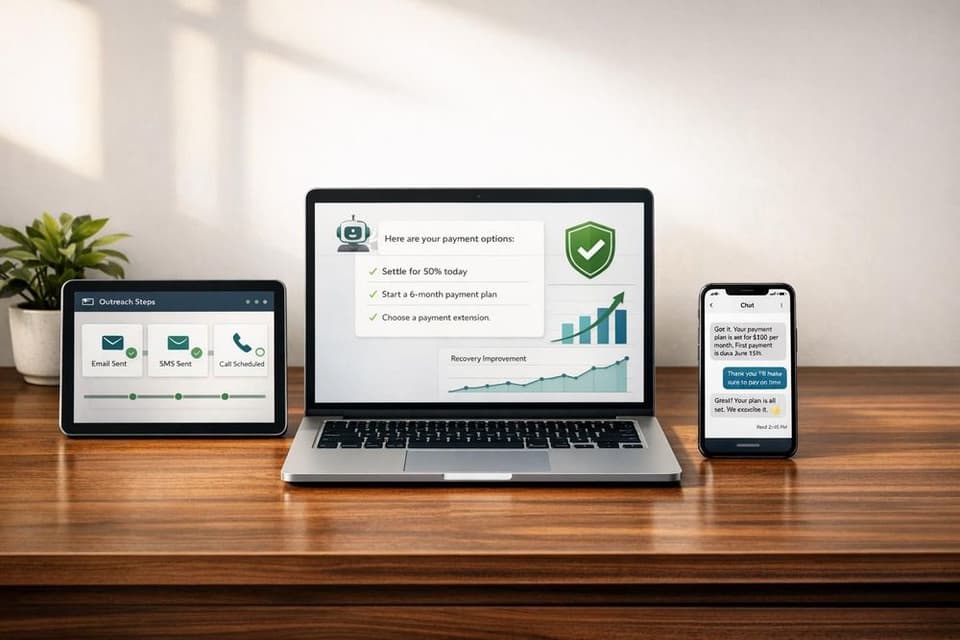
Debt collection is transforming rapidly, thanks to AI and digital tools. Here’s what’s happening:
- AI-driven platforms now handle communication, payment plans, and compliance, replacing outdated methods like phone calls and letters.
- These tools cut operational costs by 40% and improve recovery rates by 10-15%.
- Self-service portals and multichannel communication (SMS, WhatsApp, email) make the process faster and more debtor-friendly. For example, SMS has a 98% read rate, far outperforming email.
- Compliance is automated to meet legal standards like FDCPA and Regulation F, reducing violations by 40%.
The shift to digital debt collection isn’t just about efficiency - it’s about meeting debtors where they are, using smarter, data-driven strategies. Companies adopting these methods report better recovery rates, reduced costs, and improved customer experiences.
Key takeaway: The era of manual debt collection is over. AI, automation, and digital tools are now essential for managing delinquent accounts effectively.
Digital Debt Collection: Key Statistics and Performance Metrics
Digital Debt Collection: Key Statistics and Performance Metrics
Digital Debt Collection Strategies with Kristyn Leffler | Ep. 232
Technologies Behind Digital Debt Collection
Digital debt collection isn’t just about swapping phone calls for emails. It’s built on a foundation of three key technologies: AI analytics that predict debtor behavior, multichannel systems that connect with individuals on their preferred platforms, and compliance automation that ensures legal requirements are met without disrupting operations. Together, these technologies create efficient, legally sound, and customer-focused debt collection processes.
AI Analytics and Predictive Modeling
AI takes the guesswork out of debt collection by analyzing payment histories, communication patterns, and spending behaviors to calculate a "likelihood to pay" score ranging from 0 to 100. It even identifies early warning signs, like fluctuating income, before an account defaults. The results? Companies using AI-powered tools have reported 10–30% better recovery rates and 20–40% lower operational costs.
AI’s real strength lies in its ability to segment debtors into behavioral groups and tailor outreach strategies. For example, it distinguishes between those willing to pay and those less likely to engage, then determines the best time and channel to make contact. This targeted strategy has led to a 20% drop in past-due invoices and a 30% boost in team efficiency. The trend is growing: the percentage of debt collection firms adopting AI or machine learning jumped from 11% in 2023 to 18% in 2024, with more than half of these adopters using it for account prediction and segmentation. Once AI identifies these insights, multichannel systems help put them into action.
Multichannel Communication Systems
Modern platforms allow outreach through SMS, email, WhatsApp, IVR, and even voicebots. The effectiveness of these channels speaks for itself: SMS has a 98% open rate, compared to just 20% for email, while response rates are 45% for SMS versus a mere 6% for email. People are 134% more likely to respond to a text than an email.
A standout feature of these systems is their ability to sequence communication. For instance, if someone doesn’t open an email, the system can automatically send an SMS follow-up, ensuring the message reaches them on their preferred platform. Companies using omnichannel strategies have seen payment arrangements rise by 40% and collection costs drop by 50%. Self-service portals are another game-changer, allowing debtors to view balances, set up payment plans, and make payments anytime - without needing to speak to an agent. This approach not only simplifies the process but also respects the debtor’s dignity. In fact, 92% of customers say they feel more motivated to pay when self-service options are available.
Compliance and Legal Automation Software
Compliance automation ensures debt collection stays within legal boundaries by embedding regulations like the FDCPA and TCPA directly into the software’s logic. These systems enforce rules such as contact limits, disclosure requirements, and restricted contact hours (e.g., no outreach before 8:00 AM or after 9:00 PM). They also block communication in unauthorized regions.
The impact is clear: AI tools have reduced compliance violations in debt collection by 40%. Beyond legal protection, these systems create a detailed digital record of every interaction, making regulatory audits much easier. By automating compliance, companies can focus on maintaining a respectful and transparent approach to debt recovery, ensuring both efficiency and fairness.
Adding Digital Tools to Debt Portfolio Workflows
Bringing digital tools into debt portfolio management means shifting from a traditional, time-driven approach to one that focuses on maximizing value by prioritizing accounts based on their potential recovery amounts. This shift depends on two key components: AI-driven segmentation, which identifies accounts requiring immediate attention, and automated workflows, which handle routine tasks while providing real-time performance insights. Together, these tools build on existing technologies to improve recovery results.
AI-Based Portfolio Segmentation
AI plays a central role by assigning each account a propensity-to-pay score on a scale from 0 to 100. This helps teams concentrate their efforts on debtors most likely to repay, while deprioritizing accounts with low recovery potential. Borrowers are categorized into three treatment paths:
- Self-cure: Minimal reminders and access to self-service portals.
- Digital-assisted: Automated channels offering guided payment options.
- High-risk: Assigned to human agents or escalated to legal action.
This segmentation is effective. Borrowers contacted through digital channels are 73% more likely to make at least a partial payment, compared to 50% for those reached via traditional methods. Digital-first strategies have also led to a 25% improvement in resolving accounts over 30 days past due and a 15% reduction in overall collection costs. AI further enhances these outcomes by incorporating alternative data - such as utility payments, rental history, and behavioral patterns - to better predict risk and repayment likelihood.
"By moving away from a linear collections approach to a value-based approach, you can prioritize your debt collections activities and maximize collections efficiencies." - Experian
While segmentation helps focus resources, automation ensures these strategies are executed efficiently.
Automated Workflows and Performance Monitoring
Automation takes over repetitive tasks like data entry, updates, and follow-ups, reducing errors and freeing agents to handle more complex cases. Real-time dashboards track critical metrics such as Days Sales Outstanding (DSO), promise-to-pay conversion rates, and right-party contact (RPC) rates, while also evaluating the performance of different communication channels (e.g., SMS, email, WhatsApp) at every stage of the debt lifecycle.
Collection Triggers are another powerful tool, monitoring accounts for key life events - like new employment or credit inquiries - and reprioritizing dormant accounts as needed. Using real-time skip tracing tools has been shown to boost RPC rates by 10%. These digital strategies have delivered impressive results, including an 80% reduction in calling costs and a 92% increase in resolutions for some financial institutions. Overall, digital engagement rates can be five times higher compared to traditional collection methods.
How Debexpert Supports Digital Debt Collection
Debexpert
Digital platforms are reshaping how debt portfolios are traded, and Debexpert stands out as a specialized online marketplace designed for this purpose. It provides lenders with a way to sell underperforming accounts and offers buyers access to portfolios that fit their recovery strategies. This platform integrates smoothly with digital automation methods, ensuring that portfolios reach buyers equipped with the tools and expertise to optimize recovery. Below, we'll explore how Debexpert's features and strategies enhance portfolio trading as a crucial element of digital debt collection.
Debexpert Platform Features
Debexpert offers four auction formats - English, Dutch, Sealed-bid, and Hybrid - allowing sellers to tailor sales to current market conditions. The platform provides real-time activity tracking, showing which users have viewed portfolios, downloaded masked files, or placed bids. This functionality is accessible on both desktop and mobile apps. To ensure secure communication, Debexpert includes an encrypted messenger and a shared drive for document exchange.
One of the platform's standout features is auction-specific segmentation, which breaks large portfolios into smaller, more manageable pools, some as low as $6,000–$10,000. This makes it possible for smaller investors to participate, even if they lack the resources for larger, multi-million-dollar purchases. By July 2021, Debexpert had conducted 10 auctions in the U.S., totaling $60 million in debt sales. The platform charges a commission of 1% to 5% on sales, with the fee typically paid by the party designated by the seller.
"Selling and buying delinquent debt is quite a complicated process. We make it easier and clearer. Debexpert is probably the only company in the industry that invests, not in marketing, but in the product itself."
- Oleg Zankov, Product Director and Co-founder, Debexpert
Using Debexpert to Improve Collection Strategies
Beyond its advanced features, Debexpert offers strategic tools that help collection agencies refine their approach to evaluating and bidding on portfolios. Masked files provided by the platform include key debtor details - such as client IDs, debt amounts, locations, and payment histories - allowing buyers to verify critical information before placing bids. This transparency ensures that agencies can assess whether a portfolio aligns with their digital recovery capabilities.
The platform also supports automatic bidding, enabling users to set maximum bid limits. This feature allows incremental bids to be placed automatically, saving time and reducing the need for constant monitoring. For new users, Debexpert offers a viewer mode, which lets them observe live auctions discreetly, providing a chance to learn about pricing trends without actively participating. Additionally, real-time mobile app notifications keep users informed when they are outbid or when new portfolios matching their criteria become available, ensuring they can act quickly in a competitive market.
"The three things that we want to stress about our platform are how user-friendly it is, how transparent it is because you can communicate directly with the sellers... and the much wider access to a range of portfolios."
- Daniel Bloomgarden, Account Manager, Debexpert
How to Implement Digital Debt Collection
Checking Data Quality and Compliance
Reliable data is the backbone of effective digital debt collection. Before diving into automated workflows, it's critical to clean and validate existing records. This involves standardizing addresses, eliminating duplicate entries, and tagging accounts with details like consent status or disputes. Leveraging external data sources can further refine this process by confirming phone numbers, identifying line types, and verifying current addresses. These steps can boost Right Party Contact (RPC) rates by up to 10%.
Compliance should be baked into the technology from the very beginning. Modern systems use code-based compliance, where programmed rules automatically enforce federal and state regulations. This includes setting limits on communication frequency, adhering to "quiet hours", and managing opt-out requests. Interestingly, only 7% of consumers use the word "STOP" to opt out of SMS messages. To stay compliant, systems must also recognize alternative phrases like "leave me alone" or "unsubscribe" to avoid potential violations. Involving legal and compliance teams early ensures adherence to standards such as the TCPA, FDCPA, and Regulation F.
"Compliance is not just about ticking boxes - it's about delivering a consumer experience that's transparent, responsive, and respectful."
With clean data and compliance built into the system, organizations can confidently begin testing digital strategies.
Starting Small and Improving Over Time
A smart way to roll out digital debt collection is to start with a small-scale pilot. Test new digital tools on a limited, controlled portfolio before expanding further. For instance, a U.S.-based subprime consumer lender piloted Kompato AI's platform over 12 weeks in late 2025. By using intelligent segmentation and behavioral targeting, they increased their RPC rate from 35% to 52% and improved contact efficiency by 87%. This phased approach allows organizations to measure results and refine strategies before scaling up.
Incorporate A/B testing to compare digital methods against traditional approaches. Monitor metrics like RPC rate, promise kept rate, complaint rate, and recovery rate by account age to identify what works best. As automation takes over routine tasks, retrain agents to focus on more complex, high-value interactions. Companies that transition to digital strategies report a 15% decrease in overall collection costs and a 25% rise in resolving accounts over 30 days past due.
Conclusion
Managing the rising tide of delinquent U.S. household debt has become increasingly important, especially with 4.5% of all outstanding household debt classified as delinquent as of Q3 2025. Digital debt collection offers a solution, with AI-powered processes proving their worth by reducing operational costs by 40% and increasing recovery rates by 10%.
The shift in the industry is unmistakable. SMS continues to outperform email as a communication channel, and companies adopting omnichannel engagement strategies see an 89% customer retention rate - far surpassing the 33% retention rate of those with weaker approaches.
"The era of 'dialing for dollars' is over. The future of recovery is frictionless, digital, and data-driven. If you are not automating the intake and personalizing the outreach, you are leaving 30% of your revenue on the table."
- Jeffery Hartman, Distressed Asset Solutions Architect
Debexpert stands at the forefront of this transformation, offering a platform designed to simplify portfolio management and ensure compliance. With tools like AI-powered segmentation, automated compliance tracking, and secure communication channels, Debexpert enables organizations to scale their operations without adding headcount, all while maintaining high performance. The platform's auction features and portfolio analytics empower buyers and sellers to make informed decisions, maximizing recovery rates and staying compliant.
The time to adopt digital tools is now. Waiting to embrace these advancements risks falling behind in a fast-moving, tech-driven landscape.
FAQs
Is digital debt collection legal in the U.S.?
Yes, collecting debts digitally is legal in the U.S., as long as it adheres to the Fair Debt Collection Practices Act (FDCPA) and other relevant regulations. These laws set clear rules for communication and practices, ensuring debt recovery remains lawful and ethical.
How do AI models decide who to contact and when?
AI models use data like unstructured notes and behavioral patterns to figure out the best person to contact and the right time to reach out. By leveraging predictive analytics, these models evaluate the likelihood of repayment and fine-tune outreach timing based on factors such as financial habits and preferred communication channels. This approach allows for tailored, strategic interactions that enhance engagement while respecting compliance requirements and the debtor's experience.
What should I implement first to go digital?
To begin, choose a digital communication platform that brings together multiple channels like SMS, email, and self-service portals. These tools make it easier to connect with debtors in a way that feels accessible and convenient. Then, incorporate automation tools, such as AI-powered workflows and messaging, to streamline operations and ensure communication happens at the right time. Lastly, prioritize a platform with built-in compliance management and analytics to adhere to regulations while uncovering useful insights. This combination creates a solid framework for modern digital debt collection.
