

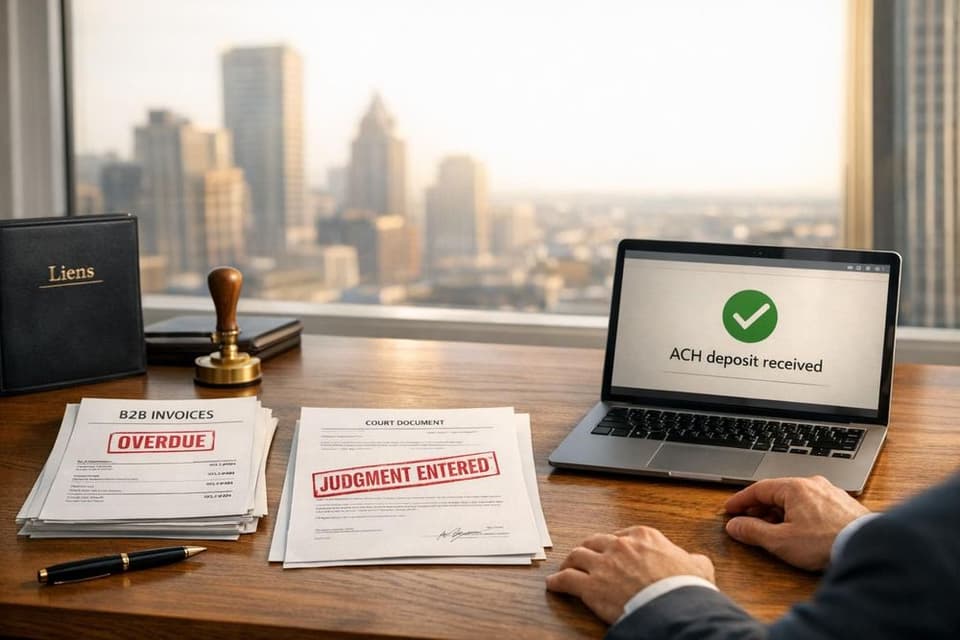
When a business client or partner fails to pay what they owe, it can severely impact your cash flow and operations. Commercial debt collection lawyers specialize in recovering unpaid business debts through legal actions like lawsuits, securing judgments, and enforcing payments. Unlike collection agencies, these attorneys can seize assets, place liens on property, and garnish wages to ensure payment.
Key points about hiring a commercial debt collection lawyer:
- They handle debts ranging from $10,000 to $2,000,000.
- Recovering debts early is critical - 50% of debts become harder to collect after 90 days.
- Hiring a lawyer can improve recovery rates by 25% on average.
- They ensure compliance with laws like the Uniform Commercial Code (UCC) and state regulations.
If you're dealing with overdue accounts, high-value claims, or unresponsive debtors, a commercial debt collection lawyer can help protect your financial stability and recover what's owed to you. Keep reading for details on their strategies, legal tools, and how to choose the right attorney.
What Commercial Debt Collection Lawyers Do
Commercial debt collection lawyers handle every stage of the debt recovery process, from reviewing case files and locating debtors to enforcing judgments through asset seizures. Their work often begins with pre-litigation tasks, such as assessing a debtor's financial situation, tracking down missing debtors, and identifying key assets. They also draft demand letters that outline the legal basis of your claim and warn of potential litigation.
When a debtor is open to negotiation, these lawyers aim to create practical solutions like payment plans, lump-sum settlements, or repayment agreements. These options often allow creditors to recover funds without the need for a costly trial. However, if negotiations break down, attorneys are prepared to file lawsuits and conduct discovery to uncover hidden assets. This thorough approach ensures that all legal, negotiation, and enforcement strategies are effectively executed.
Legal Compliance and Debt Collection
Commercial debt collection lawyers ensure that every step of the recovery process aligns with the law, including the Uniform Commercial Code (UCC), state-specific statutes of limitations, and fair practice standards. While commercial debts are generally not subject to the Fair Debt Collection Practices Act (which focuses on consumer debts), lawyers must still navigate relevant state laws, such as California's Rosenthal Act. They confirm that debts are correctly classified, maintain meticulous records of all communications, and steer clear of prohibited practices like harassment or misrepresentation.
Additionally, they ensure lawsuits are filed in the correct judicial district - typically where the debtor signed the contract or resides - to avoid venue-related challenges that could disrupt your case.
Beyond compliance, attorneys often use strategic negotiation techniques to encourage timely payments.
Negotiating Payment Plans with Debtors
Attorneys rely on tools like Pre-Negotiation Agreements (PNAs) to set clear boundaries for discussions, protecting your rights while requiring the debtor to cooperate with collateral inspections. They may also draft forbearance agreements, which provide debtors with more time to address financial struggles in exchange for fees, claims releases, or corrections to loan documentation errors.
"A PNA [Pre-Negotiation Agreement] sets the ground rules for any workout discussion and expressly reserves the lender's rights and remedies." - Monique D. Jewett-Brewster, Shareholder, Lathrop GPM LLP
In negotiations, lawyers often seek personal guarantees from business owners, turning corporate debts into personal liabilities. This tactic broadens enforcement options, enabling actions like wage garnishment that target the individual rather than just the business. Any waivers of defaults are carefully documented with precise, short-term language to mitigate future "lender liability" claims.
Taking Legal Action and Enforcing Judgments
When negotiations fail, lawyers proceed with lawsuits and represent your business in court to secure a judgment. Once obtained, they use various legal tools to convert the judgment into cash. Bank levies can freeze and withdraw funds directly from the debtor's accounts, while property liens place claims on real estate, ensuring the debt is paid when the property is sold or refinanced. Writs of execution allow law enforcement to seize and sell tangible assets like inventory, vehicles, or equipment.
For debts backed by personal guarantees, attorneys may pursue wage garnishment to collect a portion of the guarantor's income. They can also obtain assignment orders, which redirect payments owed to the debtor directly to you. These methods require strict legal compliance and court approval, making experienced legal guidance essential to maximize recovery while staying within the bounds of the law.
Types of Commercial Debts Lawyers Handle
When it comes to recovering unpaid debts, commercial debt collection lawyers tackle a wide array of cases, from straightforward unpaid invoices to intricate loan defaults. Knowing the types of debts these lawyers manage can help businesses decide when legal action is necessary to protect their cash flow and financial stability.
These attorneys often deal with breach of contract cases, such as broken service agreements, and defaults on Merchant Cash Advances (MCAs), which involve agreements tied to future receivables. They also handle government-backed loans like Small Business Administration (SBA) and Paycheck Protection Program (PPP) loans, where navigating federal regulations is a key part of the process. Beyond that, they address promissory notes, commercial loans, and open accounts where credit lines remain unpaid beyond the agreed terms.
Unpaid Invoices and Trade Debts
One of the most frequent issues businesses face is unpaid invoices or trade debts. These arise when a company provides goods or services, but the client doesn’t follow through on payment. Lawyers handling these cases typically examine contracts, purchase orders, and delivery receipts to confirm the debt’s validity. They also prepare to counter claims from debtors, such as accusations of defective goods or incomplete services.
Business-to-business transactions in these cases are usually governed by the Uniform Commercial Code (UCC), which standardizes payment terms across the country. Having thorough documentation - like signed receipts and communication records - can be crucial when disputes arise.
While unpaid invoices are common, businesses with large-scale debt portfolios face unique challenges that often require tailored legal strategies.
Debt Portfolios: Auto Loans, Medical Receivables, and More
For companies managing extensive debt portfolios, such as those involving auto loans or medical receivables, commercial debt lawyers play a pivotal role. Industries like banking, healthcare, construction, and manufacturing often rely on these attorneys for large-scale recovery efforts. Lawyers in these cases may use litigation and post-judgment enforcement to recover delinquent accounts efficiently.
When creditors hold a high volume of legally vetted or judgment-reduced accounts, selling these portfolios through platforms like Debexpert can be an effective solution. This allows businesses to recover capital more quickly, while lawyers can focus their efforts on higher-value or more complex cases.
When to Hire a Commercial Debt Collection Lawyer
Hiring a commercial debt collection lawyer can be a game-changer for managing high-risk or complicated debt cases. If you're dealing with overdue accounts exceeding $10,000 or facing uncooperative debtors, it might be time to seek professional legal help. Lawyers are particularly effective when the stakes are high, with claims often ranging between $10,000 and $2,000,000.
Delays can make things worse - debts overdue by more than 90 days are 50% harder to recover. As attorney Chad G. Mann points out, "A letter from a law firm gets a lot more attention than another email from your accounting department". In fact, involving a lawyer can boost recovery rates by an average of 25%.
High-Value Debts or Difficult Cases
High-value debts often come with added layers of complexity, such as detailed contracts, personal guarantees, or corporate debtors who may try to fight back. In cases where debtors are unresponsive or disputing the claim, legal action becomes necessary. Unlike collection agencies, which are limited to phone calls and letters, lawyers can escalate matters by filing lawsuits, securing court judgments, and even enforcing those judgments through tools like bank levies or property liens.
"An attorney has legal power an agency lacks: A collection agency is limited to making calls and sending letters. A commercial debt collection attorney can take formal legal action." – Chad G. Mann, Commercial Debt Collection Attorney
Before taking legal steps, ensure the debt is backed by a personal guarantee and verify state-specific limitation periods. For example, California imposes a four-year limit on such claims. If the case involves multiple states, legal expertise becomes even more critical.
Cross-State or Multi-Jurisdictional Cases
When debtors operate across state lines or move assets to other jurisdictions, recovering funds gets more complicated. Lawyers rely on the Uniform Enforcement of Foreign Judgments Act (UEFJA), which most states (47, plus the District of Columbia) have adopted, to enforce judgments outside the original jurisdiction.
Laws around asset recovery and creditor priority vary by state. A notable example is the 2019 Kassover v. Prism Ventures Partners, LLC case, where a New York creditor successfully claimed LLC certificates moved to Florida. Although a Florida creditor had a first-in-time lien, they lost out because they failed to domesticate their judgment in New York.
"Whether a judgment creditor will be able to reach the property of a judgment debtor that is located out of the state... will depend upon the jurisdiction in which the judgment is sought to be enforced." – Brigitte Rose, American Bar Association
Acting quickly is key. Starting the domestication process early can help ensure your lien takes priority over competing claims [23, 24]. This is especially important for businesses managing large, diverse debt portfolios.
Managing Large Debt Portfolios
If your business handles a significant number of debts - such as auto loans, medical receivables, or commercial loans - legal expertise can simplify recovery across multiple accounts. Many attorneys work on contingency fees, typically ranging from 10% to 30% of the recovered amount, making legal action a viable option even for mid-sized debts. With 36% to 53% of organizations involved in some form of litigation each year, having professional legal representation is a smart move for managing commercial debt effectively.
U.S. Debt Collection Laws and Regulations
Understanding the legal framework for commercial debt collections in the U.S. is crucial for businesses. While federal laws like the Fair Debt Collection Practices Act (FDCPA) establish baseline rules, commercial debts operate under a different set of guidelines than consumer debts. Knowing these distinctions is key to avoiding costly errors.
FDCPA and State Law Requirements
The FDCPA, along with Regulation F (12 CFR Part 1006), applies exclusively to consumer debts - those incurred for personal, family, or household purposes. It does not cover business-to-business (B2B) transactions. As outlined in the FDIC Consumer Compliance Examination Manual:
"The FDCPA and Regulation F apply only to the collection of debt incurred by a consumer primarily for personal, family or household purposes. They do not apply to the collection of corporate debt or to debt owed for business or agricultural purposes."
For commercial debts, state laws often step in to address gaps left by federal regulations. Many states have their own debt collection laws and unfair and deceptive acts and practices (UDAP) regulations that may extend to business transactions. Federal law overrides state law only when there’s a conflict, but states can enforce stricter protections for debtors. Commercial debt collection attorneys play a vital role in navigating these varying state laws, ensuring compliance with statutes of limitations, revival rules, and other collection procedures. This nuanced understanding of regulations helps shield businesses from potential compliance pitfalls.
Protecting Your Business from Legal Risks
Misclassifying a consumer debt as a commercial one can lead to steep penalties. Violations of the FDCPA can result in statutory damages of up to $1,000 for individual cases, while class action lawsuits can lead to damages capped at the lesser of $500,000 or 1% of the collector’s net worth. Attempting to collect on time-barred debts - those outside the statute of limitations - can also lead to enforcement actions by agencies like the FTC and CFPB.
Attorneys help mitigate these risks by implementing compliance measures, including a "bona fide error" defense for unintentional violations. They also ensure businesses maintain proper records - typically for at least three years after the last collection activity - and accurately classify debts before initiating collection efforts. This is particularly important when dealing with portfolios that mix consumer and commercial debts. By maintaining strict oversight, legal professionals protect businesses from regulatory scrutiny while optimizing debt recovery strategies. This careful approach not only safeguards your interests but also improves the effectiveness of your collection efforts.
How Lawyers Enforce Judgments and Collect Debts
Pre-Judgment vs Post-Judgment Debt Collection Tactics Comparison
Pre-Judgment vs Post-Judgment Debt Collection Tactics Comparison
Winning a judgment is just the beginning - turning that court ruling into actual cash is where the real challenge lies. As one client of Stimmel Law aptly put it, the goal is to transform "a piece of paper that I can wave in the air to a piece of paper I can put in the bank…namely, cash". To achieve this, commercial debt collection lawyers employ a variety of legal tools, from freezing bank accounts to seizing assets like business equipment.
Pre-Judgment vs. Post-Judgment Collection Tactics
The strategies lawyers use shift significantly depending on whether they’re working before or after a judgment has been entered. Before a ruling, attorneys focus on protecting assets and preventing debtors from moving or hiding their property. Once a judgment is secured, the legal tools available to lawyers expand dramatically, backed by the authority of the court.
| Tactic | Pre-Judgment | Post-Judgment |
|---|---|---|
| Primary Goal | Preserve assets and maintain the status quo | Enforce the judgment by seizing assets |
| Writ Used | Writ of Attachment (to secure property) | Writ of Execution (to seize or sell property) |
| Discovery | Limited to case merits | Broad discovery of all debtor assets |
| Asset Freezing | Requires strong evidence (via injunction) | Automatic through restraining notices |
| Property Impact | Lis Pendens (notice on real estate) | Judgment Lien (claim on property equity) |
| Income Impact | Rarely available | Wage Garnishment (up to 25% of net earnings) |
Once a judgment is in place, enforcement tools like writs of execution allow sheriffs or marshals to seize and sell non-exempt property, including bank accounts, vehicles, and business inventory. Wage garnishment is another powerful option, enabling creditors to claim a portion of the debtor's paycheck - up to 25% of net earnings or the amount exceeding 30 times the federal minimum wage, whichever is less. Additionally, filing a judgment lien with the county recorder’s office ensures that debtors can’t sell or refinance their real estate without first settling the debt.
Lawyers can also compel debtors to disclose their assets under oath through Orders of Examination, with refusal risking arrest or contempt charges. When it comes to bank accounts, bank levies freeze and seize funds by serving restraining notices to financial institutions. For those with stakes in LLCs or partnerships, charging orders place liens on economic distributions rather than the business itself.
Judgments often accrue interest at rates between 7% and 10% annually and typically remain enforceable for at least 10 years - renewable for even longer periods. This gives attorneys ample time to pursue collection. While court filing fees are minimal, enforcement agents typically take a 5% commission, making these efforts cost-effective.
Handling Bankruptcy and Collection Obstacles
Even with a suite of enforcement tools, lawyers often face hurdles like bankruptcy filings or attempts to conceal assets. A debtor filing for bankruptcy triggers an automatic stay, which halts all collection efforts immediately. To continue pursuing the claim, lawyers must navigate Federal Bankruptcy Court to seek relief from this stay, a process requiring specialized expertise.
Asset concealment is another challenge, as debtors may attempt to hide funds or property. Attorneys counter this by conducting thorough discovery, serving subpoenas on banks and financial institutions to uncover hidden accounts. The American Bar Association emphasizes the importance of gathering detailed, timely information about a debtor’s assets before starting enforcement efforts, as this intelligence is key to overcoming evasive tactics.
Enforcing judgments across state lines adds another layer of complexity. Under the Uniform Enforcement of Foreign Judgments Act (UEFJA), judgments must be registered in the state where the debtor’s assets are located. For instance, a judgment obtained in New York would need to be domesticated in Illinois to access bank accounts held there.
Finally, lawyers must account for exempt property, which includes items like primary residences (protected under homestead exemptions), essential furniture, and tools of a trade. These assets are legally off-limits to creditors. Understanding these exemptions helps attorneys focus their efforts on recoverable assets, ensuring their strategies are both efficient and effective.
Through these methods, commercial debt collection lawyers play a critical role in turning court rulings into tangible financial outcomes, even when faced with obstacles like bankruptcy, asset concealment, or jurisdictional challenges.
How to Choose the Right Commercial Debt Collection Lawyer
Picking the right attorney can mean the difference between recovering your money or having to write it off as a loss. Look for someone with courtroom experience, a solid understanding of your industry, and a fee structure that fits your budget.
What to Look for in a Debt Collection Lawyer
First and foremost, focus on expertise in commercial law. Your lawyer should know the Uniform Commercial Code (UCC) inside and out and have experience handling business-to-business transactions. Consumer debt experience won’t cut it here. You should also confirm that the attorney is prepared to represent you in court. Ask directly: “Will you personally handle the litigation and appear in court?” This is critical since about 90% of individuals or businesses sued for debt fail to respond, often leading to default judgments.
A strong attorney will also be skilled in post-judgment enforcement. This means they know how to execute bank levies, file property liens, garnish wages, and seize assets to turn a judgment into actual payment. As Bernard D'Orazio, Attorney at Bernard D'Orazio & Associates, P.C., aptly states:
"The goal of a lawsuit is not obtaining a piece of paper called a Judgment; it is about obtaining payment".
Bankruptcy knowledge is another must. If a debtor files for bankruptcy, an automatic stay halts all collection efforts. Your lawyer should know how to navigate Federal Bankruptcy Court and file proofs of claim to protect your interests. Industry-specific experience can also be a game-changer. A lawyer familiar with your sector - whether it’s equipment rentals, professional services, or merchant cash advances - will understand the unique contract terms and common debtor tactics. On top of that, they should use tools like skip tracing services and asset search databases to track down debtors and their assets.
Understanding Legal Fees and Payment Options
Most commercial debt collection lawyers work on a contingency basis, taking anywhere from 10% to 30% of the recovered amount. If they don’t recover anything, you usually won’t owe legal fees, though you might still need to cover out-of-pocket costs like court filing fees or service of process.
For more complex cases or those likely to succeed quickly, lawyers may charge hourly rates, which typically range from $100 to $300. Some tasks, like drafting a demand letter or filing a straightforward lawsuit, might come with a flat fee. Hybrid models - where a reduced hourly rate is paired with a smaller contingency percentage - are also an option.
The age and value of your debt are key factors to consider. Debts older than 90 days become much harder to collect, with about half losing significant recovery potential after that window. If you manage a large portfolio of overdue accounts, you might negotiate a lower contingency percentage. Keep in mind that some specialized firms only handle claims of $10,000 or more to ensure their attorney-driven approach remains cost-effective.
Once you’ve reviewed the fee structure, make sure your lawyer’s credentials and track record align with your expectations.
Vetting and Selecting Your Lawyer
After understanding fees, it’s time to dive into your lawyer’s qualifications and reputation. Start by checking their bar status through your state’s court website to confirm they’re licensed and free of disciplinary actions. Legal directories like Martindale-Hubbell can also provide insight into their credentials. Reviewing state court records can help you see the types of cases they’ve handled and their outcomes. Membership in organizations like the Commercial Law League of America (CLLA) or the Commercial Collection Agency Association (CCAA) can signal adherence to high ethical standards.
During your consultation, assess how well they communicate. Do they explain the process without drowning you in legal jargon? Ask questions such as, “What’s your success rate in cases like mine?” and “How many cases have you handled in my industry?” Request references from past clients with similar cases to get a sense of their effectiveness.
Finally, provide all relevant documents - contracts, invoices, and communications - early in the process. Strong documentation is critical for a successful recovery. A skilled attorney will also examine your contracts for provisions like attorney fee recovery clauses or personal guarantees, which can add extra pressure on the debtor.
The right lawyer will act decisively and improve your chances of recovering what’s owed to you.
Conclusion
Unpaid invoices can wreak havoc on your cash flow, especially when standard collection methods fall short. In such cases, turning to a commercial debt collection lawyer can be your best move. These professionals can file lawsuits, secure judgments, and enforce payments through methods like bank levies, property liens, and asset seizures. Timing matters - acting before the 90-day mark is crucial, as delays can sharply reduce the chances of recovering your money.
A skilled attorney brings more than just legal muscle. They can navigate complex contracts, handle cases across multiple jurisdictions, and ensure that court judgments are enforced to the fullest extent. Whether you're chasing a single large debt or managing multiple accounts, their expertise can significantly increase your recovery outcomes.
Finding the right lawyer requires careful consideration. Verify their credentials, assess their experience with commercial cases, and make sure they have a solid understanding of your industry. Many operate on a contingency fee basis, typically charging 10% to 30% of the recovered amount. This setup minimizes your upfront costs and aligns their success with yours.
For an added edge, platforms like Debexpert offer tools to streamline debt management. With features like portfolio analytics and secure transaction capabilities, they help businesses recover overdue payments more efficiently.
Unpaid debts don't have to drain your resources. By combining proactive legal strategies with advanced debt management tools, you can protect your business's financial health and maximize your chances of recovering what's rightfully yours while safeguarding your interests.
FAQs
Should I hire a lawyer or a collection agency?
The decision comes down to how complex and urgent your debt situation is. If you're dealing with large sums, contractual disputes, or the need for legal enforcement, a commercial debt collection lawyer is your best bet. They can handle lawsuits, enforce judgments, and take actions like placing liens or garnishments. On the other hand, for smaller or more straightforward debts, a collection agency might work just fine. They specialize in communication and negotiation without involving the courts. Lawyers are ideal for intricate cases, while agencies are a more budget-friendly option for simpler situations.
What documents do I need to start a claim?
To begin a commercial debt collection claim, assemble all relevant documentation that supports your claim. This includes invoices, contracts, payment agreements, and any correspondence that confirms the amount owed and the terms of the transaction. Additionally, gather financial records or other proof showing the debtor's failure to respond to payment demands. Having these documents on hand simplifies the process and provides strong support for your case if it escalates to legal proceedings.
How long does commercial debt collection usually take?
Commercial debt collection timelines can vary widely, ranging from a few months to over a year. How long it takes often depends on factors like the complexity of the case and whether legal action becomes necessary. When formal legal proceedings are involved, the process typically takes longer to reach a resolution.
