

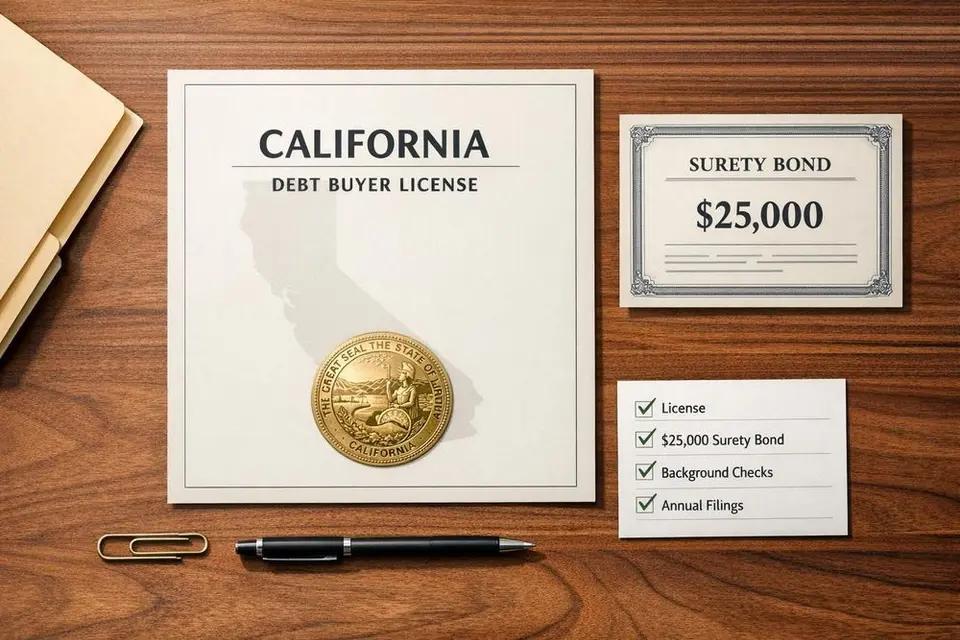
If you purchase charged-off consumer debt in California, you need a California Debt Buyer License. This license, required since January 1, 2022, is regulated by the Department of Financial Protection and Innovation (DFPI) under the Debt Collection Licensing Act (DCLA). Operating without it can lead to serious consequences, including fines, lawsuits, and being barred from the market.
Key Points:
- Who Needs It? Any individual or business collecting purchased consumer debt from California residents, whether in-state or out-of-state, must obtain a license. Exemptions include banks, credit unions, and certain licensed entities.
- License Requirements:
- Submit forms (MU1, MU2, MU3) via the NMLS.
- Provide documents like financial statements, governing documents, and a $25,000 surety bond.
- Pay state fees: $350 application fee + $150 per affiliate investigation fee.
- Compliance Obligations:
- File an Annual Report by March 15.
- Pay an Annual Assessment by January 1.
- Keep your surety bond active and update NMLS for changes in ownership, address, or personnel.
Failing to comply can result in penalties, license suspension, or revocation. The DFPI reviews applications within 90 days, so ensure all forms, fees, and background checks are completed accurately to avoid delays.
Who Must Obtain a California Debt Buyer License
Requirements for Debt Buyers
Under California law, a debt buyer is defined as any individual or entity that purchases charged-off consumer debt for the purpose of collection. This collection can be done directly, through a third-party agency, or via litigation. Charged-off debt refers to consumer debt that creditors have written off as a loss or expense and removed from their financial records.
The licensing requirement applies to all businesses - whether they are based in California or operate out of state - if they are collecting from California residents.
Affiliated debt collectors must also obtain a license. If multiple affiliates are involved, they can share one license as long as each affiliate submits Form MU1 and pays a $150 fee. Additionally, a one-time application fee of $350 applies to the entire group.
Certain entities are exempt from this licensing requirement. These include FDIC-insured banks, credit unions, finance lenders and brokers licensed by the DFPI, mortgage lenders and servicers, licensed real estate brokers, and trustees conducting nonjudicial foreclosures. If your business already holds a qualifying California license, it may exempt you from the DCLA requirements, so it's crucial to verify this before applying.
To meet regulatory obligations, ensure that all branch locations are properly registered with the NMLS.
Branch Location Registration
Securing your primary license is just the first step. Proper branch registration is equally important. While you don’t need a separate license for each branch office, every branch must be registered in the NMLS using Form MU3. A branch office refers to any location other than the primary office where debt collection activities occur and that is listed as a business address.
"A separate license is not required for each individual branch office. However, your branch offices must be registered in the NMLS." – California Department of Financial Protection and Innovation
A branch office must be registered if it handles debtor correspondence, interacts with the public, or is listed on business materials, regardless of whether its primary function is administrative. Be sure to update your NMLS registration whenever there are changes to your branch information.
Uncle Ed Announces the CA Debt Collection Licensing Act 12-28-21 (CA SB908)
Debt Collection Licensing Act
How to Apply for a California Debt Buyer License
California Debt Buyer License Application Process and Requirements
California Debt Buyer License Application Process and Requirements
If you're ready to move forward with your California Debt Buyer License application, here's a detailed guide to completing the process through the Nationwide Multistate Licensing System & Registry (NMLS).
NMLS Application Forms
NMLS
The entire application process happens online via the NMLS. Start by setting up a Company Account in the system. From there, you'll need to complete three primary forms:
- Form MU1: This is the company form and includes crucial details like your business activities, California registered agent information, website addresses, and the location of your records custodian. It also requires you to identify all direct owners with at least 10% ownership, executive officers, and control persons. Additionally, you'll need to provide documents such as fictitious business names, organizational and management charts, and a detailed explanation of your consumer debt collection methods.
- Form MU2: Every individual listed on Form MU1 - such as direct owners, executive officers, and branch managers - must complete this form. It covers personal details, employment history, and includes consents for credit and fingerprint checks.
- Form MU3: Use this form to register each branch office. While separate licenses aren't needed for multiple locations, every branch must still be registered.
Once these forms are completed, you'll need to gather and submit the required supporting documents.
Required Documentation
Here’s a breakdown of the supporting documents you’ll need:
- Certificates: Include a Certificate of Qualification or Good Standing from California and your state of incorporation. These certificates must be dated no more than 60 days before your application submission. If you operate under a fictitious business name, include a copy of your Fictitious Business Name Statement with the "filed" stamp from the county clerk.
- Governing Documents: Depending on your business structure, submit your governing documents. For example, partnerships must provide their Partnership Agreement, while LLCs need to include their Operating Agreement. Also, include organizational charts that show all owners and management overseeing California activities.
- Consumer Notices: Provide a copy of your initial validation letter that complies with 15 U.S.C. § 1692g and the notice required by California Civil Code § 1788.52(d) for California consumers.
- Financial Information: Submit supplemental financial data showing the total net proceeds from California debtor accounts for the prior year-end. This helps calculate your initial assessment.
- Surety Bond: A $25,000 surety bond must be submitted electronically through NMLS.
Additionally, you’ll need to file an "Appointment of the Commissioner of Financial Protection and Innovation as Agent for Service of Process" and include your registered agent details.
When authorizing background checks, ensure the California Department of Financial Protection and Innovation (DFPI) has access to the results within 48 hours. If fingerprints in the NMLS are older than three years, you’ll need to provide new ones.
Application Fees and Submission
Once your forms and documents are ready, it’s time to finalize your application and handle the fees.
The total state fees amount to $500, which includes a $350 application fee and a $150 investigation fee per applicant. If multiple affiliates are applying under one license, the $350 application fee covers all affiliates, but each must pay the $150 investigation fee and submit its own Form MU1.
"The $350 application will be invoiced through NMLS after the application is submitted." - California Department of Financial Protection and Innovation
Payment for the application fee is made through the NMLS portal, either by credit card or ACH (Automated Clearing House). Keep in mind, NMLS charges additional fees for processing, including credit reports and annual processing, and all fees are non-refundable.
"All applications, amendments, surety bonds, notices, related filings, supporting documents, renewals, authorizations, assessments, and fees required to be filed with the Commissioner will need to be filed electronically with and transmitted through NMLS." - California Department of Financial Protection and Innovation
The DFPI typically reviews applications within 90 days of submission. However, if you fail to address a deficiency notification within 60 days, your application may be considered abandoned. To avoid delays or a "Pending-Deficient" status, use the CA-DFPI Debt Collection License New Application Checklist to ensure you’ve uploaded all necessary documents.
Financial and Background Check Requirements
Getting a California debt buyer license isn't just about filling out forms and paying fees. Applicants must also meet specific financial and background standards to ensure they’re qualified to operate responsibly in the state’s debt collection industry. These requirements work hand-in-hand with the document and fee submissions already discussed.
Surety Bond Requirements
Applicants must post a minimum $25,000 surety bond. This bond acts as a financial safety net for California consumers and the state. If a debt buyer fails to comply with legal obligations, the bond can cover associated fines or expenses. Depending on factors like the number of affiliates being licensed or the total debt collected, the Department of Financial Protection and Innovation (DFPI) might require a higher bond amount. Keeping this bond active is critical - letting it lapse could lead to a suspended license.
"This bond acts as a form of financial security and can be used to pay for state expenses or fines if the business fails to follow the law." - LegalClarity
But financial security isn’t enough. Applicants also need to prove their integrity through detailed background and credit checks.
Background and Credit Checks
Beyond financial guarantees, California requires a thorough review of the individuals and entities behind the license application. This includes background checks on all MU2 filers - such as anyone owning 10% or more of the business, as well as principal officers, directors, trustees, and managing members. Fingerprints must be uploaded to the NMLS and must not be older than three years. If they are, updated prints will need to be submitted.
The process doesn’t stop there. Credit reports are pulled for all control persons, and any issues flagged - like derogatory credit marks - must be explained in writing. The DFPI also checks Social Security Numbers against state tax delinquency lists from the California Franchise Tax Board and the Department of Tax and Fee Administration. They also verify if there are any outstanding child support obligations. Typically, background check results are available within 48 hours of authorization.
Applicants must authorize DFPI access for background checks within this 48-hour window. Missing this deadline means paying for and authorizing a new check. For individuals who haven’t lived in the U.S. for at least 10 years, additional investigative reports are required along with fingerprinting.
"An application for a license as a debt collector is not deemed complete until all required fees, all required submissions, and all background and investigative reports are received by the Commissioner." - 10 CCR § 1850.7
To avoid delays, make sure all officers and owners have explanations ready for any credit issues, confirm fingerprints are up to date, and resolve any state tax or child support obligations. Taking these steps upfront can help your application move through the process without unnecessary hiccups.
Compliance and License Renewal
Keeping your California debt buyer license active and in good standing requires ongoing attention. Unlike many business licenses that need annual renewal, a California debt buyer license stays valid indefinitely unless you choose to surrender it or the DFPI revokes or suspends it. However, maintaining compliance involves meeting specific requirements to ensure your license remains in good standing.
After completing the initial application process, your focus should shift to meeting these ongoing obligations to protect your license.
Annual Renewal Process
California follows a unique two-step renewal process instead of the typical yearly renewal. This process ensures you continue to meet the legal standards established during your initial application.
- Annual Report Filing By March 15 each year, you must submit an Annual Report through the DFPI Self-Service Portal. This report provides details about your collection activities and operations from the previous year. For example, the report for 2025 must be filed between January 2, 2026, and March 16, 2026, since March 15 falls on a Sunday that year.
- Annual Assessment Invoice By September 30, you'll receive an invoice via the NMLS for your Annual Assessment. This fee includes a $250 minimum plus a share of the DFPI's administrative costs, calculated based on your net proceeds. Payment is due within 30 days of the invoice, no later than January 1. Missing this deadline could result in suspension or revocation of your license. For debt buyers, "net proceeds" refers to the amount collected on a debt minus the prorated purchase cost of that debt, before deducting other expenses.
Here’s a quick breakdown of key deadlines:
| Requirement | Deadline | Platform |
|---|---|---|
| Annual Report Filing | March 15 (March 16 in 2026) | DFPI Self-Service Portal |
| Annual Assessment Invoice | Issued by September 30 | NMLS |
| Assessment Payment | Within 30 days of invoice; by Jan 1 | NMLS |
To stay on track, set reminders at least 60 days before each deadline. Also, ensure your DFPI portal email is a generic business address (e.g., compliance@company.com) and can accept attachments from "@dfpi.ca.gov" and "CDFPISubscriptions@Service.GovDelivery.com."
Recordkeeping and Change Notifications
The DFPI has the authority to review your records at any time to ensure compliance with laws like the Rosenthal Fair Debt Collection Practices Act and the Fair Debt Buying Practices Act. You must keep detailed records of all collection activities, account balances, dates of last payments, and documentation verifying debts before contacting consumers.
Additionally, update your NMLS promptly for any changes in ownership, address, or key personnel. Remember, your license is tied to your principal place of business and cannot be transferred or assigned.
It’s also a good idea to regularly check your NMLS portal for any "deficiency" statuses, as the DFPI uses this system to notify you of outstanding document requirements. Lastly, display your license number in at least 12-point font on all written and digital communications with debtors.
Maintaining Your Surety Bond
You must maintain a surety bond of at least $25,000 at all times. Any lapse could result in license suspension. To stay compliant, confirm with your surety provider every quarter that your bond is active and meets the required minimum. If your debt collection volume or the number of affiliates changes, the DFPI may require a higher bond amount.
Recent enforcement actions by the DFPI highlight the importance of strictly adhering to these compliance obligations.
Conclusion
Getting and maintaining a California debt buyer license requires careful attention to both the application process and ongoing compliance requirements. The California Department of Financial Protection and Innovation (DFPI) handles licensing through the Nationwide Multistate Licensing System & Registry (NMLS), where you’ll need to submit your application and all necessary documentation.
But it doesn’t stop there. Staying compliant is just as important. For instance, you’re required to file an annual report by March 15 each year via the DFPI Self-Service Portal. Additionally, you must pay your annual assessment - starting at $250 - within 30 days of receiving the invoice, with full payment due by January 1 to avoid penalties. Make sure to display your license number in at least 12-point font on all written and digital communications with debtors. If there are changes to your business structure, ownership, or location, you’ll need to update your NMLS profile within 10 calendar days.
The DFPI keeps a close eye on compliance and may review your records. As they’ve warned:
"Licensees found to be engaging in, or hiring others to engage in, the unlawful service of process will be held accountable".
Non-compliance can lead to serious consequences, including desist and refrain orders, civil actions, refunds, restitution, and even public disclosure on the NMLS Consumer Access portal - potentially harming your reputation permanently.
To avoid delays during the application process, take the time to prepare properly. This includes gathering organizational charts, management charts, and detailed descriptions of your business activities ahead of time. Also, use a generic company email address for your DFPI portal account to maintain account continuity, even if personnel changes occur.
FAQs
Does buying debt through an affiliate still require a license?
In California, purchasing debt through an affiliate does require a license if the affiliate is involved in activities related to debt collection that fall under the state's licensing laws. California law has clear requirements that anyone engaged in collecting consumer debt - including debt buyers and their affiliates - must obtain the appropriate licensure.
What triggers a higher surety bond than $25,000?
A surety bond exceeding $25,000 becomes necessary for a debt collection agency when specific conditions, such as heightened risk or stricter regulatory requirements, demand a stronger financial safeguard. Although precise thresholds may not always be explicitly defined, elements like the agency's operational risks or its need to meet compliance standards often play a role in determining this requirement.
What happens if I miss a DFPI deadline or a deficiency notice?
Missing a DFPI deadline or receiving a deficiency notice can have serious consequences, including enforcement actions, fines, or even the suspension or revocation of your license. Since the DFPI holds the power to investigate and enforce compliance with licensing requirements, it’s essential to act quickly. Address any notices right away and ensure all deadlines are met to steer clear of these potential issues.
