

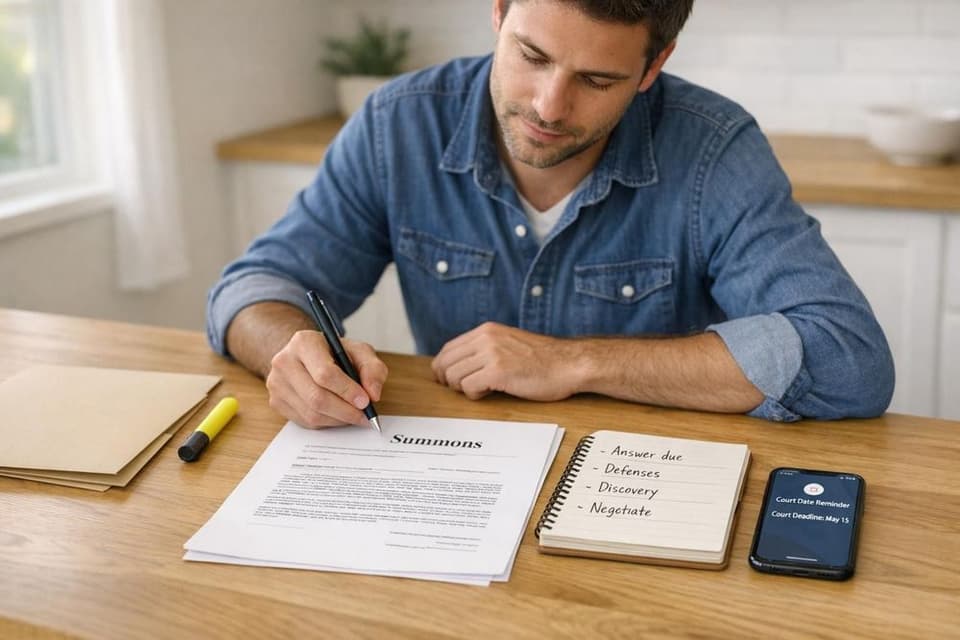
A debt buyer summons is a formal legal notice informing you of a lawsuit filed to recover an unpaid debt. Ignoring it can lead to a default judgment, allowing the debt buyer to garnish wages, freeze accounts, or place liens on property. Here's what you need to know:
- Respond promptly: Deadlines range from 20–30 days, depending on your state. Missing it can result in losing the case automatically.
- Debt buyer's burden: They must prove you owe the debt, the amount is accurate, and they have the legal right to sue.
- Check for errors: Common issues include outdated debts (statute of limitations), missing proof of ownership, or incorrect amounts.
- Defend yourself: File an Answer denying disputed claims and assert defenses like lack of evidence or time-barred debt.
- Use discovery: Request documents like the original contract or payment history to challenge their case.
- Settlement options: Debt buyers often accept less than the claimed amount, but get any agreement in writing.
Acting quickly and knowing your rights can help you avoid financial and legal trouble. Read on for detailed steps to handle a debt buyer summons.
FIGHTING A DEBT BUYER LAWSUIT
What's Inside a Debt Buyer Summons
Common Errors in Debt Buyer Summons and How to Identify Them
Common Errors in Debt Buyer Summons and How to Identify Them
Documents in the Summons Packet
When you receive a summons packet, it typically contains a few crucial documents. First, there's the Summons itself, which informs you about the lawsuit, sets a deadline (usually 20–30 days) for your response, and warns about the risk of a default judgment if you fail to act. Alongside this, you'll find the Complaint, which outlines the plaintiff's claims. This document usually includes details like the original creditor's name, the amount they claim you owe, and the legal grounds for the lawsuit.
In addition to these, the packet should include proof of debt documents. These might be a copy of the original credit card agreement, an account statement, or a charge-off statement. Another key document is the Bill of Sale (sometimes called "proof of assignment"), which shows that the debt buyer purchased your specific account and has the legal authority to sue you.
Some states go a step further with additional consumer protection requirements. For instance, in New York, the court clerk is required to send you a "Notice of Lawsuit" (Form UCS-CCR1) in both English and Spanish. This form provides important details about your rights and includes the court's return address.
Once you have these documents, your next move should be to carefully review them for any inaccuracies.
Finding Errors in the Documents
Carefully examining the summons packet for mistakes is essential, as errors are surprisingly common. Start by checking the chain of title - this means ensuring the Bill of Sale specifically references your account. If it doesn't, or if the document is too generic, it may not be enough to prove ownership of the debt. Attorney Barbara Quinn Smith explains:
The debt buyer will lack standing if it does not have a legal right to sue to recover the debt. This defense is applicable if the debt buyer cannot prove it owns the debt.
Next, verify the account details. Cross-check the creditor's name, account number, and the amount owed against your own records. Also, check whether the original signed contract is included, as some laws require this to be attached to the Complaint.
Another critical point is the statute of limitations. This is the legal time frame within which a lawsuit can be filed. For example, New York's Consumer Credit Fairness Act sets a 3-year limit. If the last payment you made falls outside this period, the debt buyer has no legal right to sue you.
Finally, review the itemization of the debt. Under the Fair Debt Collection Practices Act (FDCPA), collectors must provide a breakdown of the principal amount, interest, fees, payments, and credits. If there are inconsistencies, you can challenge the claim. Additionally, if the collector violates the FDCPA, you could be entitled to up to $1,000 in statutory damages.
Here's a quick breakdown of common errors, their potential impacts, and how to spot them:
| Potential Error | Impact on Case | How to Identify |
|---|---|---|
| Missing Assignment | Lack of Standing; Case may be dismissed | Check for a Bill of Sale specifically naming your account |
| Expired Statute | Debt is Time-Barred; Collector cannot sue | Compare the last payment date to state-specific time limits |
| No Contract Attached | Violation of "Attachment Rule" | Review the Complaint for the original signed agreement |
| Incorrect Amount | Inaccurate Claim; Potential FDCPA violation | Compare the itemized list of fees/interest to your records |
How to Respond to a Debt Buyer Summons
Understanding Deadlines and Default Judgments
The first step is to check your response deadline, which depends on the state where you're being sued. For example, in Texas Justice Court, you have 14 days to file an Answer. Other courts typically allow 20 to 30 days, while Illinois provides a full 30 days. This deadline should be clearly stated on your summons, but if it’s unclear, contact the court clerk immediately to confirm.
Missing this deadline can result in a default judgment, which is what happens when the defendant doesn’t file an answer or attend court. Unfortunately, most debt collection lawsuits in the U.S. end this way. Attorney Andrea Wimmer explains:
The most common reason people lose debt collection lawsuits is simply that they don't show up.
A default judgment gives the debt buyer the ability to garnish your wages, freeze your bank accounts, or place liens on your property. As the Consumer Financial Protection Bureau notes:
A judgment is a court order, so it can be very difficult to get it changed or set aside once the case is over.
Once you know your timeline, the next step is to prepare an Answer and assert any defenses available to you.
Filing an Answer and Using Legal Defenses
Your Answer should address each claim in the Complaint. For each point, state whether you admit, deny, or lack sufficient knowledge to respond. For instance, you can admit to basic details like your name and address but deny disputed points such as the debt amount or its validity. Denying these forces the debt buyer to provide evidence to back their claims.
In addition, include affirmative defenses in your Answer to protect your rights. Some common defenses are:
- Statute of limitations: If the debt is too old to sue on, this can be a valid defense. For example, in New York, the statute of limitations for most consumer credit transactions is 3 years as of April 7, 2022.
- Lack of standing: This applies if the debt buyer cannot prove they own your specific account.
- Documentation issues: Missing contracts, errors in the debt amount, or insufficient evidence can also be used as defenses.
File your Answer with the court and ensure the plaintiff’s attorney is served. Keep in mind that filing fees vary by jurisdiction. Serve the plaintiff via certified mail with receipt confirmation, and file a Certificate of Service with the court to document that you’ve completed this step.
Using Discovery to Challenge the Debt
Requesting Documents and Proof
Discovery is a powerful tool to compel debt buyers to provide solid evidence. Start by sending interrogatories to demand detailed information about the debt, such as the principal amount, interest rates, fees, and payment history. You should also request key documents like the original signed agreement, the complete payment history, and a full record of the debt's chain of ownership.
The chain of ownership is critical to proving the debt buyer's standing in court. For example, in Coppola v. Arrow Financial Services, the court emphasized the importance of clear documentation for debt transfers and calculations to establish standing. Discovery serves as the bridge between your initial document review and a well-prepared defense strategy.
Some jurisdictions also follow an "attachment rule", which requires debt buyers to include the original contract or an account statement with their initial complaint. If they fail to do so, you can file a motion for a "more definite statement" or even seek dismissal of the case.
What Happens When the Debt Buyer Can't Provide Evidence
If the debt buyer fails to produce the requested evidence during discovery, it opens the door to challenging their case further. To win, the plaintiff must prove two things: that you owe the debt and that the amount they’re claiming is accurate. Without the original contract or a complete payment history, they can’t meet this burden, which could allow you to seek dismissal or even file counterclaims.
In Spears v. Brennan (745 N.E.2d 862), the Indiana Court of Appeals ruled that simply presenting a copy of the consumer credit contract wasn’t enough to verify the debt. The court noted:
The contract in no way provides sufficient verification of the debt... The loan agreement contains no accounting of any payments made by Spears, the dates on which those payments were made, the interest which had accrued, or any late fees which had been assessed.
Debt buyers often struggle to obtain necessary records from the original creditor. When this happens, they may drop the case altogether. If they persist without proper evidence, you have options. For instance, you can file a motion for summary judgment to seek dismissal before trial or request a stay to pause proceedings until validation is provided. Attorney Stephanie Lane explains:
If the creditor or collector suing you fails to produce proof of the assignment, then you can ask the court to dismiss the lawsuit.
Additionally, if the debt buyer violates the FDCPA by continuing collection efforts without proper validation, you can file a counterclaim. This could allow you to seek up to $1,000 in statutory damages, along with actual damages, attorneys' fees, and court costs. To strengthen your case, bring certified copies of your dispute letters and proof of delivery as evidence of the collector’s noncompliance.
Settlement and Resolution Options
Negotiating a Settlement
Once you've filed your Answer and questioned the debt buyer's evidence, settling the case might become a practical choice. Debt buyers typically purchase debts for a fraction of their original value, which often makes them open to accepting significantly less than the full balance owed.
In fact, successful negotiations can lead to reductions of 40% to 75% of the debt's original amount. Your negotiating leverage improves if the debt is old, the debt buyer lacks proper documentation, or you're considering bankruptcy. Before entering into any settlement agreements, confirm the debt's validity and check whether it falls within the statute of limitations. Make sure the settlement aligns with your financial situation.
Never send any money without a written agreement in place. The Consumer Financial Protection Bureau advises:
If you agree to a repayment or settlement plan, get the plan and the debt collector's promises in writing before you make a payment.
A proper written settlement agreement should specify that the payment resolves the entire debt, that the lawsuit will be dismissed, and how the account will be reported to credit bureaus. Keep in mind that if your forgiven debt exceeds $600, it may trigger a 1099-C tax form.
If negotiations fail to produce a settlement, the next step is preparing to defend yourself in court.
Preparing for Trial
When settlement discussions fall through, preparing for trial becomes essential. Building on your earlier efforts to challenge the debt buyer's documentation, you’ll need to focus on presenting a strong case in court. Debt buyers often struggle to prove their claims due to insufficient documentation.
Identify your strongest legal defenses. Common defenses include the statute of limitations (if the debt is too old to sue over), lack of standing (if the debt buyer cannot prove they own the debt), and improper service of process. For instance, in New York, the Consumer Credit Fairness Act established a 3-year statute of limitations for most consumer credit transactions as of April 7, 2022. Additionally, check your original credit agreement for an arbitration clause - it could lead to a dismissal if arbitration costs exceed the debt's value.
Gather all relevant evidence to support your case, including bank statements, payment receipts, and correspondence. The Maryland Court Help Center emphasizes:
The judge evaluates the case based only on the evidence presented by you and the other party.
If you prefer a jury trial instead of a bench trial, make sure to request it on your initial appearance form. Failing to do so early on may result in waiving your right to a jury trial. Lastly, if the debt amount is significant or the legal issues are particularly complex, seeking advice from a consumer rights attorney could be a wise move.
Conclusion
Getting a debt buyer summons can feel overwhelming, but acting quickly helps protect your rights and finances. The key is to respond within the deadline - usually 20 to 30 days. Missing this window could result in a default judgment, which might allow creditors to garnish your wages, freeze your bank accounts, or even place liens on your property. As the Federal Trade Commission puts it:
The most important thing is to respond.
Debt buyers carry the burden of proving their case. They must show that you owe the debt, that the amount is correct, and that they have the legal standing to sue. This can be challenging for them because debts are often purchased in bulk, and complete records aren’t always included. Still, about 90% of debt collection cases are decided in favor of collection agencies - primarily because many defendants don’t contest the claims. This statistic shows how crucial it is to take action.
To strengthen your position, file a written answer, ask for debt validation, and check your state’s statute of limitations (for instance, New York has a three-year limit). During the discovery phase, you can request important documents like the chain of title. If the debt buyer can’t provide these, their case may be dismissed or settled for less. These steps give you leverage to negotiate or dispute the debt effectively.
FAQs
How do I know the summons is real?
To determine if a summons is genuine, look for a valid court docket number and a signature from a court clerk. You can also double-check its authenticity by reaching out to the court clerk directly or visiting the court in person. These actions help confirm whether the summons is legitimate or a potential fake.
Can I fight the lawsuit if the debt isn’t mine?
If the debt isn’t yours, you have the right to challenge the lawsuit. Start by disputing the validity of the debt and requesting proof from the debt buyer. There are legal defenses you can use in these situations, but acting quickly is key. This helps protect your rights and prevents the risk of a default judgment.
Should I hire a lawyer or handle it myself?
Deciding whether to bring in a lawyer often comes down to how confident you feel navigating legal processes and the specifics of your case. If you're dealing with a debt buyer's summons, you can handle it yourself by filing an answer. This involves responding to each point in the summons and presenting any defenses you have. That said, if the debt amount is substantial, the situation is disputed, or the case seems complicated, having an attorney on your side can help safeguard your rights and potentially strengthen your case.
