

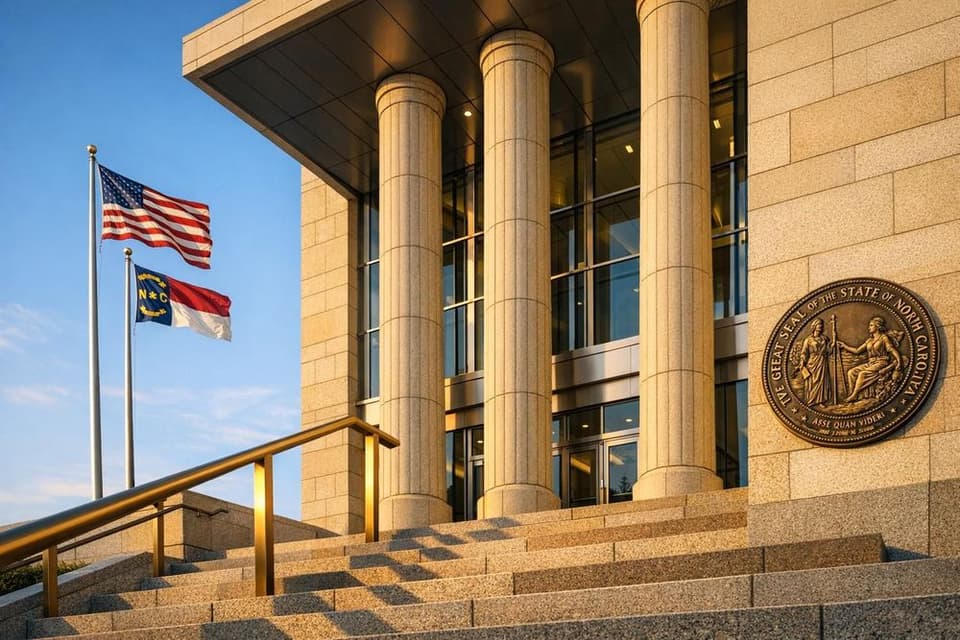
North Carolina enforces strict debt collection laws designed to protect consumers and ensure collectors operate within legal boundaries. Key points include:
- Licensing Requirements: Collection agencies must obtain a permit from the North Carolina Department of Insurance (NCDOI). Fees are $1,000, with surety bonds ranging from $10,000 to $30,000 based on collection volume. Licenses expire annually on June 30.
- Consumer Protections: Wage garnishment is prohibited for most consumer debts. The state enforces a 3-year statute of limitations for open accounts and written contracts. Collectors must issue a 30-day written notice before legal action.
- Prohibited Practices: Harassment, false representation, and unauthorized fees are banned. Collecting on time-barred debts is considered an unfair practice.
- Statute of Limitations: Most consumer debts have a 3-year limit, but specific debts like auto loans (4 years) and mortgages (10 years) differ. Actions like partial payments can reset the clock.
- Documentation Rules: Debt buyers must verify ownership, provide detailed records, and include the agency’s permit number on correspondence starting July 1, 2024.
Violations can result in civil penalties up to $2,000 per instance or criminal charges. Compliance is crucial for operating lawfully in North Carolina’s regulated debt collection market.
Licensing Requirements for Debt Collectors in North Carolina
Licensing with the North Carolina Department of Insurance
North Carolina Department of Insurance
In North Carolina, the Agent Services Division of the North Carolina Department of Insurance (NCDOI) oversees collection agency licensing under NCGS Chapter 58, Article 70. Every collection agency must obtain a permit from the Commissioner of Insurance, whether they’re collecting for North Carolina creditors or are out-of-state agencies pursuing debts from North Carolina residents.
The application process involves a nonrefundable $1,000 fee and a surety bond - $10,000 for residents and $20,000 for nonresidents. Processing typically takes 4–8 weeks, encompassing both preliminary and regulatory reviews. Agencies must secure separate licenses for each branch location. Starting July 1, 2024, all debtor correspondence must include the agency’s North Carolina Permit Number.
License holders are required to maintain a dedicated trust account at a North Carolina bank or an approved institution, with deposits made within two banking days. Permits expire annually on June 30, no matter the original issuance date, and renewals must be submitted at least 30 days before expiration. Renewal bond amounts are adjusted based on the agency's collection volume, ranging from $10,000 to $30,000. Additionally, if ownership changes by 50% or more, the agency must apply for a new license and obtain a new permit number.
Despite these strict requirements, certain entities are exempt from needing a license.
Exemptions and Special Cases
Some entities, because of their specific roles or limited involvement in debt collection, are not subject to these licensing rules. For example, attorneys collecting debts in their own name are exempt, provided they are not running a collection agency under non-attorney management. Similarly, banks, trust companies, and savings and loan associations are explicitly excluded under NCGS § 58-70-15(c). Mortgage banking companies licensed by the NC Commissioner of Banks are also exempt when collecting on loans they originated or purchased.
Other exemptions include regular employees working for a single creditor, real estate brokers handling claims tied to their business activities, and nonprofit tax-exempt organizations offering mediation or dispute resolution services. These exemptions acknowledge that these entities either operate under separate regulations or engage in collection activities as a secondary aspect of their work.
Statute of Limitations on Debt in North Carolina
Permissible and Prohibited Debt Collection Practices
Debt collectors must follow strict licensing requirements and adhere to specific rules to stay compliant. Along with federal regulations under the Fair Debt Collection Practices Act (FDCPA), collectors in North Carolina face additional state-level guidelines. Knowing these legal boundaries helps avoid costly penalties and lawsuits.
Permissible Collection Tactics
Collectors are allowed to contact consumers through phone, mail, fax, or in person, but only between 8:00 a.m. and 9:00 p.m. [5,6]. They can also reach out to consumers at their workplace unless they are aware that the employer prohibits such communication or the consumer provides an alternative contact time [5,6].
When contacting third parties, collectors are limited to obtaining basic information such as the debtor’s address, phone number, or employment details. They are not allowed to disclose any details about the debt itself [5,6].
Collectors must also provide specific disclosures to remain compliant. The first communication must clearly state that they are attempting to collect a debt and that any information obtained will be used for that purpose [6,15]. Within five days of the initial contact, a written validation notice must be sent, including the debt amount, the original creditor’s name, and a statement explaining the consumer’s 30-day right to dispute the debt. For debt buyers, North Carolina requires additional verification, such as the original account number and a detailed breakdown of fees and charges.
Before pursuing legal action, debt buyers must give the debtor at least 30 days’ written notice. This allows consumers time to validate the debt and consider resolution options.
While these practices are allowed when followed correctly, collectors must avoid certain prohibited behaviors outlined below.
Prohibited Collection Practices
Both federal and North Carolina laws strictly prohibit harassment, deception, and other unfair tactics. Collectors cannot use profanity, threaten violence, or repeatedly call with the intent to annoy or harass the consumer [5,6]. Anonymous calls meant to intimidate are also banned.
Misrepresenting one’s identity, providing false information about the debt, or threatening legal actions that cannot be carried out are similarly forbidden [5,6].
"A debt collector may not use any false, deceptive, or misleading representation or means in connection with the collection of any debt." – Fair Debt Collection Practices Act
| Practice Category | Permissible Actions | Prohibited Actions |
|---|---|---|
| Contact Methods | Contacting between 8 a.m. and 9 p.m. via mail, phone, or fax [5,6] | Using profanity, threatening violence, or calling at inconvenient hours [5,6] |
| Obtaining Information | Contacting third parties only to get the debtor’s address or phone number [5,6] | Informing employers, neighbors, or others about the debt or its amount |
| Legal Action | Filing lawsuits with proper documentation and a 30-day notice | Threatening arrest, attempting wage garnishment, or suing on expired debts [5,8] |
| Fees & Charges | Collecting principal and legally approved fees or interest [6,8] | Adding unauthorized fees or excessive charges [8,15] |
If a consumer sends a written request to cease communication via certified mail, the collector must stop all contact except to confirm the request or notify the consumer of specific legal actions [5,6]. Additionally, if the consumer is represented by an attorney, the collector must only communicate with the attorney unless they fail to respond within a reasonable timeframe [6,8].
Violating these rules can lead to serious consequences. Under the FDCPA, collectors may be held liable for actual damages suffered by the consumer, plus statutory damages of up to $1,000 for individual cases. In class action lawsuits, damages can reach the lesser of $500,000 or 1% of the collector’s net worth. Following these regulations is essential for protecting consumers while ensuring compliance in North Carolina.
Statute of Limitations for Debt Collection in North Carolina
North Carolina Debt Collection: Statute of Limitations by Debt Type
North Carolina Debt Collection: Statute of Limitations by Debt Type
When it comes to debt collection, understanding the legal deadlines creditors face is just as important as knowing the rules for collection practices. The statute of limitations sets a firm deadline for creditors and debt buyers to file lawsuits to collect unpaid debts. Once this period ends, the debt becomes time-barred, meaning collectors lose the ability to use the courts to enforce repayment. This knowledge is crucial for debt buyers and portfolio managers working in North Carolina.
Statute of Limitations Periods for Common Debts
In North Carolina, the statute of limitations for most consumer debts is three years, starting from the date of the last payment or account activity. This timeframe applies to credit card debt, medical bills, written contracts, oral agreements, promissory notes, and open retail accounts. However, some debts have different timeframes:
- Contracts involving the sale of goods, like auto loans, have a four-year statute of limitations under N.C.G.S. § 25-2-725.
- Mortgage debt has a much longer statute of limitations, lasting 10 years.
"In North Carolina, the statute of limitations on most types of debt requires a creditor to file a lawsuit to collect the debt within three years of the last activity on the debt account." – Sasser Law Firm
| Debt Type | Statute of Limitations | Relevant Statute |
|---|---|---|
| Credit Card Debt | 3 Years | N.C.G.S. § 1-52 |
| Medical Debt | 3 Years | N.C.G.S. § 1-52 |
| Written Contracts | 3 Years | N.C.G.S. § 1-52 |
| Oral Contracts | 3 Years | N.C.G.S. § 1-52 |
| Sale of Goods (Auto Loans) | 4 Years | N.C.G.S. § 25-2-725 |
| Mortgages | 10 Years | N.C.G.S. § 1-47 |
Once the statute of limitations has passed, debt buyers are prohibited from filing lawsuits or initiating arbitration on the account under N.C.G.S. § 58-70-115. While original creditors may continue informal collection efforts, debt buyers cannot pursue legal action. If a creditor does file a lawsuit on an expired debt, the debtor must actively raise the statute of limitations as a defense; otherwise, the court may still rule in favor of the creditor.
Risks of Debt Revival
Debt buyers must also be cautious about actions that could restart the statute of limitations. A partial payment on a time-barred debt resets the clock, giving creditors another three years to sue. Similarly, a written acknowledgment of the debt or a formal promise to repay can also reset the limitations period. According to the Consumer Financial Protection Bureau, many consumers are unaware that such actions can revive expired debts, inadvertently exposing themselves to new legal risks.
To avoid purchasing time-barred accounts, debt buyers should confirm the exact date of the last activity before acquiring portfolios. If a debtor moves out of North Carolina, the statute of limitations may pause (or "toll") until they return. Additionally, contracts signed under seal extend the limitations period to 10 years. North Carolina law further requires collection agencies to inform consumers that they are not legally required to acknowledge a time-barred debt and that making a payment could restart the limitations period.
Compliance Strategies for Debt Buyers and Sellers
Ensuring Licensing and FDCPA Compliance
Debt buyers operating in North Carolina must adhere to strict collection regulations to ensure smooth and lawful operations. According to state law, debt buyers are classified as collection agencies and are required to secure a collection agency permit from the North Carolina Department of Insurance (NCDOI) before engaging in any collection activities. As outlined in the licensing guidelines, applicants must fulfill specific fee and bond obligations, with licenses needing renewal every year by June 30th.
Before purchasing any debt portfolio, buyers must verify the ownership of the debt. This involves obtaining original creditor information, detailed account records, and an itemized breakdown of fees. Additionally, debt buyers are required to provide debtors with at least 30 days' written notice before initiating any lawsuits or arbitration proceedings. It is also unlawful to transfer or sell delinquent accounts to individuals or entities lacking the necessary North Carolina permit.
Using Debexpert for Compliance and Trading
Debexpert
Technology can play a pivotal role in simplifying compliance and trading processes for debt buyers and sellers. Debexpert offers tools designed to help users navigate North Carolina's stringent regulatory landscape. For instance, its portfolio analytics feature allows buyers to track the age of debts, ensuring they avoid legal action on accounts that fall outside the state's three-year statute of limitations for most consumer debts. Additionally, secure, encrypted file sharing supports the exchange of documentation required under the North Carolina Consumer Economic Protection Act of 2009.
Debexpert's auction capabilities facilitate transactions exclusively between verified entities, helping participants comply with licensing rules outlined in the North Carolina Collection Agency Act. The platform also includes a documentation management system that supports thorough record-keeping practices, reducing the risk of statutory damages, which can range from $500 to $4,000 per violation. By centralizing compliance documentation and offering real-time communication tools, Debexpert eases the administrative challenges of adhering to North Carolina's regulations while enabling efficient and compliant portfolio trading.
Conclusion
North Carolina's strict regulations significantly influence every aspect of debt collection within the state. Compliance is non-negotiable, as debt buyers are required to hold a valid collection agency permit. This permit comes with specific fee and bond obligations, and failing to secure one is classified as a Class I felony.
The state's three-year statute of limitations for most consumer debts plays a key role in determining portfolio value and shaping collection strategies. Additionally, since wage garnishment is heavily restricted, collectors must rely on negotiated settlements rather than aggressive recovery tactics. Collecting on debts past the statute of limitations can lead to civil penalties ranging from $100 to $2,000 per violation.
Debt buyers must also meet stringent documentation requirements, such as proving ownership through valid records, providing an itemized breakdown of fees, and issuing a 30-day pre-suit notice to the debtor. These rules are critical for those aiming to stay compliant and succeed in North Carolina's highly regulated market.
Debexpert's platform simplifies these challenges by offering tools like portfolio analytics, secure management of chain-of-title documentation, and auction features for licensed and verified entities. Its encrypted file-sharing system ensures the safe transfer of required documentation, helping users navigate North Carolina's complex regulatory environment with confidence.
FAQs
How do I check if a collector is licensed in North Carolina?
To check if a debt collector is properly licensed in North Carolina, you can verify their license status through the North Carolina Department of Insurance (NCDOI). Collection agencies operating in the state are required to hold a permit issued by the NCDOI. You can confirm this by visiting the NCDOI's official website or reaching out to them directly. This step ensures the debt collector is legally permitted to operate in North Carolina.
What is considered “last activity” for the statute of limitations clock?
In North Carolina, the term “last activity” generally means the most recent payment made on a debt or any acknowledgment of that debt. This action can either restart or temporarily halt the statute of limitations for debt collection efforts.
What should I do if I’m contacted about a time-barred debt?
If you're approached about a time-barred debt, it's important to ask for validation of the debt. Keep in mind that making even a small payment could restart the statute of limitations, so proceed with caution. Also, debt collectors are not allowed to threaten legal action on debts that are time-barred. Knowing your rights can make it easier to handle these situations with confidence.
