

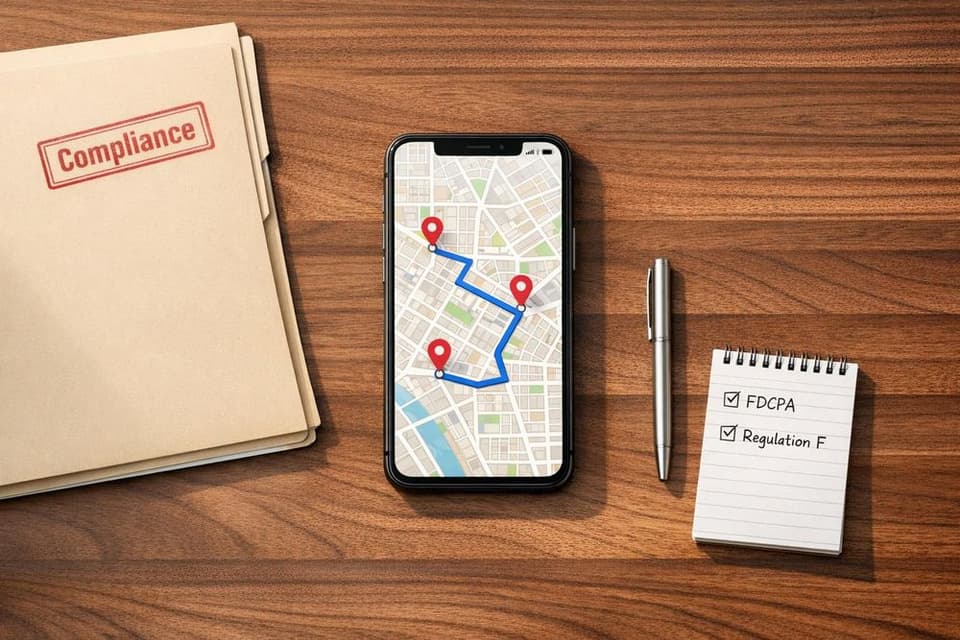
Debt collection agencies face a common challenge: locating debtors who move or avoid contact. Location services provide updated contact details using tools like skip tracing and geo-location technologies. These services improve recovery rates, reduce costs, and ensure compliance with laws like the FDCPA and Regulation F. Here's a quick breakdown:
- Skip Tracing: Uses public records, credit reports, and social media to find addresses, phone numbers, and employment details.
- Geo-Location Tools: GPS tracking, geo-fencing, and geo-tagging help optimize field agent visits and provide timestamped proof of contact.
- Compliance: Agencies must follow strict rules when contacting third parties, such as avoiding disclosure of debt and limiting contact frequency.
- Benefits: Higher recovery rates, cost savings (fuel, labor), and improved communication through accurate, real-time data.
Debt Collection 101: Tips for Successful Skiptracing at Scale
Technologies and Tools for Locating Debtors
Debt collectors rely on a range of digital tools to track down individuals who may have moved or become unresponsive. These tools analyze large volumes of public and private data, using algorithms to pinpoint a debtor's location. By combining software, databases, and tracking systems, collectors can significantly improve their ability to recover accounts.
Skip Tracing Software
Skip tracing software is a key tool for locating individuals who have relocated or are avoiding contact. These platforms compile data from public and private records, such as address histories, phone numbers, emails, utility records, and even information about relatives. Some advanced systems also incorporate alternative data sources like rental payments and social media activity, which is especially useful for identifying individuals in the "unbanked" population - those who lack standard credit files, estimated to include around 25 million people.
A standout feature of modern skip tracing tools is the use of identity graphs. These graphs link various data points to create detailed consumer profiles, reducing errors caused by common names or typos - issues that account for nearly half of all data problems in skip tracing. To stay accurate, these platforms often provide real-time updates, with premium services offering continuous data refreshes rather than relying on outdated monthly updates.
Most skip tracing tools are accessible through cloud-based portals for individual searches, or via APIs and batch processing for handling large volumes of accounts. Batch processing is particularly valuable, allowing agencies to update thousands of records at once instead of manually searching each one.
To avoid legal complications, collectors should verify that any credit-sourced software complies with FCRA regulations. Testing potential vendors with your own information can also help ensure the accuracy of their data before signing a contract.
GPS Tracking and Geolocation Tools
While skip tracing focuses on gathering data, GPS tracking and geolocation tools enhance field operations. These technologies provide real-time location updates, helping managers optimize travel routes and increase the number of visits agents can complete in a day. Geo-fencing adds another layer by creating virtual boundaries around specific locations, automatically logging when an agent enters or leaves the area.
Geo-tagging goes further by timestamping visits and providing proof of an agent's presence, which can help resolve disputes and improve accountability. Beyond individual tracking, these tools offer insights into operational patterns, enabling managers to identify areas with the highest recovery potential and adjust resources accordingly.
"The technology to bring absolute transparency, accountability, and intelligence to your operations is no longer a futuristic concept - it is here, and it is proven." – Mobicule Technologies
Public Records and Online Databases
Public records and online databases are essential for building a comprehensive profile of a debtor. These resources provide key identifiers like full names, aliases, Social Security Numbers (SSNs), and dates of birth, which help differentiate between individuals with similar names. Cross-referencing this information across multiple databases can uncover useful leads.
Address histories and real estate records are particularly helpful for tracking movement patterns and linking past locations to current ones. When direct contact information is unavailable, people-search databases can identify relatives or associates who might provide additional clues.
Other valuable data sources include utility listings, directory assistance, and National Change of Address (NCOA) records. These are especially useful for tracking "unintentional skips", as forwarding orders with the postal service are typically only retained for 90 days. Additionally, databases can flag uncollectible accounts early on, such as those involving bankruptcy or deceased individuals, saving agencies time and resources.
Major skip tracing platforms process over 1.3 billion updates each month, including changes to phone numbers, addresses, and employment details. Social media posts can also provide geographic clues and lifestyle insights, but collectors must avoid deceptive practices like creating fake profiles to connect with debtors.
"The Collections Advantage tool that we've implemented has allowed us to go from more of a 'dialing for dollars' kind of recovery effort to a more targeted, queuing workflow pipeline, so it's a much more efficient process." – Mike London, Manager, Delta Community Credit Union
For agencies handling large volumes of accounts, batch skip tracing is a game-changer, allowing thousands of records to be processed simultaneously. Vendors that provide continuous updates (rather than monthly refreshes) reduce the risk of outdated information. To ensure accountability, collectors should include a consumer's account number with every database search.
Legal and Ethical Requirements
Privacy and Compliance Requirements for Debt Collection Location Services
Privacy and Compliance Requirements for Debt Collection Location Services
Using location services to track down debtors comes with strict legal rules. The Fair Debt Collection Practices Act (FDCPA) allows debt collectors to obtain specific "location information" - such as a consumer's home address, phone number, or workplace - but they must follow detailed guidelines when reaching out to third parties for verification. Additionally, Regulation F from the Consumer Financial Protection Bureau (12 CFR § 1006.10) outlines these rules in greater detail.
Federal and State Law Compliance
When contacting third parties to verify a debtor's location, collectors must:
- Clearly identify themselves and explain they are seeking location information.
- Only disclose their employer's name if directly asked.
- Avoid mentioning that the consumer owes a debt during these interactions. Violating this rule can lead to penalties, such as up to $1,000 in damages for individual lawsuits or as much as $500,000 (or 1% of the collector's net worth) in class actions.
Collectors are also restricted to contacting a third party only once, unless the third party requests additional communication or new evidence shows the previous information was incorrect. If a debtor is represented by an attorney and the collector has the attorney’s contact information, all third-party inquiries must stop - unless the attorney fails to respond within a reasonable time frame.
Even postal communications are subject to privacy rules. Debt collectors cannot use postcards or envelopes with markings that reveal debt collection activity. Some states have stricter rules than federal guidelines. For instance, California enforces a four-year statute of limitations for collecting debts based on written agreements.
FDCPA Section 816 (15 USC 1692n): "This subchapter does not annul, alter, or affect, or exempt any person subject to the provisions of this subchapter from complying with the laws of any State with respect to debt collection practices, except to the extent that those laws are inconsistent with any provision of this subchapter, and then only to the extent of the inconsistency."
These legal requirements form the foundation for ethical communication with debtors, which is further explored in the next section.
Protecting Debtor Privacy
Beyond legal obligations, protecting a debtor’s privacy demands careful and ethical communication. Once a collector secures accurate location information, contacting third parties again is unnecessary and could be seen as harassment.
For email or text communications, collectors must include a clear opt-out option and avoid using workplace email addresses. Contact should also occur during reasonable hours - between 8:00 AM and 9:00 PM in the debtor’s local time zone - to minimize disruption. When leaving voicemail messages, collectors are encouraged to keep them brief, sharing only the business name, a callback request, and contact details - without mentioning the debt.
Federal rules also limit how often collectors can contact a debtor. Calling more than seven times within seven days about the same debt is considered excessive. After speaking directly with a debtor, collectors must wait at least seven days before calling again about that debt. These restrictions recognize the harm that aggressive debt collection can cause, such as financial stress, job loss, and privacy violations.
| Privacy Requirement | Guideline | Legal Basis |
|---|---|---|
| Third-Party Disclosure | Never reveal that the consumer owes a debt | FDCPA § 804 |
| Contact Frequency | Limit to one contact per third party (with exceptions) | 12 CFR § 1006.10 |
| Mail Privacy | No postcards or marked envelopes suggesting collection | FDCPA § 808 |
| Call Limits | Max of 7 calls per 7 days for the same debt | Regulation F |
| Communication Hours | Contact only between 8:00 AM and 9:00 PM local time | FDCPA § 805 |
Benefits of Using Location Services in Debt Collection
Location services play a key role in improving recovery rates, cutting costs, and enhancing communication with debtors. These tools turn collection processes into efficient, data-driven operations.
Higher Recovery Rates
Accurate location data makes a big difference in recovery outcomes. Skip tracing helps collectors reconnect with debtors who have moved or changed contact details without notifying creditors. Some skip-tracing services handle over 1.3 billion data updates monthly, including new phone numbers, addresses, and employment information. This constant stream of updates ensures collectors are working with the most current data, reducing wasted effort on disconnected numbers or outdated addresses.
Right-party contact (RPC) rates also improve with real-time location data. For example, Experian's credit database includes information on 245 million U.S. consumers and 25 million U.S. businesses, giving collectors verified and reliable contact details. With accurate data, collectors can reduce failed contact attempts and recover more debt. On average, U.S. debt collectors recover about 20-30% of the debt they pursue, and location services help push recovery rates toward the top of that range.
Geo-location tools further enhance efficiency by optimizing field agents' routes, allowing them to contact more debtors in a day. More visits mean more opportunities to recover debt. Additionally, geo-tagging provides undeniable proof of field visits with timestamps and photos, which can resolve disputes when debtors claim no visit occurred. Managers can also use aggregated geo-location data to pinpoint areas with higher recovery success, enabling smarter resource allocation.
While these tools improve recovery rates, they also offer major savings in operational costs.
Lower Operating Costs
Location services help agencies save money in several ways. For instance, route optimization reduces fuel costs and travel time. By using geo-location tracking, managers can plan efficient routes that avoid unnecessary mileage, significantly cutting fuel reimbursement expenses.
Fraudulent reporting - like "ghost visits" where agents falsely claim they visited a location - can be eliminated with geo-tagging. This technology creates an automatic audit trail with timestamps and location data, giving agencies indisputable evidence of field visits. This transparency reduces the time and labor spent investigating disputes and avoids potential legal costs.
Switching to digital reporting also lowers administrative overhead. Real-time reporting replaces manual, paper-based processes, freeing up agents and managers to focus on higher-value tasks like negotiating with debtors or managing accounts.
Geo-fencing adds another layer of cost savings by automating compliance audit trails. This helps agencies avoid regulatory penalties from organizations like the Consumer Financial Protection Bureau.
| Cost Category | Traditional Method | Location Services Impact |
|---|---|---|
| Travel Expenses | Unoptimized routes, high fuel costs | Route optimization reduces fuel use |
| Labor Verification | Manual reports prone to false claims | Geo-tagging eliminates "ghost visits" |
| Administrative Work | Paper-based documentation | Digital reporting reduces paperwork |
| Dispute Handling | Time-consuming investigations | Timestamped proof resolves disputes fast |
| Compliance Risk | Manual tracking | Geo-fencing automates audit trails |
Beyond cost savings and efficiency, location services also improve how agencies communicate with debtors.
Better Communication with Debtors
Location services enhance both the timing and effectiveness of debtor interactions. Right-party contact verification ensures collectors reach the intended individual rather than wasting time on outdated phone numbers or addresses. With Experian's skip-tracing data updating 24/7, collectors can avoid futile attempts on disconnected lines or former residents.
Timing contact attempts becomes more strategic with geo-location insights. By analyzing patterns, agencies can identify the best times to reach debtors in specific areas, improving the chances of successful communication.
Dispute resolution also benefits from geo-tagging. Field agents can provide visual proof of visits with timestamped photos, shifting conversations from "Did you visit?" to "How can we resolve this?" This clarity helps eliminate misunderstandings and move discussions forward.
Finally, personalized treatment strategies become possible when collectors have up-to-date location data. Knowing a debtor's current situation allows collectors to tailor their approach, prioritize accounts, and engage in more meaningful conversations. This personal touch can lead to better outcomes and higher payment rates.
"Locating consumers and business contacts and maintaining current addresses and telephone numbers on your accounts is critical to the success of your collections and account management efforts." - Experian
Best Practices for Location Services in Debt Collection
Building on the earlier discussion of technology and legal considerations, the following practices can help ensure that location services are used effectively and within legal boundaries.
Selecting the Right Tools and Software
Having reliable, up-to-date location data is a cornerstone of successful debt recovery. When choosing tools, prioritize those that refresh data frequently - monthly updates may not suffice in high-demand situations. Tools with 24/7 data updates are better equipped to provide accurate phone numbers and addresses, cutting down on wasted time and effort.
Accuracy is more important than sheer data volume. The best tools combine multiple sources, like public records, utility payments, rental histories, and alternative financial data. Real-time phone validation, for example, often leverages data from over 5,000 local exchange carriers.
Compliance should be a built-in feature, not an afterthought. Software must automatically monitor communication frequency and track attorney representation data to align with Regulation F and the FDCPA. For field operations, geo-fencing and geo-tagging can verify agent visits and improve route planning. These tools have been shown to increase productivity, enabling agents to complete 12–14 visits daily compared to the usual 8–10.
Integration capabilities are another time-saver. Platforms with API connectivity allow for batch skip-tracing and seamless syncing with existing collection systems. Additionally, AI and machine learning can help identify patterns and improve contact success rates.
"While many data resellers update their files once a month, our skip-tracing data is updated 24/7 so you can avoid inaccurate, outdated information." - Experian
| Criteria | Key Feature to Look For | Benefit |
|---|---|---|
| Data Quality | 24/7 updates and 1B+ monthly changes | Reduces "dead-end" calls and inaccurate mailings |
| Compliance | Regulation F/FDCPA automated filters | Prevents legal risks and protects reputation |
| Field Efficiency | Geo-fencing and route optimization | Lowers fuel costs and increases daily visits |
| Connectivity | API and batch processing | Supports high-volume operations seamlessly |
| Intelligence | AI/ML pattern recognition | Improves right-party contact (RPC) rates |
Once you’ve secured the right tools, training your team is the next essential step for compliant and effective location outreach.
Training Collection Teams
Proper training is critical to avoiding compliance missteps and improving collection outcomes. Team members need to understand that "location information" refers only to a consumer’s residence (and associated phone number) or place of employment.
When contacting third parties, collectors must follow strict protocols. They should identify themselves by name, explain that their purpose is to confirm or correct location information, and disclose their employer only if explicitly asked. Under no circumstances should they reveal that the consumer owes a debt. Collectors are also limited to one contact per third party unless additional outreach is requested or prior information was incomplete.
If a consumer is represented by an attorney, all communication with both the consumer and third parties must cease. For electronic communications, collectors must provide a clear opt-out option and avoid using work-related email addresses unless specific conditions are met.
Standardized scripts are invaluable for ensuring compliance. These scripts should align with § 1006.10, requiring collectors to state their name first, their purpose second, and disclose their employer only upon request. Additionally, mailroom staff must avoid sending postcards or using envelopes that could link the communication to debt collection.
"The regulatory landscape for debt collection and contacting consumers is constantly evolving. Staying updated with the latest changes ensures that your skip-tracing practices remain compliant with the law." - Laura Burrows, Experian
With the right tools and a well-trained team in place, tracking performance metrics becomes the next step in optimizing recovery operations.
Tracking and Measuring Performance
Measuring the success of your location services requires focused metrics. Right-party contact (RPC) rates are a key indicator, reflecting how often your location data leads to successful debtor contact. Another important metric is time to locate, which tracks how quickly individuals are found after initiating skip-tracing. Shorter times mean lower recovery costs.
For field agents, productivity can be measured by the number of visits completed daily and the time spent at each location. Geo-fencing technology can automatically log agent visits, reducing disputes and identifying top performers. These tools not only enhance recovery rates but also help cut operational expenses.
Financial metrics, such as cost per successful location, offer insights into the return on investment (ROI) for your location tools. Separately analyzing fuel consumption and travel allowances can further highlight the benefits of route optimization.
Finally, geographical recovery analysis allows agencies to allocate resources more effectively by identifying high-recovery areas. Reviewing collection success rates by zip code or locality can help design smarter collection territories for field agents.
| Metric Category | Key Performance Indicator (KPI) | Purpose |
|---|---|---|
| Contact Quality | Right-Party Contact (RPC) Rate | Measures data accuracy and success in reaching debtors |
| Efficiency | Time to Locate | Evaluates the speed of skip-tracing efforts |
| Field Operations | Visits Per Day | Tracks agent productivity and route efficiency |
| Financial | Cost per Location/Skip-trace | Assesses the ROI of location tools |
| Compliance | Dispute Resolution Rate | Validates the use of geo-tags for agent presence |
Regularly analyzing performance data can uncover trends, such as the best times or locations for successful contact, enabling you to refine your strategies based on what works.
Conclusion
Modern debt collection relies heavily on location services, but their true value lies in how agencies use them. Tools like skip tracing databases, geo-fencing, and route optimization can boost recovery rates and lower operational costs. However, the key is striking the right balance between efficiency and legal compliance - a balance that isn’t just recommended but essential.
Under the FDCPA and Regulation F, non-compliance can result in statutory damages of up to $1,000 per violation. Beyond the financial hit, agencies risk damaging their reputation and losing the trust that’s crucial for long-term relationships with customers. Fortunately, today’s technology offers solutions that emphasize transparency, accountability, and operational intelligence.
Three elements are critical for success: using real-time technology with built-in compliance safeguards, ensuring teams are well-trained on proper contact protocols, and maintaining consistent performance tracking. Agencies that embrace these principles and leverage tools like skip tracing and geo-location see improved efficiency and reduced costs.
Switching to data-driven processes doesn’t just streamline operations - it also creates a verifiable digital audit trail. Geo-tagging offers clear proof of visits, automated compliance monitoring helps avoid harassment violations, and real-time data ensures collectors connect with the right person at the right moment.
The most effective use of location services comes from viewing them as tools for responsible recovery, not shortcuts to faster results. Agencies that prioritize quality data, invest in thorough training, and uphold privacy protections - even when it takes more time - set themselves up for long-term success. This approach reflects the industry’s shift toward more ethical and responsible debt collection practices.
FAQs
What is considered “location information” under the FDCPA?
Under the FDCPA, location information refers to details about a consumer's home address, phone number linked to that address, or place of employment. This definition helps ensure that collectors gather information within the bounds of legal requirements.
How can agencies use geolocation without violating privacy laws?
Agencies can handle geolocation data responsibly by securing clear and explicit consent from consumers before collecting or using their location information. Additionally, they must adhere to legal requirements, including FTC guidelines and regulations like 12 CFR § 1006.10, ensuring that any use of location data respects privacy and complies with relevant laws.
Which KPIs best show ROI from location services?
Key performance indicators (KPIs) that show the return on investment (ROI) from location services in debt collection include:
- Improved right-party contact (RPC) rates: Accurate location data helps agents connect with the correct individuals more often, reducing wasted effort.
- Enhanced operational efficiency: Streamlined processes, like better case assignments, mean teams can work more effectively.
- Higher recovery rates: With precise location insights, recovery efforts become more targeted, boosting overall success rates.
These benefits stem from better location accuracy, optimized case distribution, and less travel time for field agents.
