

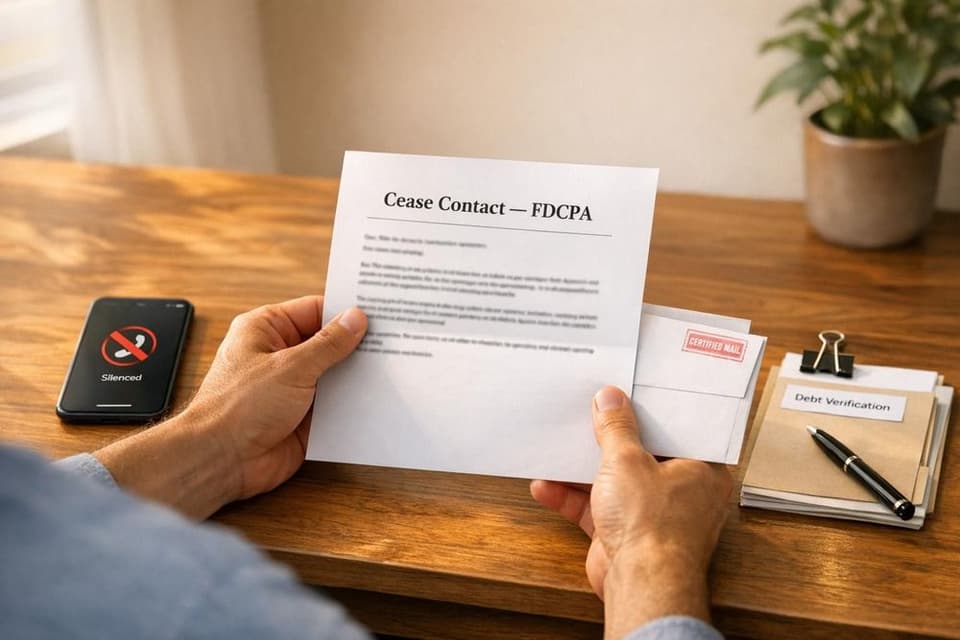
The Fair Debt Collection Practices Act (FDCPA) protects consumers from abusive, misleading, and unethical debt collection practices. It applies to personal debts like credit cards, medical bills, and mortgages, but excludes business debts. Debt collectors must follow strict rules, including:
- No harassment: Limited to 7 calls in 7 days about a specific debt.
- Truthful communication: No false claims or threats.
- Debt validation: Must provide a notice within 5 days of first contact, detailing the debt and consumer rights.
- Communication limits: Calls only between 8 a.m. and 9 p.m., no workplace calls if prohibited, and no public social media posts about debts.
- Consumer rights: Consumers can dispute debts or stop communication in writing.
Violations can result in fines up to $1,000 per case or $500,000 in class actions. The law is enforced by the CFPB and FTC. Compliance is critical for debt collectors to avoid penalties and maintain ethical practices.
The Fair Debt Collection Practices Act - Explained
Fair Debt Collection Practices Act
Core Provisions of the FDCPA
FDCPA Prohibited Practices and Penalties Guide
FDCPA Prohibited Practices and Penalties Guide
The Fair Debt Collection Practices Act (FDCPA) sets clear boundaries for debt collectors, prohibiting harassment, false claims, and unfair tactics.
Prohibited Practices: Harassment, False Statements, and Unfair Acts
Under 15 U.S.C. § 1692d, debt collectors are forbidden from engaging in behavior that could harass, oppress, or abuse individuals:
"A debt collector may not engage in any conduct the natural consequence of which is to harass, oppress, or abuse any person in connection with the collection of a debt."
This includes excessive phone calls - collectors are limited to a maximum of 7 calls within 7 days about a specific debt and must wait 7 days after a phone conversation before calling again.
False or misleading representations, as outlined in 15 U.S.C. § 1692e, prevent collectors from using deceptive tactics:
"A debt collector may not use any false, deceptive, or misleading representation or means in connection with the collection of any debt."
Unfair practices, under 15 U.S.C. § 1692f, ban unethical methods like charging unauthorized fees, depositing postdated checks early, threatening illegal repossession, or using postcards that compromise privacy.
| Category | Examples of Prohibited Practices |
|---|---|
| Harassment | Excessive calls (7+ in 7 days), obscene language, threats of violence, anonymous calls |
| False Statements | Pretending to be law enforcement, misrepresenting the debt amount, fake legal documents, threats of arrest |
| Unfair Acts | Unauthorized fees, early deposit of postdated checks, illegal repossession threats |
Violations can lead to financial penalties. Individuals may recover up to $1,000 in statutory damages per case, while class actions can result in fines reaching $500,000 or 1% of the collector's net worth.
The FDCPA also ensures consumers' rights through debt validation procedures.
Debt Validation and Consumer Rights
Debt collectors are required to provide a validation notice within five days of their first communication with a consumer, unless the information was already disclosed. This notice must include the total debt amount, the current creditor's name, and inform the consumer of their 30-day right to dispute the debt in writing.
Under Regulation F, the notice must also break down the debt into components (e.g., interest, fees, payments, and credits) and may use the Consumer Financial Protection Bureau's (CFPB) model form for compliance.
"The FDCPA provides debtors with a means for challenging payoff demands, and for determining the validity and accuracy of asserted debts." - Cornell Law School
If a consumer disputes the debt or requests information about the original creditor in writing within 30 days, the collector must pause all collection efforts until they provide verification or the requested details:
"Any collection activities and communication during the 30‑day period may not overshadow or be inconsistent with the disclosure of the consumer's right to dispute the debt."
The notice must include a tear-off dispute form with pre-written options (e.g., "This is not my debt") to help consumers exercise their rights. Collectors can presume the notice is received five business days after it’s sent, excluding weekends and federal holidays.
Clear communication rules further shape how collectors interact with consumers.
Communication Rules for Debt Collectors
The FDCPA regulates when, where, and how collectors can contact consumers. Calls are generally allowed only between 8:00 a.m. and 9:00 p.m. local time:
"In the absence of knowledge of circumstances to the contrary, a debt collector shall assume that the convenient time for communicating with a consumer is after 8 o'clock antemeridian and before 9 o'clock postmeridian, local time at the consumer's location."
Collectors cannot call consumers at their workplace if they know such communication is prohibited. If a consumer has legal representation and the collector is aware of the attorney’s contact details, all communication must go through the attorney.
Third-party contact is limited to gathering location information, such as an address or phone number. Collectors must avoid disclosing that the consumer owes a debt and can only identify their employer if explicitly asked.
Consumers can stop all communication by notifying the collector in writing. After such a request, the collector may only confirm communication has ceased or inform the consumer of legal actions being taken.
Digital communication rules under Regulation F address modern interactions. Collectors must provide a simple opt-out option for messages sent via email or text. While private messages on social media are allowed (unless the consumer opts out), public postings about debts are strictly forbidden.
| Communication Channel | FDCPA / Regulation F Guidelines |
|---|---|
| Telephone | Limited to 8 a.m.–9 p.m.; prohibited if deemed "inconvenient" |
| Workplace | Banned if the employer prohibits personal calls |
| Social Media | Public posts are banned; private messages must include opt-out options |
| Email & Text | Allowed if they offer a clear opt-out method |
| Third Parties | Contact allowed only for location details |
| Postcards | Prohibited for any debt-related communication |
Additionally, collectors must provide a Mini-Miranda notice during their initial contact with consumers.
These rules are crucial for maintaining ethical practices in the debt collection industry and impact both debt buyers and sellers.
FDCPA Compliance Requirements for Debt Buyers and Sellers
Debt buyers are considered debt collectors under the FDCPA if their primary business involves debt collection or if they regularly collect debts owed to others. This classification means they must follow the same strict rules as traditional collection agencies, including compliance with Regulation F, which clarifies communication methods and required disclosures.
Key requirements include notifying consumers and waiting 14 days before reporting debts to credit bureaus. Additionally, debt buyers cannot initiate or threaten legal action for debts that are past the statute of limitations.
The FDCPA allows a "bona fide error" defense for unintentional violations, provided the collector has written procedures designed to prevent such errors. To avoid penalties, debt buyers must maintain comprehensive documentation and systems. Violations can result in statutory damages of up to $1,000 per individual or up to $500,000 (or 1% of the collector’s net worth) in class action cases. These responsibilities demand strong internal compliance controls, which are explored further below.
Building Internal Compliance Programs
A strong Compliance Management System (CMS) is essential for debt buyers and sellers. It should include tools for managing consumer complaints, communication, information sharing, and dispute resolution. The CFPB's Debt Collection Examination Procedures provide a useful framework, broken into seven modules that cover everything from business models to litigation practices.
| CFPB Examination Module | Compliance Focus |
|---|---|
| Module 1 | Business model and overall compliance management |
| Module 2 | Communication practices (time, place, frequency, and medium) |
| Module 3 | Information sharing and privacy (e.g., credit bureau interactions) |
| Module 4 | Validation notices, dispute handling, and ceasing communication |
| Module 5 | Payment processing and account maintenance |
| Module 7 | Litigation practices and managing time-barred debts |
Internal systems should ensure that validation notices are sent during the initial contact or within five days, meeting disclosure requirements. Using the CFPB's model validation notice template helps meet standards for providing debt details like the amount owed, creditor name, and dispute rights.
Programs must also track call attempts, limiting them to no more than seven within a seven-day period for a single debt. After speaking with a consumer, collectors must wait at least seven days before calling again. Additionally, systems should enforce a mandatory 14-day waiting period after mailing a validation notice before reporting the debt to credit bureaus. Collection activities must halt immediately upon receiving a written dispute until the debt is verified, and debts past the statute of limitations must be flagged to prevent improper legal action.
Technology can play a critical role in reinforcing these compliance measures.
Using Technology for FDCPA Compliance
Automation simplifies compliance efforts and reduces the workload for staff. For instance, call tracking systems ensure adherence to the "7-in-7" rule, while time-zone sensitive dialers ensure calls are only made between 8:00 a.m. and 9:00 p.m. local time.
Automated tools can also generate validation notices, ensuring all mandatory disclosures are sent within five days of first contact. These systems help maintain consistent documentation for Regulation F’s record-keeping requirements.
For electronic communications, platforms should include features like automated opt-out options and tracking of consumer preferences to honor requests to stop emails, texts, or social media messages. Some collectors use pre-recorded voicemail technology to deliver limited-content messages (LCMs), which are designed to avoid third-party disclosure risks.
"A limited-content message is an 'attempt to communicate' but is not a 'communication' under the Debt Collection Rule because it does not convey information regarding a debt directly or indirectly to a person." – Consumer Financial Protection Bureau
Secure platforms like Debexpert can further support compliance by offering encrypted file-sharing for sensitive data during portfolio transfers. Real-time communication features also help debt buyers and sellers coordinate compliance efforts and maintain audit trails for regulatory purposes.
Other tools, like "scrubbing" software, can identify consumers represented by attorneys or those who have submitted "cease communication" requests, ensuring all direct contact is stopped immediately. Automated systems can also flag accounts where negative credit information has reached its seven-year reporting limit, ensuring compliance with reporting guidelines.
| Compliance Requirement | Technology Solution | FDCPA/Reg F Standard |
|---|---|---|
| Call Frequency | Automated Call Tracking | Max 7 calls in 7 days |
| Call Timing | Time-zone Dialers | 8:00 a.m. – 9:00 p.m. local time |
| Debt Validation | Notice Automation | Send within 5 days of contact |
| Consumer Privacy | LCM Templates | Prevent third-party disclosures |
| Opt-out Rights | Preference Management Tools | Honor consumer opt-outs |
Common FDCPA Violations and Prevention Strategies
Even with well-designed compliance systems, debt buyers and sellers can sometimes make mistakes that lead to violations. Understanding where these errors commonly occur allows organizations to better protect consumers and avoid hefty penalties.
Examples of FDCPA Violations in Debt Trading
Communication mistakes are some of the most frequent issues. For example, calling a consumer outside the permitted hours - before 8:00 a.m. or after 9:00 p.m. in their local time zone - violates §805 of the FDCPA. Similarly, continuing to call someone at work after being told their employer forbids such calls is another common error. Exceeding the seven-call limit in seven days or contacting during the mandatory waiting period can lead to claims of harassment under §806.
False or misleading statements under §807 often involve misstating the debt amount, pretending to be an attorney or government official, or threatening legal action that isn’t legally possible. For instance, threatening to sue over a time-barred debt (one outside the statute of limitations) is strictly prohibited. Such actions can result in penalties of up to $1,000 per violation for individuals or as much as $500,000 - or 1% of the collector’s net worth - in class action cases.
Validation errors occur when collectors fail to send a proper validation notice within five days of initial contact or continue collection efforts on a disputed debt without first providing verification. These actions violate §809.
Third-party disclosure violations happen when a debt collector discusses a consumer’s debt with unauthorized individuals, such as friends or family. Collectors are only allowed to contact third parties for "location information" and cannot disclose that the consumer owes a debt. Such breaches can lead to privacy complaints and additional penalties.
Here’s a quick breakdown of common violations:
| Violation Category | Common Mistake | FDCPA Section | Penalty Range |
|---|---|---|---|
| Communication | Calling outside permitted hours | §805 | Up to $1,000 per violation |
| Harassment | Exceeding 7 calls in 7 days | §806 | Up to $1,000 per violation |
| False Statements | Threatening legal action on time-barred debt | §807 | Up to $500,000 in class actions |
| Validation | Collecting during the dispute window | §809 | Up to $1,000 per violation |
| Unfair Practices | Adding unauthorized fees | §808 | Up to $1,000 per violation |
These examples underscore the importance of following FDCPA rules carefully. To help avoid these pitfalls, organizations can adopt several proactive strategies.
Best Practices for Avoiding Violations
Preventing violations starts with extending your internal compliance efforts into everyday operations.
Send accurate validation notices quickly. Use the CFPB model form to ensure all required details - like the debt amount, creditor name, and dispute rights - are included and sent within five days of first contact. The model form also provides a "safe harbor" against liability for validation-related errors.
Honor attorney representation immediately. Once it’s clear a consumer has legal representation, stop all direct contact and communicate only through their attorney. A robust database that flags such accounts can help prevent accidental violations.
Cease contact after receiving a written request. If a consumer submits a written cease-contact request, halt all communication except to acknowledge the request or notify them of specific legal actions. Proper documentation and system-wide tracking of these requests are essential.
Verify lawsuit eligibility before threatening legal action. Confirm that debts are not time-barred under state law before initiating or threatening a lawsuit. Flagging these accounts in your system can help avoid costly mistakes.
Rely on the "bona fide error" defense. Maintain written procedures designed to prevent errors. If a mistake occurs, this defense can protect your organization - provided you can prove the error was unintentional and your procedures were reasonable.
"A debt collector may not be held liable in any action brought under this subchapter if the debt collector shows by a preponderance of evidence that the violation was not intentional and resulted from a bona fide error notwithstanding the maintenance of procedures reasonably adapted to avoid any such error." – 15 U.S.C. § 1692k
Track call frequency carefully. Automated systems can help ensure call limits are not exceeded and time-zone restrictions are followed. Features like time-zone-sensitive dialers are especially useful for staying within the allowed calling hours.
Handle disputes promptly. If a consumer disputes a debt within 30 days, stop all collection activity until you verify the debt and mail the verification to the consumer. Ignoring this requirement can lead to statutory damages and legal fees.
Provide opt-out options for electronic communications. When using email or text messages, include a simple way for consumers to opt out of future contact. Ensure these preferences are recorded and respected across all communication channels.
Conclusion
The Fair Debt Collection Practices Act (FDCPA) serves as the backbone for ethical and responsible debt collection. Following its guidelines not only shields your business from legal pitfalls - like civil liabilities of up to $1,000 per violation or $500,000 in class actions - but also ensures long-term business stability.
The FDCPA’s mission is clear: to stamp out abusive practices while protecting ethical debt collectors from being undercut by unscrupulous competitors. Sticking to the rules - like providing validation notices within five days, limiting communication to the hours of 8:00 a.m. to 9:00 p.m., and honoring cease-contact requests - creates a foundation for lasting success and avoids the risks of costly legal disputes.
"It is the purpose of this subchapter to eliminate abusive debt collection practices by debt collectors, to insure that those debt collectors who refrain from using abusive debt collection practices are not competitively disadvantaged." – Fair Debt Collection Practices Act, Section 802
Strong compliance programs, advanced tools for tracking calls, and meticulous recordkeeping are essential components of staying on the right side of the law. These measures not only help meet regulatory standards but also uphold the integrity of the industry. The "bona fide error" defense offers some protection for accidental violations - but only if your business has well-documented procedures in place to prevent such errors. And with the Consumer Financial Protection Bureau overseeing debt collectors earning over $10 million annually - covering roughly 60% of the industry - regulatory scrutiny is a reality that can’t be ignored.
FDCPA compliance is about more than just avoiding penalties. By treating consumers with respect, verifying debts before pursuing them, and honoring their rights, you foster trust and professionalism. This approach not only safeguards your reputation but also lays the groundwork for a thriving, ethical business.
FAQs
Does the FDCPA apply to original creditors or only third-party collectors?
The Fair Debt Collection Practices Act (FDCPA) specifically governs the actions of third-party debt collectors. It does not extend its rules or protections to original creditors. This difference is key to identifying which entities fall under the act's regulations and which do not.
What should I do if I think a debt is wrong or not mine?
If you think a debt is inaccurate or doesn’t belong to you, you have the right to dispute it in writing with the debt collector. Ask for debt validation, which requires them to provide evidence that the debt is yours and that they are authorized to collect it. According to the FDCPA, they must send a validation notice within five days of their initial contact. Additionally, you can send a written request asking them to stop contacting you.
How can debt buyers prove FDCPA compliance during audits or lawsuits?
Debt buyers can show compliance with the FDCPA by keeping detailed records of their collection efforts. This includes maintaining communication logs, copies of debt validation notices, and proof that they’ve followed legal obligations, such as sending required disclosures or honoring cease communication requests. Conducting regular internal audits and compliance reviews also helps ensure they’re following the rules. Additionally, having documented policies and training materials in place highlights their commitment to meeting FDCPA standards and prepares them for potential audits or legal challenges.
