

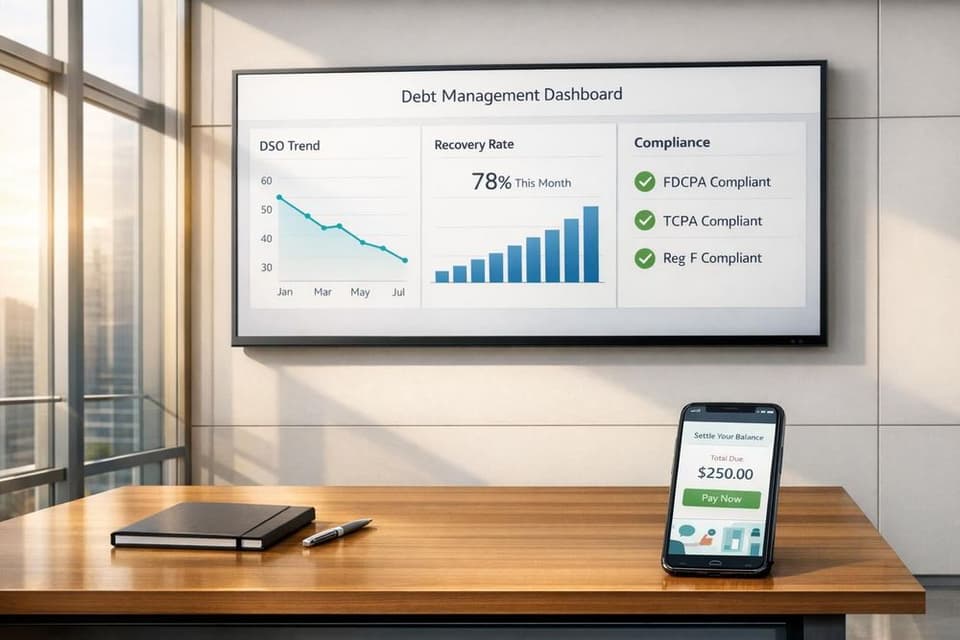
Managing debt effectively requires automation, data-driven insights, and strict compliance with regulations. Modern debt management systems centralize debtor information, streamline workflows, and ensure adherence to laws like FDCPA and TCPA. With U.S. consumer debt reaching $16.84 trillion in 2023, these tools are indispensable for creditors, buyers, and collectors.
Key features include:
- Automation: AI-powered workflows prioritize high-risk accounts, reducing manual tasks by up to 85%.
- Segmentation: Smart scoring identifies accounts likely to pay, enabling targeted strategies.
- Compliance: Automated safeguards enforce quiet hours, track consent, and maintain audit trails.
- Self-Service Portals: Borrowers can resolve debts independently, improving payment rates.
- Dashboards: Real-time analytics help optimize recovery efforts and monitor compliance.
These systems cut costs by 40–60%, enhance recovery rates by 10–15%, and reduce Days Sales Outstanding by 20%. Additionally, platforms like Debexpert simplify debt portfolio trading with auction tools and secure communication. Implementing these technologies not only boosts efficiency but also ensures ethical and regulatory compliance.
Debt Management System Benefits: Cost Savings, Recovery Rates & Efficiency Gains
Debt Management System Benefits: Cost Savings, Recovery Rates & Efficiency Gains
Loan management software EarlyResolution by Luxoft
Luxoft
Core Features of Debt Management and Collection Systems
Debt management systems are built around three key pillars: automation, segmentation, and real-time visibility. Together, these features streamline manual processes, improve targeting accuracy, and ensure compliance throughout the debt collection process.
Automated Workflows and Process Optimization
Automation removes repetitive tasks and ensures processes run smoothly and consistently. For example, AI-powered worklists automatically rank accounts by risk scores (on a scale of 0–100) and payment likelihood, allowing collectors to focus on accounts that matter most . Omnichannel dunning sequences automate communication - emails, SMS, and voice calls - triggered by the age of delinquency. Features like "Smart Send" adjust delivery times for better engagement, with text messages often outperforming email in response rates .
Self-service portals empower debtors to check balances, set up payment plans, and resolve debts anytime, without needing agent assistance. This reduces friction and speeds up resolutions . Additionally, RPA bots handle tasks like uploading invoices to AP portals (e.g., Ariba, Coupa) and tracking payments in real time, eliminating the need for manual logins. Compliance is baked into these systems, with "compliance-as-code" features that enforce rules like FDCPA, TCPA, and Regulation F, ensuring proper contact limits and required disclosures.
Customer Segmentation and Scoring
Smart segmentation ensures resources are directed where they'll have the most impact. AI analyzes over 100 variables - such as credit history, payment habits, and account age - to identify high-priority accounts. Propensity-to-pay scoring categorizes customers into groups like "Can't Pay" or "Won't Pay", tailoring intervention strategies accordingly.
Some platforms even identify "self-cure" accounts, where customers are likely to pay without intervention, saving time and effort. Behavioral science adds another layer, assessing not just a debtor's ability to pay but also their willingness, enabling highly personalized outreach. Dynamic worklists pair accounts with collectors based on their skills or past success with similar cases, further refining the process.
"AI-powered debt collection software stands apart from simple solutions through smart prioritization. Modern systems tap into the potential of artificial intelligence to identify urgent accounts first, so teams focus their efforts on where they'll make the biggest impact." - C&R Software
These segmentation tools are complemented by dashboards that provide a clear view of performance and actionable insights.
Dashboards and Reporting Tools
Real-time dashboards offer a detailed look into portfolio performance and compliance. They track recovery rates, highlight trends, and allow teams to adjust strategies on the fly without downtime . Audit trails and session logs provide a secure, tamper-proof record of actions like clicks, views, and payment attempts, which is crucial for audits and ensuring transparency .
Portfolio analytics dive deeper with vintage reports, roll rates by bucket, and netback views, helping executives make informed, long-term decisions . Compliance tools monitor communication frequency, enforce quiet hours, and manage consent or opt-out preferences automatically . Agent performance metrics - like right-party contact rates, promise-kept rates, and average handle time - help managers coach their teams and refine processes.
With these advanced reporting tools, teams can save time while gaining the insights needed to make smarter decisions.
Building an Effective Debt Collection Process
Creating a strong debt collection process means combining efficiency, adaptability, and strict adherence to regulations. For buyers, sellers, and portfolio managers, these elements directly influence better recovery rates and greater operational control. The key lies in using automated workflows, seamless integrations, and compliance-focused safeguards to establish an end-to-end system that truly delivers.
Customizable Workflows and Integrations
The best workflows are designed to act automatically based on specific triggers, like when an account becomes overdue by 7 or 14 days, a payment agreement is broken, or an account status changes. For instance, introducing a multi-channel messaging approach with customer segmentation and self-service portals has been shown to increase cash recovery in the first quarter.
Modern debt collection platforms often feature low-code environments, enabling teams to tweak rules or messaging without needing IT support. These automated systems can cut Days Sales Outstanding (DSO) by as much as 20% and triple team productivity. Low-code tools and REST APIs also allow seamless integration with CRM and accounting software, reducing manual work and speeding up cash application updates. Companies leveraging AI-driven workflows have reported up to an 80% improvement in servicing efficiency.
"Collections live outside the core Loan Servicing Software... Agents spend time re-keying notes and chasing broken promises." – LendFoundry
Web-Based Access and User Experience
Accessibility plays a huge role in modern debt collection. Cloud-based platforms allow teams to access tools from anywhere, eliminating the need for local software installations. This is a game-changer for remote teams and organizations with multiple locations. Collectors can log in through a browser to view live dashboards, update account notes, and process payments - all from one central interface.
Self-service portals further enhance the experience by letting customers manage their balances and payment plans on their own. A mobile-first design ensures these portals work smoothly on smartphones, making it easier for customers to engage on the go.
Compliance and Regulatory Adaptation
Compliance is non-negotiable in collections. Advanced systems enforce rules like Regulation F, which limits collectors to no more than seven calls about a specific debt within seven consecutive days. Automated safeguards also block calls outside the legal timeframes of 8:00 a.m. to 9:00 p.m. local time.
Electronic communications require extra care, with every email or text message including an opt-out option, and systems tracking consent across all channels. Validation notices, such as the Itemization Table, must be sent within five days of the first communication to comply with FDCPA standards. Comprehensive audit trails that log every interaction - complete with timestamps, user IDs, and content - are essential for regulatory audits and legal defense.
"Compliance is at the heart of every collections operation. A modern collections platform should empower teams to implement and maintain practices that support alignment with key U.S. laws and standards." – CGI
Role-based access control (RBAC) ensures sensitive data is only accessible to authorized personnel, while compliance blocks prevent unauthorized actions. Automated systems also handle "cease and desist" requests by flagging accounts and halting all outreach as soon as a written refusal or communication block is logged.
Using Debexpert for Debt Portfolio Trading
Debexpert
Debexpert simplifies debt trading for portfolio managers, buyers, and sellers by offering flexible auction formats, real-time insights, and secure communication tools. The platform supports English, Dutch, Sealed-bid, and Hybrid auctions. The Hybrid format stands out by combining elements of the other three, aiming to achieve the best possible returns. Sellers can quickly list portfolios and set up auctions through an intuitive dashboard, while the "My Pools" dashboard provides detailed analytics on sales and buyer behavior. These tools help sellers fine-tune their strategies and improve portfolio performance.
Portfolio Analytics and Auction Setup
Debexpert offers real-time tracking during auction setups, giving sellers valuable insights into buyer interest. Metrics like views, masked file downloads, and bidding activity help sellers gauge market demand before auctions close. Additionally, Debexpert's experienced team - boasting over 100 years of combined expertise - provides portfolio valuations and market insights to help sellers set realistic price expectations tailored to each auction. With hundreds of vetted debt buyers on the platform, every listing benefits from healthy competition.
| Auction Type | Description | Key Benefit |
|---|---|---|
| English | Standard ascending-bid auction | Encourages competitive bidding to increase prices |
| Dutch | Descending-price auction | Promotes quick sales by starting at a high price |
| Sealed-bid | Hidden bids submitted simultaneously | Avoids bidder influence and ensures fairness |
| Hybrid | Mix of English, Dutch, and Sealed-bid features | Offers flexibility to achieve optimal pricing |
By combining these auction formats with robust analytics, Debexpert provides a streamlined trading experience.
Secure Communication and Real-Time Notifications
Debexpert prioritizes secure communication through end-to-end encrypted messaging and file sharing, ensuring sensitive discussions and document exchanges remain private. Buyers can access masked files and media samples to conduct initial evaluations before requesting full data access. Push notifications keep users updated on critical events, like being outbid or the launch of new auctions, allowing them to respond instantly from anywhere.
"Our platform is also a mobile app, which is a great convenience because you can get notified in real-time if you have to change your bid, if someone outbids you, or even if a new auction starts" – Daniel Bloomgarden, Account Manager at Debexpert
Support for Various Debt Types
Debexpert accommodates a wide range of debt portfolios, including consumer debt, auto loans, and real estate notes - whether performing or non-performing. The platform integrates Data Tree reports for title checks, making due diligence faster and more efficient. Buyers can set up custom alerts for specific debt types, like auto loans or medical bills, ensuring they’re notified the moment relevant portfolios are listed. All features, from portfolio analytics to secure messaging, are accessible on both desktop and mobile, offering users a seamless experience.
Improving Collection Results While Following Regulations
Boosting recovery rates while adhering to strict legal requirements is no easy task. However, modern technology is making it possible for debt collection teams to achieve this balance. Tools like AI-driven analytics, omnichannel communication, and automated compliance frameworks are helping agencies focus on high-priority accounts, engage borrowers through their preferred channels, and ensure adherence to laws such as the Fair Debt Collection Practices Act (FDCPA) and CFPB Regulation F.
AI-Driven Analytics for Better Insights
AI-powered systems are transforming how collection teams operate. By analyzing historical payment data, machine learning models can score accounts based on their likelihood to pay and potential recovery value. This allows teams to focus their efforts on accounts with the highest return potential, while automating interactions with lower-priority accounts.
Advanced platforms go beyond simple demographics by identifying delinquency archetypes, which help predict both a borrower's ability and willingness to pay. These insights lead to more efficient account prioritization and improved recovery rates. In fact, AI-driven platforms have been shown to increase recovery rates by 10% to 20%, while boosting collector productivity by an impressive 30%.
The demand for these tools is growing rapidly, with the AI debt collection software market expected to expand from $3.34 billion in 2024 to $15.9 billion by 2034.
"AI is not replacing collectors - it's empowering them. From precision targeting to compliance confidence, AI is the future of collections." – Sedric AI
Omnichannel Communication for Enhanced Engagement
Reaching borrowers through multiple channels - like SMS, email, phone calls, web portals, and mobile app notifications - is proving to be a game-changer. Companies that excel in omnichannel engagement retain 89% of their customers, compared to only 33% for those with weak strategies.
Self-service web portals are especially effective, allowing borrowers to check balances and set up payment plans anytime, which leads to more completed payments. Push notifications offer a low-pressure way to guide customers to payment platforms, while machine learning optimizes the timing and channel of communications for maximum impact. These personalized approaches can result in up to 2x higher recovery rates and 3-5x better response rates.
Interestingly, 80% of customers in digital-first collection environments prefer managing their accounts independently using web apps, highlighting the growing importance of digital tools.
"Companies with omnichannel customer engagement strategies retain on average 89% of their customers compared to 33% of retention rates for companies with weak omnichannel strategies." – Laura Burrows, Experian
Regulatory Compliance Frameworks
Staying compliant with regulations like the FDCPA is a top priority for collection agencies, and modern platforms are stepping in to make this process seamless. These systems automatically track communication frequency, enforce "quiet hours" based on time zones, and manage consent requirements without manual intervention.
From generating legally required debt validation notices to blocking outreach on time-barred debts, automated compliance features significantly reduce the risk of violations. They also streamline operations, cutting manual agent interactions by 60-85% while ensuring every action meets federal and state regulations.
| Compliance Feature | Regulatory Alignment | Practical Functionality |
|---|---|---|
| Frequency Caps | FDCPA / Regulation F | Limits calls and messages to seven per week |
| Electronic Opt-Outs | Regulation F | Tracks and honors "STOP" keywords for SMS and unsubscribe links for emails |
| Validation Automation | FDCPA Section 809 | Sends required debt validation notices with itemized balances |
| Time-Barred Debt Blocking | Regulation F | Prevents legal action on accounts past the statute of limitations |
| Consent Management | TCPA / Regulation F | Maintains a tamper-evident audit trail of consumer consent |
| Quiet Hour Enforcement | FDCPA "Convenient Time" | Blocks outreach during restricted hours based on zip code/time zone |
Other tools, like third-party address verification, help ensure accurate borrower information. For example, solutions like TrueTrace have improved right-party contact (RPC) rates by 10%, reducing errors and ensuring outreach reaches the correct individuals.
Tools and Technologies for Portfolio Managers
Portfolio managers rely on technology to gain instant insights into performance, streamline decision-making, and engage borrowers through their preferred communication channels. The right tools minimize manual effort and enhance efficiency across the board.
Real-Time Performance Tracking and Reporting
Centralized dashboards provide managers with real-time metrics, such as cash flow trends, Days Sales Outstanding (DSO), and collector productivity, enabling swift adjustments to resource allocation.
These systems integrate data from over 600 accounts payable portals and ERP systems using RPA bots and APIs, eliminating the need for manual data entry. For example, a global debt management platform currently manages more than $8 trillion in active accounts, showcasing the scale and reliability of such tools. Additionally, machine learning-driven predictive risk scoring analyzes payment behaviors to forecast delinquency, reducing past-due invoices by 20% and increasing team productivity by 30% for organizations leveraging AI-powered platforms.
"Real time analytics help us predict outcomes and optimize every step in the recovery process." – Head of Recovery, Top 5 Bank, Central Europe
This real-time insight paves the way for understanding how automation transforms traditionally manual processes.
Automation vs. Manual Processes
Automation is revolutionizing debt management, replacing manual processes that depend on human intuition with data-driven workflows. Automated systems ensure consistency and efficiency across accounts, reshaping how teams operate.
| Feature | Manual Processes | Automated Systems |
|---|---|---|
| Efficiency | Time-intensive repetitive tasks | 30% boost in team productivity |
| Prioritization | Relies on agent judgment | AI-ranked worklists based on 20+ factors |
| Visibility | Limited insights; siloed data | Real-time KPI tracking on centralized dashboards |
| Error Rates | Higher risk of mistakes | Reduced errors through ERP/API integration |
| Scalability | Requires more staff as workload grows | Handles increased volume without added headcount |
| Customer Experience | Inconsistent follow-ups | Optimized, personalized outreach |
Automation delivers cost savings of 40-60% while improving recovery rates by 10-15% by ensuring high-priority accounts receive timely attention. About 60% of collections cases are resolved through automated re-debiting, freeing agents to focus on more complex negotiations. These systems can also reduce DSO by up to 20%, accelerating cash flow without increasing staff.
Mobile and Customer Portal Access
Mobile and web-based portals enhance convenience for borrowers while providing managers with valuable engagement data. Borrowers can check balances, view payment history, and set up payment plans anytime, without needing to contact an agent.
Mobile-optimized portals include features like "Pay Now" links in SMS or email communications, allowing borrowers to settle payments instantly before they reconsider. Tools like payment calculators and flexible plan options further encourage successful payment completion.
Data from these portals - such as login activity, payment selections, and completion rates - feeds directly into portfolio dashboards. This real-time behavioral insight helps refine collection strategies, reducing the need for agent involvement by 60-85%. With fewer routine interactions, collection teams can focus on high-value accounts that require a personalized approach.
Conclusion: Key Takeaways for Optimal Debt Management
Automated debt management systems are changing the game by combining automation, compliance, and data-driven strategies. These systems deliver impressive results, including a 10x ROI, with recovery rates increasing by 10-15% and operational costs dropping by 40-60%. The secret lies in replacing manual, labor-intensive processes with intelligent systems that handle routine tasks, allowing teams to focus on more complex, high-value accounts.
Compliance is non-negotiable. Automated systems are designed with built-in safeguards that ensure adherence to FDCPA, TCPA, and Regulation F standards. Features like quiet hour enforcement, contact frequency limits, and consent tracking operate automatically, reducing the risk of costly violations. With audit trails for every interaction, these systems provide a "compliance-by-code" approach, eliminating human error and enhancing accountability.
The rise of omnichannel, self-service options is also reshaping the customer experience. Borrowers can now resolve debts on their own terms through mobile portals and digital payment tools. These features significantly reduce the need for agent involvement - by as much as 60-85% - while improving payment completion rates. For example, in 2025, Shell Group recovered an additional $650,000 within just seven months by implementing automated debt management solutions. During this time, card payments nearly doubled, accounting for 40% of total transactions, as customers embraced self-service tools.
"The best collection strategies leverage technology to help customers overcome financial challenges while preserving relationships and fostering long-term loyalty."
Beyond automation, predictive analytics and performance tracking are empowering portfolio managers and debt traders. Platforms like Debexpert simplify the buying and selling of debt portfolios with tools for analytics, auction management, and secure communication. AI-driven scoring helps pinpoint accounts that need immediate attention versus those likely to self-cure through automated outreach.
These advancements don’t just streamline operations - they prepare organizations to tackle the enormous U.S. consumer debt market, valued at $16.84 trillion. Success hinges on constant refinement. Pilot programs, data cleansing before migration, and regular KPI reviews are essential for fine-tuning communication strategies. By adopting these practices, businesses can navigate debt recovery more efficiently while upholding ethical and compliant operations.
FAQs
How do I choose the right debt management system for my portfolio size?
When choosing a debt management system, consider the size and complexity of your portfolio. For smaller portfolios, straightforward tools that help track interest payments and maturity dates are often enough. However, larger portfolios demand more advanced solutions, such as systems offering real-time analytics, automation, and compliance features. Align the system’s functionality with your portfolio’s requirements to manage it effectively and improve overall performance.
What data is required for accurate AI scoring and segmentation?
To get accurate AI scoring and segmentation, you need a mix of key data points like payment history, account behavior, demographic details, and credit risk factors. These elements work together to ensure a precise analysis and efficient categorization.
How can I prove FDCPA/TCPA/Reg F compliance during an audit?
To stay compliant with FDCPA, TCPA, or Regulation F during an audit, it's crucial to keep thorough records of all debt collection communications. This includes call logs, messages, and disclosures, ensuring they meet the rules around content, frequency, and timing. Automated systems can be a big help here, as they allow you to track and review communications efficiently.
Don't forget to keep your policies, training records, and audit trails up-to-date as well. Regular internal audits can also go a long way in showing you're prepared and adhering to the necessary regulations. These steps not only help with compliance but also ensure you're ready for any formal examination.
