

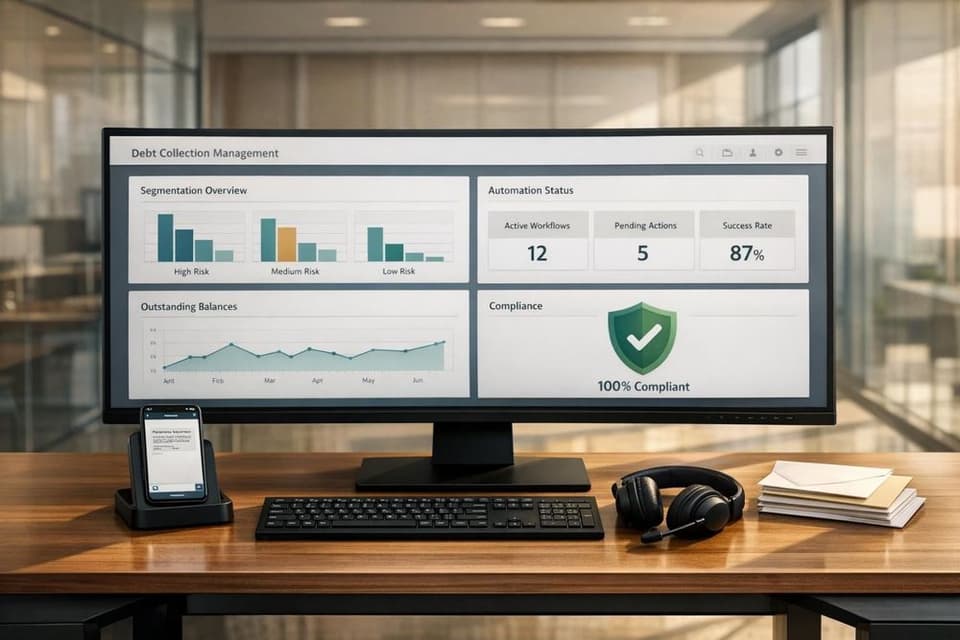
Debt collection management is about recovering overdue funds while maintaining compliance and efficiency. With U.S. household debt exceeding $18 trillion in Q3 2025, financial institutions face rising challenges. Effective strategies combine data analytics, automation, and personalized communication to boost recovery rates, reduce costs, and improve customer retention.
Key Takeaways:
- Recovery Rates: On average, only 20% of delinquent accounts are recovered.
- Digital Tools: Automation and digital outreach improve payment likelihood by 30% and cut collection costs by 15%.
- Compliance: Adhering to laws like FDCPA and Regulation F is critical to avoiding legal risks.
- Segmentation: Data-driven segmentation prioritizes accounts with the highest recovery potential.
- Software: Modern platforms streamline operations, automate compliance, and enhance communication.
To succeed, organizations must integrate AI-driven tools, maintain accurate data, and focus on empathetic communication. These methods not only improve recovery rates but also safeguard long-term customer relationships.
Debt Collection Management: Key Statistics and Recovery Rates
Debt Collection Management: Key Statistics and Recovery Rates
Debt Collection Strategies for a Digital-First Era with Brian Bowers of Financial Recovery Services
Financial Recovery Services
The Debt Collection Process: Step-by-Step
Debt collection follows a structured process that evolves as accounts age, aiming to recover funds effectively while keeping costs in check. This journey starts even before an invoice becomes overdue and can extend to external methods or selling off debt portfolios. Knowing these steps equips businesses to allocate resources wisely and decide when to escalate - or step away.
Accounts that are 1–15 days past due generally respond to gentle reminders, while the odds of recovery drop significantly after 90 days of delinquency. At this point, external methods like third-party agencies, legal action, or portfolio sales often become necessary. The average age of debt in collections is 3.5 years, highlighting the importance of acting quickly. This phased approach forms the backbone of effective internal collection strategies.
By using data-driven segmentation, businesses can move away from a one-size-fits-all approach. Predictive analytics identify accounts most likely to pay, allowing teams to focus their efforts where they'll have the greatest impact. For example, in September 2025, Terrace Finance partnered with NeuroID and Experian to integrate behavioral analytics into its fraud and debt prevention strategy. This system identified a coordinated fraud attempt within hours, enabling a faster response than traditional methods and safeguarding its network of 5,000 merchants and lenders.
Internal Collections and First-Party Contact
The internal collection process begins with gentle outreach during the first 15 days of delinquency. Automated emails sent at specific intervals - such as 7 days before the due date and 1 day after - paired with friendly phone calls, can help resolve minor oversights or temporary cash flow issues. These early efforts are effective: 73% of customers contacted through digital channels make at least partial payments, compared to 50% via traditional phone calls.
If these initial steps don't work, the tone of communication shifts as accounts move into the 16–45 day range. Friendly reminders give way to formal letters and assertive phone calls focusing on resolution. This phase often introduces payment plans or settlements, offering flexibility to recover some portion of the debt rather than risking a total loss. Between 46–90 days, final demand letters are sent, and negotiations become more urgent to avoid the need for external intervention.
During this stage, maintaining accurate data is critical. Skip-tracing tools ensure contact details are up-to-date and help identify special statuses like bankruptcy or active military service, ensuring compliance. Additionally, keeping a detailed audit trail of all interactions, disputes, and agreements is essential if the account transitions to external collections.
Moving to External Collection Methods
When internal efforts fail, the next step is external collections. Accounts that remain delinquent for extended periods are often handed over to third-party agencies or legal counsel. Recovery rates on delinquent accounts average around 20%, so it's important to weigh the costs of external methods - like agency fees or legal expenses - against potential returns. Before escalating, ensure all electronic communications comply with Regulation F, including clear opt-out notices, to minimize legal risks.
Modern debt recovery software has shown impressive results, boosting recovery rates by 10–15% and cutting operational costs by 40–60% compared to traditional methods. Third-party agencies bring expertise and often use more aggressive tactics such as credit reporting, lawsuits, wage garnishments, or asset seizures. However, these methods can affect your brand's reputation, so choosing partners whose practices align with your standards is crucial. Maintaining a unified communication history across all channels - SMS, email, or voice - ensures third-party agencies have full context and prevents conflicting messages. If external efforts fall short, selling the debt portfolio becomes the final option.
Selling Non-Performing Debt Portfolios
When all recovery options are exhausted, selling the debt portfolio can provide a way to recoup some losses. This approach is often used for accounts like credit cards, auto deficiencies, personal loans, and small business loans with personal guarantees. However, selling small-dollar medical debt, student loans, or high-APR debt is usually avoided due to heightened sensitivity and regulatory challenges.
Debt sales can deliver immediate financial benefits, such as a 10% profit increase, but they come with ongoing responsibilities. Sellers must be prepared for post-sale obligations like handling media requests, managing buy-backs, and supporting litigation.
"Sellers should seek someone experienced, with a proven track record of building long lasting relationships and who will protect their brand".
Approach the sale process like a procurement exercise. Conduct due diligence on potential buyers, evaluating their IT security, handling of personal data, use of AI, and dispute resolution methods. Onsite or virtual reviews can provide valuable insights into their operations. Setting clear governance terms upfront - such as audit schedules and performance penalties - helps ensure protections remain in place after the sale. As of Q1 2022, Americans owed $178 billion in debt, up 24% from $144 billion in Q1 2021.
Using Data to Segment and Prioritize Debt Portfolios
Data-driven segmentation has transformed how teams prioritize debt portfolios, moving away from outdated "first-in, first-out" methods. By focusing on factors like balance size, payment history, and behavioral patterns, collection efforts can target accounts with the highest recovery potential. For instance, a $50,000 commercial loan overdue by 60 days demands a vastly different approach than a $300 consumer credit card balance that's been delinquent for 120 days. This shift allows teams to allocate resources more effectively, focusing on accounts that promise the best returns.
The results speak for themselves. Predictive scoring models have shown to deliver 1.53× to 1.70× higher recovery amounts compared to random assignment. This isn't just about efficiency - it's about aligning efforts with financial outcomes. By identifying which accounts are most likely to pay and when, teams can avoid wasting time on low-probability cases and focus on those with higher recovery potential.
Categorizing Debts by Account Characteristics
Effective segmentation begins with grouping accounts into meaningful categories. Balance size plays a critical role - high-value accounts often justify manual attention, while smaller ones respond well to automated outreach. Account age and delinquency stage also matter. Early-stage accounts (1–15 days past due) may only need a gentle nudge, while accounts over 90 days delinquent often require more aggressive tactics or external intervention. Payment history provides further insight: a debtor who has paid consistently in the past but recently stopped may be facing temporary hardship, while habitual late payers may need a different strategy.
Behavioral data fine-tunes these groupings. For example, understanding how a debtor prefers to communicate - be it SMS, email, or phone - can significantly enhance engagement. Interestingly, 56% of consumers with low credit scores and balances under $1,000 prefer email contact, while only 18% prefer phone calls. Compliance factors, such as bankruptcy status, active military service, or deceased flags, must also be considered to ensure adherence to regulations.
| Segmentation Model | Primary Use Case | Key Benefit |
|---|---|---|
| Stage-Based | Delinquency/Recovery stage | Avoids premature escalation of early-stage debt |
| Value-Based | Balance size / Expected value | Focuses manual effort on high-impact financial returns |
| Behavior-Based | Responsiveness / Engagement | Adjusts strategy based on consumer behavior |
| Channel-Based | Preferred communication method | Boosts engagement while minimizing "contact fatigue" |
| Compliance-Sensitive | Disputes / Regulatory constraints | Ensures adherence to legal and regulatory rules |
It's important to avoid over-segmentation. Creating too many categories can lead to operational inefficiencies and confusion. Start with a few high-impact segments, like high-value accounts with a strong likelihood of recovery, and expand only when the process is stable. Regularly refresh segmentation criteria - at least quarterly - to adapt to changes in economic conditions or portfolio composition.
Using Predictive Analytics to Assess Recovery Probability
Predictive analytics adds another layer of precision by estimating which accounts are most likely to pay and when. These models use historical payment trends, behavioral data, and alternative metrics to provide insights far beyond traditional credit scores. Key scoring types include:
- Payment Likelihood: Identifies who is most likely to pay.
- Payment Timing: Determines the best time to contact.
- Channel Responsiveness: Suggests the most effective communication method.
- Plan Adherence: Predicts who will stick to payment plans.
One of the most valuable applications of predictive analytics is identifying "self-cure" accounts - those likely to resolve without intervention. By routing these accounts to automated self-service options, agents can focus on high-value cases that require negotiation. In early-stage collections, about 80% of customers typically "cure" within 30 days, making it essential to distinguish between accounts needing minimal effort and those requiring more intensive follow-up.
"You can't get blood from a stone... with a scoring strategy, you can establish your 'hit list' and find the most attractive accounts to collect on." - Paul Desaulniers, Experian
Behavioral triggers further enhance prioritization by monitoring life events that might signal a debtor's improved ability to pay. For example, new employment, recent credit inquiries, or professional licenses can indicate a shift in financial stability. Advanced skip-tracing and data verification tools can improve right-party contact rates by 10%, ensuring teams reach the correct individuals at the right time.
The true value of predictive scores lies in their integration with workflows. A score sitting unused in a spreadsheet won't drive results. Instead, it should trigger specific actions, such as tailored contact strategies or escalation paths. Limit manual overrides to well-documented exceptions, as these can undermine consistency and create compliance risks. Regularly reassess scoring models - at least quarterly - to ensure they remain accurate in light of evolving consumer behaviors and economic trends. These insights lay the groundwork for selecting the right tools and software to support advanced collection strategies.
Software and Tools for Debt Collection
Using advanced software is a natural step for modernizing debt collection strategies. Today’s debt recovery platforms streamline operations by automating repetitive tasks like uploading invoices, sending payment reminders, logging calls, and tracking payment commitments. This automation allows collectors to dedicate their time to high-priority cases while routine tasks run on autopilot. It's not just about saving time - it's about focusing human effort where it matters most.
A key feature of these tools is AI-powered prioritization. Machine learning assigns a "propensity-to-pay" score (on a scale of 0–100) to each account, ranking them based on factors like payment history, balance size, and behavioral trends. This real-time ranking system replaces outdated methods like alphabetical or simple balance-based sorting. For instance, one case study highlighted a system that doubled collection efficiency and cut Days Sales Outstanding (DSO) by nearly 50%. Another example showed a 26% drop in DSO through automation that handled 98% of payments, freeing up teams to engage directly with customers.
Multi-channel communication is another must-have. Effective platforms let collectors reach customers via SMS, email, voice calls, and self-service portals, ensuring outreach aligns with customer preferences. Self-service portals, in particular, are a game-changer - 92% of customers prefer them. These portals provide 24/7 access for debtors to check balances, set up payment plans, and make payments without needing to interact with an agent.
Compliance is non-negotiable in debt collection. Modern software helps ensure adherence to regulations like FDCPA, TCPA, and Regulation F by automating communication limits, quiet hours, and required disclosures. These systems also maintain detailed audit trails, reducing regulatory risks and offering protection in case of disputes. By automating these safeguards, collectors can focus on resolving accounts while staying compliant.
What to Look for in Collection Software
When evaluating collection software, focus on features that enhance intelligence, communication, operations, compliance, and technical integration:
- Intelligence: AI-driven prioritization, predictive risk scoring, and behavioral analysis to assess a debtor's likelihood of paying.
- Communication: Omnichannel outreach tools (SMS, email, voice) with features like automated email creation and chatbots for real-time assistance.
- Operations: Tools like self-service portals, automated workflows, and dispute management systems that address issues proactively.
- Compliance: Built-in audit trails, role-based access controls, and automated enforcement of regulatory rules.
- Technical Integration: API compatibility with existing systems (like CRM and billing), cloud-based scalability, and low-code configuration for easy updates.
Security is also critical. Look for certifications like PCI-DSS for payment security, ISO 27001 for data management, and SOC 2 for overall data protection. A user-friendly interface is equally important - features like WCAG-compliant accessibility and role-specific customization ensure the platform works well for all users, from agents to supervisors.
Pricing models vary widely. Options include per-user, per-month fees, volume-based pricing tied to account or transaction numbers, and tiered subscriptions offering different features at varying price points. Some platforms even offer contingency-based pricing, starting at 5%. To evaluate ROI, consider the total cost of ownership, including software fees, implementation expenses, and internal resource allocation.
How to Implement Collection Software Successfully
A phased approach ensures smooth implementation. Start with a pilot program targeting a small account segment to test workflows and messaging before scaling up. For example, one company saw significant benefits by testing AI-driven prioritization on a limited scale before rolling it out company-wide. Another study reported a 33-day reduction in DSO and tripled productivity within the first year of implementation.
Data quality is crucial. Before migrating to a new system, audit, clean, and standardize data, including addresses, consent tags, and dispute flags. Poor data can create more problems than it solves. Seamless integration with ERP systems is also essential for maintaining accurate records of payment history and credit limits. Modern platforms should support real-time data exchange through robust APIs like GraphQL or REST.
Change management plays a pivotal role. Secure executive support early and provide thorough training to ensure staff adoption. Continuous improvement is key - use feedback loops, A/B testing, and performance benchmarking to refine strategies over time. For example, testing different message tones or dunning strategies in "Simulate Mode" can help optimize results before full deployment. Most organizations see a positive ROI within 6 to 18 months of implementation.
Define success metrics upfront. Establish baselines for recovery rates, cost per cure, and DSO. Track key performance indicators like Call Success Rate, Promise-to-Pay Rate, and Agent Utilization Rate to measure progress and identify areas for improvement. With the right software and a well-thought-out implementation process, collection teams can shift from reactive problem-solving to proactive account management.
Recovery Techniques and Negotiation Methods
Building on data-driven segmentation and digital outreach strategies, successful recovery depends on understanding debtors' circumstances and working together to create practical solutions.
Communicating with Debtors Effectively
Every negotiation should begin with professionalism and respect. The tone you set in your opening can shape the entire conversation. For example:
"We'd like to discuss options for bringing your account current in a way that works for both sides." – Retrievables
Empathy plays a key role in these discussions. Laura Burrows from Experian emphasizes this approach:
"Teaching your call center agents to use empathy-based communication techniques and work as a partner with consumers to find a viable payment plan... can help you build trust and improve customer lifetime value."
Acknowledging the debtor's challenges can also build trust. For example:
"We understand cash flow has been tight for many businesses this quarter. Let's create a schedule that gives you space to recover while ensuring consistent progress on the balance." – Retrievables
Reaching out through the debtor's preferred communication channels is equally important. Data shows that 73% of customers contacted via digital channels make at least a partial payment, compared to only 50% when traditional methods are used.
Open-ended questions can encourage honest dialogue and realistic planning. For example:
"What payment schedule feels sustainable for your business right now?"
For commercial accounts, requesting documents like sales forecasts or cash flow statements can help verify financial capacity. This type of empathetic and transparent communication sets the stage for building repayment plans that work for both parties.
Structuring Payment Plans and Settlement Offers
When creating payment plans, ensure all terms are clearly documented. Include details like the total debt, payment schedule, deadlines, and consequences of default. Written agreements - preferably on company letterhead - help avoid misunderstandings and provide a reference for both sides.
Before entering negotiations, establish your minimum acceptable terms. Knowing the lowest acceptable payment or longest allowable timeline prevents hasty decisions during discussions. For debtors able to pay, offering a lump-sum settlement of 25%–50% can be a practical way to close accounts quickly.
Creating urgency can also motivate action. Limited-time incentives - such as waiving fees, offering loyalty credits, or discounts for payments within 24 to 48 hours - can prompt immediate responses. A well-structured payment plan appeals to 76% of consumers. Additionally, offering flexible payment options like digital wallets, ACH transfers, or self-service portals makes it easier for debtors to follow through.
Once a plan is in place, monitor compliance closely. Send reminders before due dates and follow up quickly on missed payments to prevent small issues from escalating. For debtors facing temporary setbacks, automated systems that track positive financial changes - such as new employment or credit lines - can signal the right time to re-engage. These strategies help turn uncertain debts into steady cash flow while maintaining professionalism and rapport.
Staying Compliant and Managing Legal Risks
Creating a strong legal framework is just as important as improving recovery rates in debt portfolio management. A well-structured recovery strategy ensures compliance with laws like the FDCPA and Regulation F, safeguarding against potential legal issues. Since 2008, financial institutions in the U.S. have faced over $243 billion in fines due to compliance violations, while compliance-related costs have risen by 60% in recent years.
For instance, the "7-in-7 rule" limits collectors to seven calls about a specific debt within seven days and requires a seven-day gap after each call [40,45]. Communication is restricted to the hours of 8:00 a.m. to 9:00 p.m. local time. Collectors must also provide validation details within five days of initial contact, including the debt amount, creditor's name, and notice of the consumer's 30-day right to dispute the debt. If a consumer submits a written request to stop communication, collectors must comply, except for notifications about specific legal actions.
Non-compliance can lead to severe penalties. Consumers can sue for FDCPA violations, potentially recovering actual damages and statutory damages of up to $1,000. For class actions, recovery is capped at the lesser of $500,000 or 1% of the debt collector's net worth. Additionally, collectors are required to retain records of all collection activities for three years after the last activity on a debt. With modern software automating routine tasks, the focus has shifted to embedding compliance into every operational process.
Using Automation to Maintain Compliance
Relying on manual processes increases the risk of human error. Automated systems, on the other hand, integrate legal requirements directly into workflows, ensuring compliance without depending on agents' memory. These systems handle critical rules like the 7-in-7 guideline, state-specific communication hours, and licensing restrictions.
AI-driven tools have proven effective, reducing compliance violations in debt collection by 40% and achieving compliance pass rates as high as 99.91% on some platforms. Automation ensures timely delivery of mandatory disclosures - like the "Mini-Miranda" and model validation notices - across digital channels. Real-time consent tracking prevents TCPA violations by updating communication preferences immediately when debtors opt out. For text messages, consent must be re-obtained every 60 days.
Natural Language Processing (NLP) adds another layer of precision by identifying stress signals or hardship claims, such as "I lost my job", and escalating these cases to human agents for appropriate handling. As Kompato AI explains:
"Automation is a structural shift in how recovery work gets done. Organizations that successfully automate debt collections will be those that treat compliance as architecture and consumer experience as a performance driver."
Automated platforms also log every interaction with timestamps and disclosure records, providing regulators with clear, audit-ready evidence. Explainable AI (XAI) further simplifies audits by clarifying the reasoning behind specific actions, reducing the burden of regulatory reviews.
Verifying Third-Party Partners and Vendors
Compliance doesn’t stop with internal processes - it extends to third-party partners as well. If one of your vendors fails to comply with regulations, your organization could be held accountable. To avoid this risk, regularly check the FTC's list of banned debt collectors and verify that all partners are properly licensed and in good standing.
Before finalizing any agreements, request up-to-date proof of licensing, insurance, and compliance certifications. Contracts should include clauses for regular audits and immediate termination if violations occur. Monitor vendor performance by reviewing complaint rates, regulatory actions, and consumer feedback.
Document every step of your due diligence process, including license verifications, audit results, and any corrective actions taken. This documentation demonstrates that you’ve taken reasonable steps to ensure compliance, which can protect your organization if a vendor’s actions are later called into question. By working exclusively with verified and ethical partners, you minimize legal risks while maintaining the integrity of your operations.
Integrating Debt Portfolio Trading Platforms
Trading platforms have become a practical solution for liquidating non-performing debt portfolios, complementing both internal and external collection strategies. When internal recovery efforts hit their limits, selling these portfolios offers a way to recover capital efficiently. These platforms connect sellers with vetted buyers in a secure auction setting, streamlining the entire process - from valuation to closing - without the need to manage individual buyer relationships.
Debexpert is one such platform, serving as an online marketplace that links sellers with a network of over 1,000 investors across the U.S. who actively purchase debt portfolios. The platform handles everything, from portfolio analytics to transferring files post-sale, significantly reducing the manual workload. Sellers can list portfolios of various types, such as unsecured installment loans or judgments, while buyers participate in structured auctions that often conclude in under an hour.
This shift toward platform-based debt sales aligns with changing market dynamics. With rising delinquencies, liquidating non-performing accounts in secondary markets provides immediate liquidity, removing the costs of prolonged internal recovery efforts. Platforms like Debexpert simplify the process and integrate easily into broader collection strategies.
How Debexpert Supports Portfolio Management
Debexpert starts the process by analyzing the portfolio, offering valuation insights based on extensive industry experience. This ensures sellers have realistic price expectations before launching their portfolio. Sellers can choose from four auction formats: English (ascending bids), Dutch (descending price), Sealed-bid (private offers), or Hybrid (a mix of formats). This tailored approach aligns with best practices for maximizing recovery while maintaining compliance.
Once the auction is live, the platform markets the portfolio to its vetted buyer network. Sellers can monitor activity in real time via a dashboard or mobile app, tracking file downloads, buyer inquiries, and bid placements. All communication is encrypted, and file sharing meets strict security standards.
In September 2022, Sergi Omar, Managing Director at CheapCars, shared his experience using Debexpert for auctioning non-performing loans. He stated:
"They helped us with some npl auctions... and not only were they incredibly knowledgeable and easy to work with, but they also... were able to exceed them [expectations] by two and a half times."
Similarly, in March 2023, Andy, CFO of Asbury Management Group, Inc., highlighted the platform's ability to provide "numerous buyers" and secure "top dollar" through the support of a dedicated account representative.
After an auction concludes, Debexpert’s post-sale CRM handles contract execution using standardized templates and ensures secure account file transfers. This system ensures smooth documentation and fulfillment of obligations, making it easier for sellers to manage their portfolios effectively.
Choosing the Right Debexpert Plan
Debexpert provides its services to sellers without charging any fees, making the platform accessible regardless of portfolio size. Sellers benefit from features like portfolio analytics, auction setup, access to vetted buyers, encrypted file sharing, and post-sale support - all at no cost. Buyers can register for free to browse portfolios, view masked files, and receive notifications about matching investment opportunities.
| User Type | Cost | Key Features |
|---|---|---|
| Seller | $0 | Portfolio analytics, auction setup (English, Dutch, Sealed-bid, Hybrid), access to 1,000+ vetted investors, encrypted file sharing, real-time tracking, and CRM support |
| Buyer | Free Access | Browse masked files, real-time notifications, encrypted communication, full auction access |
The platform is trusted by over 300 companies worldwide and more than 500 Buy Here Pay Here dealers, lenders, and financial institutions. For instance, in February 2026, a lender successfully sold a $904,000 portfolio of unsecured installment loans in Texas through the marketplace. Similarly, in January 2026, a $1.05 million Nevada judgment with 18% post-judgment interest was listed, showcasing Debexpert’s ability to handle high-value, specialized debt portfolios.
Measuring and Improving Collection Performance
Managing collection efforts without clear metrics is like navigating without a map - you won't know what's working, what's wasting resources, or where to direct your focus.
Key Metrics for Collection Operations
The right metrics validate both how effectively you're recovering debt and how efficiently your operations are running. Start with the recovery rate, which measures the percentage of delinquent debt collected. The industry average sits around 20%. Another critical metric is cost per dollar collected, which determines whether your recovery efforts are financially worthwhile. Modern collection software can boost recovery rates by 10-15% while cutting operational costs by 40-60%.
Resolution time is another key factor - it tracks how quickly you settle accounts, from initial contact to final payment. Faster resolutions mean better cash flow and lower costs. Meanwhile, the re-default rate identifies how often customers fail to stick to their payment plans, offering insight into whether your terms are realistic for debtors.
For digital channels, two metrics stand out. The Right Party Contact (RPC) rate measures how often you're reaching the actual debtor, while self-service engagement rates show how many customers prefer handling payments on their own. One example: a UK credit card provider discovered that 90% of customers who opened an SMS logged into their self-service portal, and 50% of them went on to schedule a payment. This kind of data helps you invest in channels that drive real results.
"We've found that clients who implement structured scorecards report higher satisfaction with their collection partnerships. The scorecard isn't just for measuring their agencies - it's creating the blueprint for a better working relationship". - Charles Allen, US Client Solutions Director at InDebted
Methods for Ongoing Performance Improvement
These metrics lay the groundwork for refining your approach over time. The first step? Controlled testing. Compare your current methods (the "champion") against new strategies (the "challengers"). Experiment with different communication channels, timing, and messaging to see what works best for specific account types.
Another essential practice is maintaining data hygiene.
"Bad data in, bad data out". - Jackie Sullivan, former Senior Program Manager at Bridgeforce
Duplicate records, errors, and irrelevant information can derail your analysis and lead to poor decisions. Clean data ensures that your strategies are both effective and compliant.
A great case study comes from Multi Service Fuel Card, which adopted Tratta's self-service payment tools in February 2026. Over seven months, the company nearly doubled its debit card payments to 40% of total collections and recovered an additional $650,000 in debt. The success came from reducing friction - customers could make payments immediately, without waiting for callbacks or dealing with mailed forms.
When reviewing strategies, focus on behavioral segmentation rather than grouping accounts solely by balance. Classify accounts based on repayment intent and engagement patterns. This allows you to assign experienced agents to high-value, complex cases while automating routine follow-ups. The result? Higher recovery rates with lower costs.
Finally, AI-driven personalization can transform your results. By analyzing millions of potential strategies, AI identifies the most effective approaches to maximize recovery while minimizing costs and maintaining customer relationships. These tools can double recovery rates and increase response rates by three to five times. With this kind of innovation, collection teams can continuously improve their methods and outcomes.
Conclusion
Effective debt collection management brings together technology, compliance, and customer relationships into a unified strategy. By adopting approaches like data-driven segmentation, omnichannel engagement, and AI-powered messaging - as highlighted in this guide - organizations can achieve better recovery rates and operational efficiency. For instance, modern debt recovery software has been shown to boost recovery rates by 10–15% while cutting operational costs by 40–60%. However, these improvements hinge on having clean, reliable data and a commitment to ongoing optimization.
The shift from aggressive phone campaigns to digital-first strategies has proven that precision outperforms sheer volume in debt recovery. Considering that 75% of Americans ignore calls from unknown numbers, relying solely on traditional dialing methods wastes resources. On the other hand, teams that embrace digital communication channels often see higher recovery rates and build stronger customer loyalty. This approach not only enhances immediate results but also safeguards long-term customer relationships.
Maintaining strict regulatory compliance is another cornerstone of effective debt collection. Automated tools that enforce contact limits and provide audit trails allow teams to focus on complex negotiations rather than manual tracking. With the CFPB increasing its scrutiny of collection practices, automated compliance measures are becoming essential for avoiding fines and protecting organizational reputations.
Debt collection strategies must evolve continuously. Shifting market conditions, changing consumer behaviors, and new regulations require organizations to stay agile. By establishing feedback loops - such as reviewing dashboards weekly, piloting new strategies, and using real-time data to make adjustments - companies can stay ahead. Whether it’s implementing behavioral segmentation, incorporating open banking data, or offering flexible payment options through digital wallets, treating your strategy as a dynamic process ensures steady improvement with each interaction.
The strategies discussed here provide a clear path to building a collection operation that balances efficiency with empathy, automation with human judgment, and short-term recovery with long-term customer value. To get started, focus on targeted changes that deliver measurable results. For example, you might begin by cleaning up your data or testing an omnichannel strategy on a small group of accounts. Success often favors those who adapt, experiment, and continuously refine their approach.
FAQs
When should I move an account from internal to external collections?
Deciding the right time to escalate an account often hinges on how overdue the payments are and how successful internal collection efforts have been. Generally, accounts are handed off when payments remain outstanding after a specific timeframe or after several failed attempts to contact the customer. Many businesses establish clear benchmarks - like 60 or 90 days past due - to guide this process. It’s also important to weigh factors like compliance with regulations, the cost of resources involved, and the importance of preserving customer relationships when making this call.
How do I choose the best channel (SMS, email, or phone) for each debtor?
When choosing the right communication channel, it's essential to think about what the debtor might prefer. Often, their preferences can be guessed based on previous interactions or demographic insights. For less pressing matters, digital options like SMS or email tend to work well, especially for initial contact. On the other hand, phone calls are better suited for situations that are urgent or require a more personal touch. Using a mix of these methods - an omnichannel approach - can help increase engagement and improve the chances of successful recovery.
What’s the fastest way to reduce compliance risk in my collection workflows?
The fastest way to reduce compliance risk in your collection processes is by leveraging automated compliance screening tools. These tools help ensure that all communications align with regulatory requirements by continuously monitoring interactions and delivering real-time insights. By integrating these solutions, you can simplify compliance management and minimize the likelihood of mistakes.
