

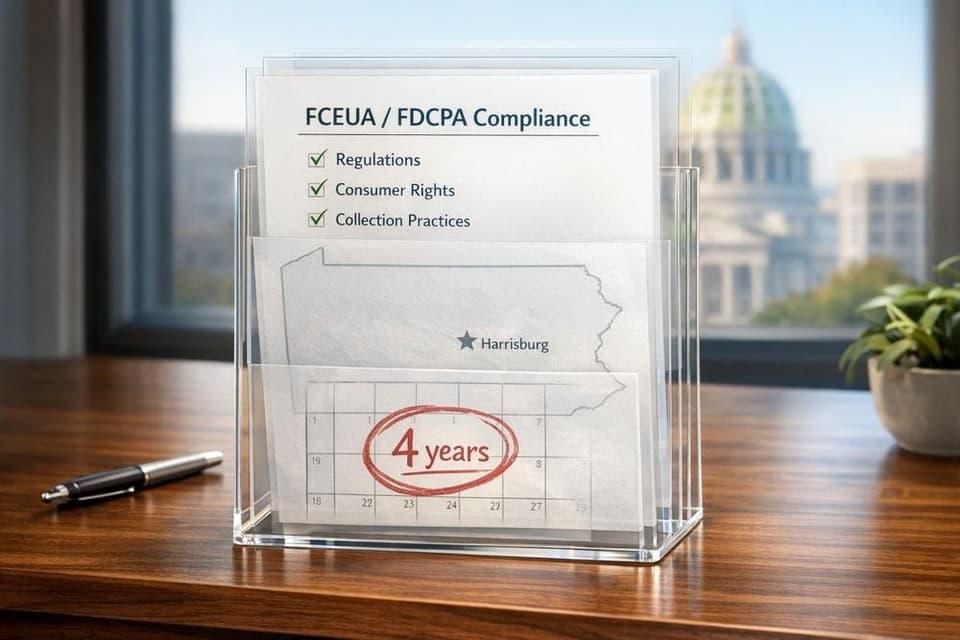
Debt collection in Pennsylvania involves navigating both federal and state-specific laws. Agencies handle unpaid debts, ranging from credit cards to taxes, either as representatives or by purchasing debt portfolios. Key regulations include:
- Federal FDCPA: Governs third-party debt collectors nationwide.
- Pennsylvania FCEUA: Extends rules to original creditors and prohibits wage garnishment, except for taxes, child support, or student loans.
- Statute of Limitations: Most consumer debts have a 4-year limit for legal action.
- Licensing: General collection agencies don’t need a state license, but debt management services must be licensed and bonded.
Agencies like Aargon, IC System, and First Credit Services operate in Pennsylvania, offering specialized services for various industries. Technology-driven platforms, such as Debexpert, streamline debt portfolio trading while ensuring compliance with state laws. Compliance with both federal and state regulations is critical when selecting a debt collection partner.
Statute of Limitations on Debt in PA
Pennsylvania Debt Collection Laws and Regulations
Pennsylvania Debt Collection Licensing Requirements: General Agencies vs Debt Management Services
Pennsylvania Debt Collection Licensing Requirements: General Agencies vs Debt Management Services
Grasping the legal rules surrounding debt collection in Pennsylvania is key to managing debt portfolios effectively and ensuring compliance during recovery efforts.
Fair Debt Collection Practices Act (FDCPA) in Pennsylvania
In Pennsylvania, the FDCPA is enforced through the Fair Credit Extension Uniformity Act (FCEUA). According to 73 Pa. Cons. Stat. Ann. §2270.4, any violation of the FDCPA automatically counts as a breach of state law. Unlike federal law, the FCEUA applies not only to collection agencies but also to original creditors.
"The Pennsylvania law applies both to creditors (the person or company you actually owe money to) and to collection agencies... The federal law applies only to collection agencies." - Pennsylvania Legal Aid Network
Violations of these laws can lead to enforcement under Pennsylvania's Unfair Trade Practices and Consumer Protection Law, which allows for statutory damages, attorney fees, and even triple-damage awards. Consumers who win lawsuits may receive up to $1,000 in statutory damages, along with attorney fees and other costs.
Pennsylvania offers consumers 2 years to file lawsuits for collection violations, doubling the 1-year limit set by federal FDCPA rules. Collectors must follow strict guidelines, such as avoiding contact before 8:00 AM or after 9:00 PM, refraining from using postcards, and ceasing workplace calls if the employer prohibits them. They are also forbidden from using obscene language, threatening violence, impersonating attorneys or government officials, or making false legal threats.
Licensing and Bonding Requirements
Pennsylvania does not require general debt collection agencies to hold a state license or post a bond.
"Pennsylvania does not require debt collectors or collection agencies to be licensed in the state." - Holly Johnson, ConsumerAffairs
However, businesses offering Debt Management Services (handling consumer funds to pay creditors) or Debt Settlement Services (negotiating reductions in debt) must obtain a license through the Pennsylvania Department of Banking and Securities. This process is managed via the Nationwide Multistate Licensing System (NMLS). These services also require a $5,000 surety bond, and licenses must be renewed annually by September 30.
| Requirement | General Collection Agency | Debt Management/Settlement Service |
|---|---|---|
| State License | Not Required | Required (via NMLS) |
| Surety Bond | Not Required | $5,000 |
| Regulatory Body | Attorney General | Dept. of Banking and Securities |
| Renewal Frequency | N/A | Annual (by 9/30) |
Even without general licensing requirements, all debt collectors must adhere to the FCEUA. Failing to obtain specific licenses when required could result in fines or being prohibited from operating in Pennsylvania.
Consumer Protection Rules
Pennsylvania enforces comprehensive consumer protections. The statute of limitations for most consumer debts - such as credit cards, written contracts, oral agreements, and promissory notes - is 4 years. After this period, collectors cannot sue to recover the debt, though they may still attempt other collection methods. However, any payment or promise to pay can reset the statute of limitations.
Consumers have 30 days to dispute a debt after receiving notice. Once a dispute is submitted in writing, the collector must halt all collection activities until the debt is verified in writing. Additionally, consumers can issue a written "cease and desist" letter to stop further communication. While this doesn't erase the debt, it may lead to legal action.
Debt collectors cannot engage in certain practices, including:
- Collecting amounts not authorized by the original agreement
- Discussing the debt with third parties (except to locate the debtor)
- Simulating court documents
- Threatening arrest
- Using profane language
The legal interest rate and judgment interest rate in Pennsylvania are both capped at 6%. For bad checks, collectors can demand triple damages up to $500 or $100, whichever is greater, after requesting payment.
Consumers can report violations to the Pennsylvania Office of Attorney General by calling 1-800-441-2555. Documenting illegal practices provides the foundation for pursuing legal action under both state and federal laws.
Debt Collection Agencies Operating in Pennsylvania
This section highlights key debt collection agencies working within Pennsylvania, reflecting the state's regulatory landscape. Both national firms and specialized providers operate here, offering businesses a range of options to align their debt recovery strategies with the right partner.
Agencies by Debt Type
Different agencies cater to specific types of debt, leveraging their expertise and technology to address unique needs.
Aargon Agency, Inc. has been active in Pennsylvania since 1996, with over 25 years of experience and six offices across North America. They focus on high-volume call center recovery and first-party billing services, handling debts in sectors like utilities, medical, telecom, real estate, hospitality, retail, banking, and finance.
IC System serves key areas such as Philadelphia and Pittsburgh, providing tailored programs for healthcare, manufacturing, energy, and small businesses. This family-owned agency, with 85 years of experience, boasts a 95% consumer satisfaction rate based on post-call surveys. Their InstiCollect platform is designed for small businesses managing fewer than 50 debts monthly. It charges a 35% contingency fee for recoveries within the first 180 days, which increases to 50% afterward, along with a $75 setup fee.
First Credit Services (FCS) operates in hubs like Harrisburg, Scranton, Allentown, and Erie. They specialize in automotive finance, fintech, government, health and fitness, and commercial lending debts. FCS handles over 29 million calls annually, utilizing AI-driven "Contact Optimization" engines and omnichannel platforms (OmniXp and EngageRight) to identify the best contact times and methods. Additionally, the Pennsylvania Department of Revenue partners with private collection agencies to recover non-filed returns and overdue state taxes when internal efforts fall short.
Debt collection agencies increasingly emphasize compliance and ethical practices to protect their clients' reputations. Many now use omnichannel communication tools, enabling consumers to interact via SMS, email, and chatbots, reducing reliance on traditional phone calls. Below is a closer look at the specialties and technological tools of these agencies.
Agency Profiles
| Agency | Primary Specializations | Technology/Feature |
|---|---|---|
| Aargon Agency | Utilities, Medical, Telecom, Real Estate, Hospitality, Retail, Banking, Finance | 24/7 Online Account Information & Proprietary Software |
| IC System | Healthcare, Manufacturing, Energy, Small Business | Recovery Plus (Two-Phase Letter/Collection Program) |
| First Credit Services | Automotive Finance, Fintech, Government, Health & Fitness, Commercial Lending | OmniXp (Omnichannel Platform) & EngageRight (AI) |
IC System’s Recovery Plus program uses a two-phase approach. The first phase relies on a letters-only strategy, allowing businesses to retain 100% of recovered funds for a flat fee. Accounts that remain unresolved move to a contingency-based collections phase.
"We have used your service for many, many years and I must say that anytime I had to call for assistance, I have always had a courteous and professional agent to help me. Keep up the excellent customer service you provide!" – Locker Room Storage, Inc.
When choosing a debt collection agency, businesses should ensure compliance with the federal Fair Debt Collection Practices Act (FDCPA) and Pennsylvania-specific laws, such as the Fair Credit Extension Uniformity Act.
How to Choose a Debt Collection Agency
What to Look for in an Agency
Start by ensuring the agency complies with both federal and Pennsylvania laws. Pennsylvania’s Fair Credit Extension Uniformity Act (FCEUA) goes beyond the federal FDCPA by regulating not just third-party agencies but also original creditors. While the state doesn’t require licensing or bonding for general collection agencies, agencies handling commercial (B2B) debt should ideally be certified by the Commercial Collection Agency Association (CCAA). This certification requires a minimum $300,000 surety bond and at least four years of experience.
Pennsylvania law imposes stricter limits than federal rules in several areas. For instance, agencies can only contact a consumer once per week about a specific debt, and they’re barred from using public-facing social media or employer-provided email to reach debtors. Before hiring an agency, confirm they monitor call frequency and follow clear communication policies to avoid legal missteps. Also, ensure they honor Pennsylvania’s four-year statute of limitations on most consumer debts.
Pay close attention to the agency’s fee structure. Pennsylvania caps the legal interest rate on debt and judgments at 6%, and agencies can only collect amounts authorized by the original agreement or permitted by law. Collecting unauthorized fees is a third-degree misdemeanor in the state.
"It is unlawful for a collection agency to appear for or represent a creditor in any manner whatsoever, but a collection agency... may bring legal action on claims assigned to it... if the agency appears by an attorney." - 18 Pa. Cons. Stat. Ann. § 7311
Keep in mind that collection agencies in Pennsylvania cannot directly represent creditors in court; they must work through licensed attorneys to pursue legal action on assigned claims.
Finally, evaluate whether an agency’s expertise and service model align with the specific needs of your debt portfolio.
Matching Agencies to Your Debt Portfolio
Different types of debt require specialized knowledge. For commercial (B2B) debt, prioritize agencies affiliated with organizations like the CCAA or the Commercial Law League of America (CLLA). These memberships ensure agencies meet high ethical standards and maintain separate trust accounts for creditor funds. The CCAA, for example, mandates that at least 80% of an agency’s business be commercial.
Consider the agency’s industry focus. Some specialize in sectors like healthcare, manufacturing, or energy, while others target automotive finance, fintech, or government debt. If your portfolio involves 50 or fewer debts per month, look for agencies that offer "no minimum" account requirements and simple online setup.
For real estate-related debt, make sure the agency understands Pennsylvania’s FCEUA exclusions. While purchase-money mortgages on real estate aren’t covered, home equity loans are. Also, remember the state’s four-year limitation for most consumer debts, such as medical or credit card debt. Choose an agency that’s well-versed in the specific rules governing your debt type.
Once you’ve identified an agency suited to your portfolio, it’s time to explore how technology can enhance the recovery process.
Using Technology to Find and Work with Agencies
After aligning an agency with your portfolio, assess their technological capabilities to optimize recovery efforts. Cloud-based platforms like AKUVO provide real-time data insights, automation, and third-party integrations to streamline operations. In August 2025, Pennsylvania’s $9 billion PSECU credit union adopted AKUVO’s platform to modernize collections for nearly 600,000 members, focusing on efficiency and maximizing recoveries.
"It's especially meaningful to work with forward-thinking institutions like PSECU, who recognize that technology - and member expectations - have evolved." - Steve Castagna, Chief Revenue Officer, AKUVO
Look for agencies using omnichannel communication tools that let debtors choose their preferred contact methods, such as SMS, email, chatbots, or secure online portals, instead of relying solely on phone calls. For example, First Credit Services uses its EngageRight machine learning engine and OmniXp platform to increase reach and recovery rates. By February 2026, the agency was managing over 29 million annual calls with AI-driven strategies to optimize outreach.
Agencies with compliance management systems and real-time speech analytics can monitor collector communications to ensure adherence to Pennsylvania and federal regulations. Additionally, client portals offering 24/7 visibility into collection activities and recovery metrics are invaluable. Ensure the agency’s technology integrates seamlessly with your accounting or CRM systems to automate account placements. With about 6,200 agencies and a market value exceeding $13 billion in Pennsylvania, technology is a key factor in comparing and choosing the right partner for your needs.
Debt Portfolio Trading and Recovery in Pennsylvania
How Debt Portfolio Trading Works
In Pennsylvania, collection agencies can purchase debt portfolios through written assignments from original creditors, provided the original contracts don't include "no-assignment" clauses. Once the assignment is valid, the buyer gains the right to pursue collection efforts, which can include legal actions handled by licensed attorneys.
"It is lawful for a collection agency, for the purpose of collecting or enforcing the payment thereof, to take an assignment of any such claim from a creditor, if... the assignment between the creditors and collection agency is in writing." - Pennsylvania Debt Collection Statute § 18 Pa. Cons. Stat. Ann. § 7311
Debt portfolios often change hands in Pennsylvania. Some of the key players in this market include Midland Funding, Asset Acceptance, and LVNV Funding. A significant legal development came in December 2024, when the Third Circuit ruled that buyers of charged-off consumer debt are not required to obtain a license under the Consumer Discount Company Act (CDCA). However, buyers must operate within Pennsylvania's four-year statute of limitations, as debts beyond this period are no longer legally collectible. Additionally, Pennsylvania's wage garnishment exemption for consumer debts - excluding taxes, student loans, or child support - further shapes recovery strategies.
This active trading environment highlights the importance of having a streamlined and compliant system for handling portfolio transfers.
How Debexpert Facilitates Debt Trading
Debexpert
Debexpert's online platform simplifies and accelerates debt portfolio trading in Pennsylvania by connecting sellers and buyers directly. Sellers can list portfolios with detailed data and use auction features to attract competitive bids, while buyers receive notifications tailored to their preferred debt types. The platform offers built-in analytics, allowing users to assess portfolios and negotiate terms in real time.
Compliance is a top priority for Debexpert. The platform ensures that all necessary documentation, including the written assignment agreements required under Pennsylvania law, is securely exchanged through its file-sharing system. After a sale is completed, Debexpert provides post-transaction support to ensure seamless portfolio transfers and proper handling of compliance documentation.
Conclusion
Understanding both the federal Fair Debt Collection Practices Act (FDCPA) and Pennsylvania's Fair Credit Extension Uniformity Act (FCEUA) is essential for managing debt collection effectively. The FDCPA focuses on third-party collection agencies, while the FCEUA extends its reach to include original creditors as well. Together, these laws create a stricter framework, making compliance a top priority when choosing a collection partner.
This regulatory landscape directly impacts how you should evaluate potential agencies. For consumer debt, ensure the agency follows FCEUA rules and maintains clear, thorough communication records. If you're dealing with commercial (B2B) debt, look for agencies with CCAA certification, which requires a $300,000 surety bond and adherence to rigorous ethical standards. Pennsylvania's four-year statute of limitations and its wage garnishment exemptions also play a key role in shaping recovery strategies.
Technology has also reshaped how debt portfolios are managed and traded in Pennsylvania. Platforms like Debexpert simplify the process by offering advanced analytics and ensuring compliance with state laws, including the documentation requirements outlined in 18 Pa. Cons. Stat. Ann. § 7311.
Whether you're selecting a collection agency or trading debt portfolios, compliance should always be your focus. Proper documentation, verification processes, and automated tracking systems not only protect your business but also help you achieve better recovery outcomes. By following these guidelines, you can confidently navigate Pennsylvania's debt collection market.
FAQs
How do I know if a Pennsylvania collector is breaking the law?
To determine whether a debt collector in Pennsylvania is breaking the law, it's important to know your rights under both federal and state regulations. The Pennsylvania Fair Credit Extension Uniformity Act (FCEUA) and the Unfair Trade Practices and Consumer Protection Law (UTPCPL) strictly forbid harassment, threats, or deceptive actions by debt collectors. If you're subjected to any of these behaviors, you can file a complaint with the Pennsylvania Attorney General or seek advice from a legal professional to explore your options.
Can a collector sue me after 4 years in Pennsylvania?
In Pennsylvania, a collector cannot sue you for a debt after four years. This is because the statute of limitations for most types of debt in the state is four years. Once this time frame passes, legal action to collect the debt is no longer allowed. However, keep in mind that certain actions - like making a payment - might reset the statute of limitations, effectively restarting the four-year period.
What should I check before hiring a Pennsylvania collection agency?
Before bringing on a debt collection agency in Pennsylvania, it's crucial to ensure they comply with both state and federal laws, including the Pennsylvania Fair Debt Collection Practices Act. Look for agencies that prioritize ethical practices, handle debt assignments correctly, and are upfront about their fees. While Pennsylvania doesn’t mandate licensing for debt collection agencies, you should confirm that they operate within the law, follow federal guidelines, and have a strong reputation. This can help you steer clear of any legal or ethical complications.
