

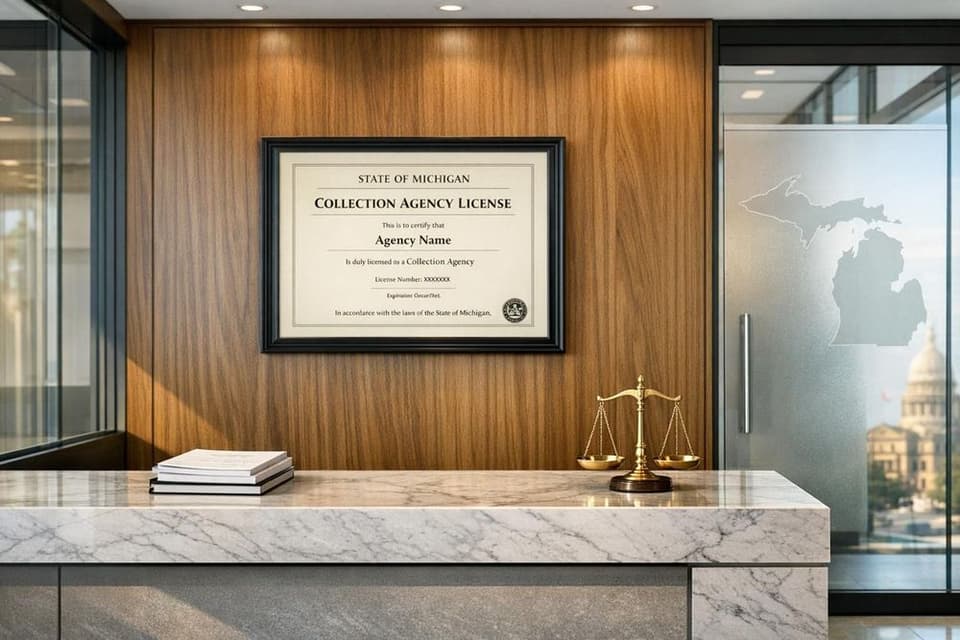
When businesses in Michigan face unpaid invoices, debt collection agencies help recover funds while following strict state and federal laws. Here's what you need to know:
- Core Functions: Agencies recover unpaid debts through debtor communication, negotiation, legal action, and compliance with Michigan and federal regulations.
- Key Laws: Agencies must follow the Michigan Collection Practices Act (MCPA) and the federal Fair Debt Collection Practices Act (FDCPA). These laws regulate communication, licensing, and consumer protections.
- Licensing: Each agency location must be licensed, with bonds ranging from $5,000 to $50,000 based on business volume.
- Regulations: Collectors can only contact debtors between 8:00 a.m. and 9:00 p.m., must provide written debt verification upon request, and avoid harassment or deceptive practices.
- Statute of Limitations: Michigan enforces a six-year limit for most debts and a ten-year limit for court judgments.
For businesses, choosing a licensed agency with industry experience and compliance expertise is critical. Many agencies also use advanced tools to improve efficiency and transparency. Understanding these rules and selecting the right partner ensures effective and lawful debt recovery.
Debt Collection Process in Michigan
Michigan Debt Collection Laws and Compliance Requirements
Michigan Debt Collection Licensing Requirements and Fees
Michigan Debt Collection Licensing Requirements and Fees
Michigan Collection Practices Act (MCPA) Requirements
Michigan Collection Practices Act
The Michigan Collection Practices Act (Act 70 of 1981) sets strict guidelines for how collection agencies, banks, trust companies, and attorneys can handle unpaid debts. It applies to "regulated persons" conducting collection activities tied to their business operations.
The act enforces clear communication rules. For example, agencies cannot use fake judicial-looking stationery or government seals to create an illusion of official authority. When reaching out to third parties to locate a debtor, collectors must identify themselves and explain they’re verifying location details like the debtor's residence, workplace, or phone number. Additionally, collectors are banned from contacting a debtor’s employer about a debt unless the debtor has given written consent.
The law also prohibits scare tactics like threatening arrest, property seizure, or garnishment without legal grounds. Physical violence, profanity, and public humiliation tactics - like "shame cards" or vehicles - are strictly off-limits.
Violators face serious penalties. The Attorney General can impose fines up to $500 per violation. For repeated, willful violations, penalties start at $5,000 for the first offense and can rise to $10,000 or even one year of imprisonment for subsequent offenses. Consumers can sue for actual damages or $50 (whichever is higher). In cases of intentional violations, courts may award triple damages or $150, plus attorney fees.
These state laws work alongside federal regulations, which are outlined below.
Federal FDCPA Requirements in Michigan
In addition to state rules, Michigan debt collectors must follow federal guidelines under the Fair Debt Collection Practices Act (FDCPA). According to the Michigan Department of Attorney General:
"The Federal Fair Debt Collection Practices Act (FDCPA) generally governs how debt collectors may legally operate nationally, as well as in Michigan".
Under the FDCPA, collectors must send a written validation notice within five days of their first contact, detailing the debt amount and creditor's name. If the consumer disputes the debt in writing within 30 days, the collector must stop pursuing the debt until verification is provided. Any legal action must be filed in the judicial district where the consumer signed the contract or currently resides.
FDCPA violations can lead to hefty penalties. Individual consumers may receive up to $1,000 in statutory damages, along with actual damages. For class actions, collectors could face the lesser of $500,000 or 1% of their net worth. As Bowen Hoogstra Law notes:
"While the federal FDCPA sets the standard, Michigan has adopted and expanded upon these regulations, offering additional protections for residents and businesses alike".
Licensing Process for Michigan Debt Collectors
To operate a collection agency in Michigan, a license is required for each business location under Article 9 of Public Act 299 of 1980. The designated manager must be at least 18 years old, hold a high school diploma or GED, and have six months of full-time collection experience.
The process includes passing the Michigan Collection Agency Manager examination, administered by PSI. Applicants must also secure a corporate surety or cash bond ranging from $5,000 to $50,000, depending on their average monthly business volume after the first year. Applications are submitted through the Michigan Professional Licensing User System (MiPLUS) at www.michigan.gov/[miplus](https://www.michigan.gov/lara/bureau-list/bpl/miplus).
| License Type | Fee | Duration |
|---|---|---|
| New Owner Managed Application | $475.00 | 3 years |
| Relicensure | $495.00 | 3 years |
| Renewal | $375.00 | 3 years |
Operating without a valid license can lead to steep fines. Licenses last three years and must be renewed through MiPLUS. Individual collectors also need to register. Proper licensing ensures compliance with Michigan’s debt recovery laws.
How to Select a Debt Collection Agency in Michigan
What to Look for in a Debt Collection Agency
Finding the right debt collection agency in Michigan begins with checking their credentials. Start by confirming their license status and any disciplinary actions through Michigan's MiPlus portal. Agencies operating in Michigan are required to hold a surety bond ranging from $5,000 to $50,000, based on their business volume. Ask for documentation to ensure they meet this legal requirement.
Experience in your specific industry is another critical factor. Look for agencies with certifications from reputable organizations like the Commercial Collection Agencies of America or the International Association of Commercial Collectors.
"Choosing the right Michigan debt collection firm is about more than just recovery rates. It's about compliance, client service, and finding a partner who truly understands your business." – Advanced Collection Bureau, Inc.
Technology also plays a big role. Leading agencies provide online portals for tracking accounts, communicating with collectors, and generating performance reports in real time. For commercial collections, many Michigan agencies utilize tools like the Secretary of State's website and county property records to better assess recovery potential. Additionally, verify the credentials of key staff members to ensure professionalism and expertise. These steps will help you confidently assess the agencies discussed below.
Michigan Debt Collection Agencies
With these guidelines in mind, here are a few Michigan-based debt collection agencies that stand out for their compliance and industry-specific expertise.
IC System serves cities like Detroit, Grand Rapids, and Warren, offering a two-phase recovery process. The first phase is a letters-only approach, allowing creditors to retain 100% of recovered funds. This is followed by a more intensive collection phase. IC System boasts a 95% satisfaction rate from post-call consumer surveys and provides specialized programs for small businesses handling accounts under 180 days, with a 35% contingency fee.
Leib Solutions focuses on business-to-business collections in Detroit and Grand Rapids. Their expertise lies in serving Fortune 1000 companies and middle-market businesses. They leverage advanced accounts receivable technologies and automated cash application systems, making them a strong choice for commercial and insurance premium collections.
CBM Services, Inc., established in 1919, operates out of Mid-Michigan as part of the Midland Business Alliance. They use modern tools like predictive dialers and interactive voice response systems to enhance their collection strategies.
When choosing an agency, review their compliance practices to ensure they steer clear of prohibited behaviors, such as using threats, obscene language, or impersonating government officials. Michigan-based agencies often benefit from strong relationships with local credit managers and business networks, which can speed up the resolution of receivables.
Using Technology Platforms for Debt Recovery in Michigan
Digital platforms are reshaping debt recovery, offering faster and more flexible solutions tailored to Michigan's regulatory landscape.
Debexpert Features for Debt Portfolio Trading
Debexpert
For Michigan creditors aiming to simplify debt recovery, Debexpert's online marketplace provides an auction-based platform to sell debt portfolios. It connects sellers with pre-screened buyers, ensuring transactions achieve fair market value through a clear and competitive bidding process. This is especially helpful for businesses managing older accounts, given Michigan's six-year statute of limitations.
Debexpert offers portfolio analytics tools that help creditors assess factors like debt type and age before listing. Sellers can choose from auction formats such as English, Dutch, Sealed-bid, or Hybrid. End-to-end encryption safeguards sensitive debtor data, while real-time chat makes negotiations straightforward and efficient.
The platform also ensures buyers comply with Michigan's legal requirements. With both mobile and desktop access, businesses can manage their debt portfolios from anywhere, streamlining their operations.
Debexpert Pricing Plans Comparison
Debexpert’s pricing structure is designed to accommodate different needs, offering flexibility for Michigan businesses.
| Plan Name | Price | Key Features | Best For |
|---|---|---|---|
| Basic Access | Free | View masked files, browse portfolio details | Exploring the marketplace before committing |
| Seller Plan | Custom | Portfolio analytics, auction setup, presale marketing, secure file sharing | Businesses selling debt portfolios |
| Buyer Plan | Custom | Real-time bidding, portfolio evaluation tools, secure communication | Investors purchasing debt portfolios |
Both Seller and Buyer plans require compliance verification to ensure adherence to Michigan's licensing and bonding regulations. Custom pricing allows businesses to scale services based on their portfolio size and transaction frequency.
Advantages of Digital Debt Collection Platforms
Digital platforms bring speed and efficiency to debt recovery for Michigan businesses. Many systems allow users to complete setup and start collections in as little as one business day, cutting down the delays typical of traditional methods.
Automated multi-channel outreach - using letters, emails, and texts - maintains consistent communication with debtors without manual effort. These tools also help businesses comply with Michigan's rules, such as the 5-day written notice and 30-day dispute period, by tracking and documenting all interactions systematically.
With 24/7 online account management, businesses can submit accounts, monitor updates in real time, and report payments instantly. This constant access improves cash flow visibility, enabling quicker decisions on whether to manage accounts internally, sell them, or escalate to a collection agency.
These digital tools work alongside traditional methods, meeting the growing need for efficient and compliant debt recovery in Michigan.
Debt Recovery Strategies for Michigan Businesses
Best Practices for Debtor Communication
When it comes to communicating with debtors, timing and thorough record-keeping are critical. Michigan law limits debt collection calls to between 8:00 a.m. and 9:00 p.m., and violations can result in penalties of up to $500 per infraction. To protect your business, maintain detailed logs of every interaction - calls, emails, and letters - to guard against potential harassment claims.
Within five days of your first contact, you’re required to send a written notice. This notice must include the debt amount, the creditor’s name, and inform the debtor of their right to dispute the debt within 30 days. If the debtor disputes the debt in writing, all collection efforts must pause until you provide verification.
"If the consumer notifies the collection agency in writing... that the debt, or any portion of the debt, is disputed, collection of the debt... shall cease until the collection agency obtains verification".
If a debtor prohibits workplace contact, stop immediately. Additionally, if they request in writing that all communication cease, you must comply, except to confirm you’ll stop contacting them or to notify them of specific legal actions. However, as the Michigan Attorney General’s Office points out:
"It is important to keep in mind that even if you are able to stop a debt collector from contacting you, you will still owe a valid debt!".
It’s also crucial to avoid sharing debt-related information with a debtor’s employer, family, or neighbors unless you have their written consent. When reaching out to third parties to locate a debtor, you’re only allowed to share your name and confirm that you’re seeking location details. And if the debtor has legal representation, all communication must go through their attorney - unless the attorney fails to respond within 30 days.
By following these guidelines, you can minimize compliance risks and set a solid foundation for effective debt recovery.
Common Compliance Mistakes to Avoid
One of the most significant compliance errors is operating without a valid Michigan license. Under Article 9 of Act 299 of 1980, third-party collection agencies must secure proper licensing to operate legally.
Another common mistake is misrepresenting your authority. For example, never threaten arrest, jail time, or immediate wage garnishment unless you have a court order. Similarly, avoid using any documents that resemble official court papers. Violations of this nature can lead to penalties amounting to three times the actual damages or a minimum of $150, whichever is greater.
Michigan also enforces a six-year statute of limitations on most consumer debts. Attempting to file lawsuits for debts older than six years is against state law. However, be aware that partial payments can restart the limitations period.
Only collect interest or service charges if they are explicitly allowed by the original agreement or state law. Practices such as using abusive language, making excessive calls to annoy, or publishing "shame lists" of debtors are clear violations of the Michigan Collection Practices Act. To avoid these pitfalls, invest in comprehensive training for your employees to ensure compliance.
With about 25% of Michigan residents having at least one debt in collections, staying within legal bounds is crucial for long-term success in debt recovery. Proper adherence to these rules not only protects your business but also fosters trust and professionalism in your operations.
Conclusion
Recovering debts in Michigan requires a careful balance of adhering to strict regulations, choosing the right collection partner, and using modern technology. The numbers speak for themselves: in 2022, 68% of Michigan cases ended in default judgments, with an average claim of $1,600. These figures highlight the high stakes for businesses and creditors alike.
Compliance is the cornerstone of effective debt recovery. Non-compliance can lead to severe penalties, including multiple damages and attorney fees. For state violations, penalties could reach three times the actual damages or $150 (whichever is higher), plus attorney fees. On the federal level, violations of the FDCPA could result in up to $1,000 in statutory damages, in addition to actual damages. To avoid these risks, businesses must ensure proper licensing, secure sufficient surety bonds, and follow communication rules set by law.
When selecting a collection agency, verifying their Michigan licensing status is critical. The Michigan Bureau of Professional Licensing provides a reliable way to confirm this. Partnering with a licensed agency offers additional safeguards, even in B2B collections where licensing isn't always required. Licensed agencies are held to higher standards, including maintaining trust accounts and manager certifications. As Account Adjustment Bureau emphasizes:
"Hiring a licensed commercial collection agency services provider in Michigan will ensure you have one more layer of protection against risk to your business".
Technology plays a transformative role in modern debt recovery. Digital platforms simplify compliance, streamline portfolio management, and improve operational efficiency. These tools not only help agencies navigate Michigan’s licensing requirements but also ensure records are properly maintained for at least three years. For businesses handling large volumes of accounts, advanced features like automated reporting, CRM integration, and skip tracing provide capabilities that traditional methods simply can’t match.
A strong debt recovery strategy ties together legal compliance, expert partnerships, and cutting-edge technology. With Michigan’s six-year statute of limitations on most consumer debts and a legal interest rate of 5% (capped at 25% for usury), understanding the legal framework is key. By combining these elements, businesses can maximize recovery rates while staying protected from legal pitfalls.
FAQs
How can I verify a Michigan collection agency is properly licensed and bonded?
To confirm if a Michigan collection agency is properly licensed and bonded, visit the Michigan Department of Licensing and Regulatory Affairs (LARA) website. Their licensing records will provide the necessary details. Collection agencies in Michigan are required to secure a bond - usually ranging from $5,000 to $50,000 - as part of their licensing obligations. If you need further verification, you can request documentation directly from the agency or reach out to LARA's Bureau of Professional Licensing for additional confirmation.
What should I do if a debtor disputes the debt or asks for verification?
If someone disputes a debt or asks for verification, you’re legally obligated to provide the necessary details. In Michigan, this means sending a written notice within five days of your first contact. This notice must include:
- The amount owed
- The creditor’s name
- A statement explaining the debtor’s right to dispute the debt within 30 days
If the debtor disputes the debt, you must pause all collection efforts until you provide proper verification or proof of the debt, as required by both federal and state laws.
When should I assign a debt to an agency versus selling the account as a portfolio?
If you're looking to recover money owed while keeping control and ensuring compliance with Michigan's regulations, assigning the debt to a collection agency can be a solid option. However, if the debts are older or harder to collect, selling the portfolio might be a better route. This approach provides quick cash flow by transferring the responsibility for collection to the buyer. Your decision should hinge on whether you prefer to stay involved in the process or prioritize immediate liquidation.
