

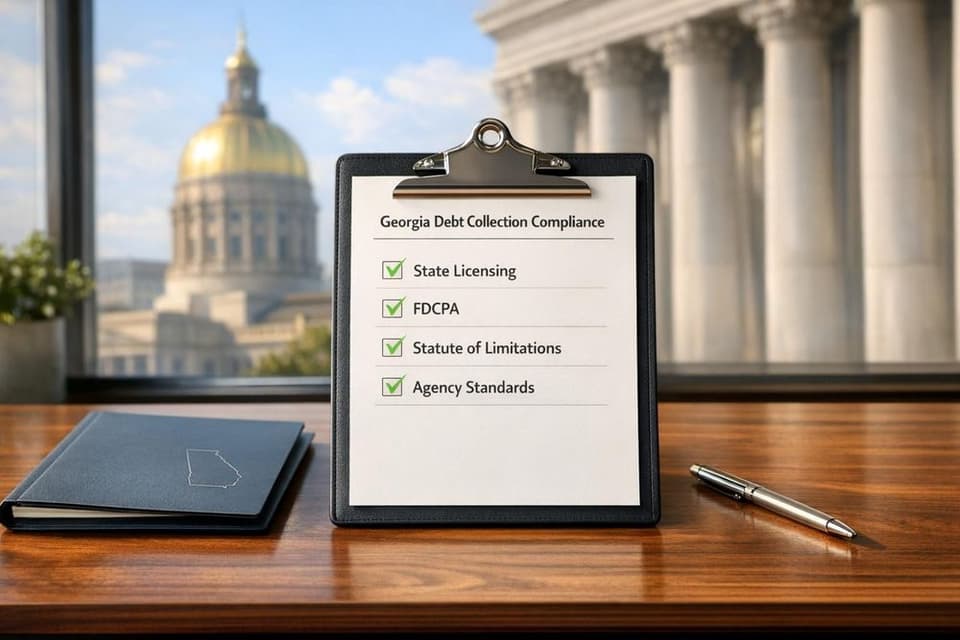
Debt collection agencies in Georgia specialize in recovering unpaid debts for businesses and creditors. They operate under federal laws like the Fair Debt Collection Practices Act (FDCPA) and state-specific rules such as the Georgia Fair Business Practices Act. Unlike many states, Georgia does not require general debt collection agencies to obtain a state license, though agencies handling small installment loans must meet specific licensing requirements.
Key points about debt collection in Georgia:
- Licensing: No general state license required, except for installment loans under $3,000.
- Regulations: Governed by FDCPA and state laws, with stricter collection timeframes (e.g., no calls between 10:00 p.m. and 5:00 a.m.).
- Statute of Limitations: 6 years for written contracts; 4 years for oral agreements or credit card debt.
- Debt Recovery Methods: Includes consumer and commercial collections, skip tracing, asset recovery, and litigation support.
- Legal Actions: Creditors can pursue wage garnishments, bank levies, and property liens after obtaining a court judgment.
Georgia's creditor-friendly laws allow agencies to aggressively recover debts, but compliance with both state and federal regulations is critical. Consumers should verify debts and dispute any inaccuracies in writing within 30 days to protect their rights.
Georgia Statute of Limitations on Debt Collection
Georgia Licensing and Regulations for Debt Collection Agencies
Georgia Debt Collection Laws: Federal vs State Requirements Comparison
Georgia Debt Collection Laws: Federal vs State Requirements Comparison
Licensing Requirements in Georgia
In Georgia, third-party debt collection agencies are not required to obtain a state license. However, businesses involved in making or servicing consumer installment loans of $3,000 or less for terms up to 36 months and 15 days must be licensed under the Georgia Installment Loan Act. These lenders are regulated by the Georgia Department of Banking and Finance, but this oversight does not extend to general collection agencies or debt collectors.
For installment loan license holders, the application and renewal process is handled through the Nationwide Multistate Licensing System & Registry (NMLSR). Licenses expire annually on December 31, with renewals accepted starting November 1. If you need to confirm whether a company collecting on small installment loans is authorized, you can check the NMLS Consumer Access website.
These licensing specifics provide a foundation for understanding how debt collection is regulated within the state.
Georgia State Regulations
In addition to licensing, Georgia law places operational restrictions on debt collection practices. The Georgia Fair Business Practices Act, enforced by the Georgia Attorney General, prohibits unfair or deceptive practices in consumer transactions:
"The purpose of this part shall be to protect consumers and legitimate business enterprises from unfair or deceptive practices in the conduct of any trade or commerce in part or wholly in the state." - Georgia Fair Business Practices Act of 1975
For licensed installment lenders, Georgia Code § 7-3-33 outlines further rules, such as barring collections between 10:00 p.m. and 5:00 a.m., a stricter timeframe compared to federal law:
"No licensee or employee or agent thereof shall willfully use any unreasonable collection tactics." - Georgia Code § 7-3-33
Georgia also enforces specific time limits for legal actions. Collectors have six years to sue for credit card debt or written contracts, and four years for oral agreements and promissory notes. Violating the Georgia Installment Loan Act can lead to severe penalties, including liability for twice the amount of interest and fees paid, with a minimum fine of $100.
Federal Compliance Standards
Georgia debt collection agencies must also adhere to federal guidelines, particularly the Fair Debt Collection Practices Act (FDCPA), which is enforced by the Federal Trade Commission (FTC). The FDCPA governs third-party collectors handling personal, family, or household debts but does not apply to commercial debt collection. Georgia law further requires non-employee debt collectors working for licensed installment lenders to comply with the FDCPA.
| Feature | Federal Law (FDCPA) | Georgia State Law (GILA) |
|---|---|---|
| Contact Hours | 8:00 a.m. – 9:00 p.m. | 5:00 a.m. – 10:00 p.m. |
| Licensing Required | No federal license | Only for installment loans ≤ $3,000 |
| Commercial Debt Coverage | Not covered | Not covered |
The FDCPA provides consumers with strong protections. If a debt collector violates the law, individuals can sue in state or federal court within one year, seeking actual damages, additional damages up to $1,000, plus court costs and attorney fees. A notable case in 2020 saw the FTC shut down Atlanta-based Critical Resolution Mediation LLC for illegal practices, including posing as law enforcement, threatening arrests, and attempting to collect nonexistent debts.
To protect yourself, always dispute debts in writing within 30 days of initial contact. This forces the collector to halt collection efforts until they provide verification. Complaints about debt collectors can be submitted to the Georgia Attorney General's Consumer Protection Division. If a collector claims to be an attorney, verify their credentials through the State Bar of Georgia.
Services Offered by Georgia Debt Collection Agencies
Operating under Georgia's specific regulatory framework, debt collection agencies in the state provide services tailored to both consumer and commercial recovery needs. These services are designed to address a wide range of debt scenarios effectively.
Consumer and Commercial Debt Collection
Debt collection agencies in Georgia handle both consumer and business-to-business (B2B) debts.
For consumer debt, agencies recover obligations like medical bills, credit card balances, car loans, and retail charge accounts. These efforts adhere strictly to the Fair Debt Collection Practices Act (FDCPA), ensuring compliance and professionalism. In fact, 95% of respondents in post-call surveys reported satisfaction with the professionalism and results delivered by national agencies operating in Georgia. Many agencies also offer credit reporting services to further assist creditors.
On the other hand, commercial debt collection focuses on B2B debts, such as unpaid invoices and larger claims across various industries. Unlike consumer debt recovery, commercial collection relies on personalized evaluations rather than automated or scripted approaches. Specialized agencies in this area often achieve an 85% success rate on claims exceeding $10,000, showcasing their ability to handle complex cases.
| Feature | Consumer Collection | Commercial Collection |
|---|---|---|
| Regulatory Framework | Governed by FDCPA | Not subject to FDCPA |
| Methods | Automated letters, emails, and scripts | Personalized evaluation and negotiation |
| Interest Rates | 7% (Legal) or 12% (Judgment) | Up to 18% for commercial accounts |
| Fees | 35–50% based on account age | 10–25% based on claim size |
For small businesses, agencies offering a "letters-only" phase can be a smart choice, as this allows creditors to retain 100% of recovered funds before contingency fees apply. Meanwhile, commercial creditors may benefit from agencies that operate on a "no-fee-unless-collected" basis, which minimizes financial risk.
These initial collection strategies often transition into more advanced recovery tools, such as skip tracing and legal support, for cases requiring additional effort.
Skip Tracing and Asset Recovery
When debtors are difficult to locate, agencies employ skip tracing techniques that leverage specialized databases and advanced technology. Asset recovery efforts include legal actions such as wage garnishment, bank account levies, and property liens. For example, Georgia courts processed nearly 60,000 garnishment filings in 2019, reflecting a notable increase in such cases.
For secured debts, agencies may arrange the repossession and sale of assets initially purchased with a loan to cover outstanding balances. Many agencies in Georgia work on a contingency basis, meaning fees are only charged upon successful recovery. However, when recovering funds from bank accounts, agencies must navigate specific exemptions under Georgia law, such as protections for pension benefits, unemployment benefits, disability insurance, and child support.
When conventional strategies fail, agencies often turn to legal interventions to resolve debts more effectively.
Legal Assistance and Litigation Support
Debt collection agencies frequently provide litigation support by connecting creditors with experienced attorneys. This is crucial for recovery methods like bank account levies or property liens, which require court orders to execute.
"A judgment is a declaration by a court that the creditor has the legal right to demand a wage garnishment, a levy on the debtor's bank accounts, and a lien on the debtor's property." – Bills.com
With legal support, agencies help businesses obtain judgment-creditor status, which allows them to pursue more aggressive recovery methods. For instance, to carry out bank levies or property seizures in Georgia, agencies may secure a writ of Fieri Facias, authorizing a sheriff to seize property to satisfy the debt. Domestic judgments in Georgia remain valid for seven years, with the option to renew them for an additional three years after they become dormant.
It’s also important for businesses to be aware of Georgia's statute of limitations: six years for written contracts and four years for oral agreements. Once this time expires, debts are considered "time-barred" and are no longer legally enforceable. When choosing an agency for litigation support, ensure their affiliated attorneys are members of the State Bar of Georgia. All legal actions must comply with both state and federal regulations.
How to Select a Debt Collection Agency in Georgia
Choosing the right debt collection agency in Georgia involves a careful review of their experience, compliance with regulations, and fee structures. Let’s break down what to look for at each step.
Checking Agency Experience and Track Record
Start by confirming the agency’s credentials, especially if you need commercial debt recovery services. Look for certifications from organizations like the Commercial Law League of America (CLLA) or membership in the Commercial Collection Agency Association (CCAA). These agencies meet strict standards, with CCAA members requiring at least four years in business and a focus on business-to-business (B2B) collections for 80% of their operations.
"Members of the CCAA are the only collection agencies in the United States certified by the Commercial Law League of America. In order to obtain certification, the agency must meet rigorous criteria." – Burt and Associates
Check the agency’s complaint history through the Georgia Attorney General's Consumer Protection Division or the Federal Trade Commission (FTC). It’s also essential to ensure they maintain separate trust accounts for creditor funds and carry surety bonds (a minimum of $300,000 for CCAA members). This is particularly important as debt collection issues are a major concern in Georgia, with 38% of complaints involving attempts to collect debts not owed.
Additionally, confirm the agency’s familiarity with Georgia’s laws, such as the four-year statute of limitations for open accounts and the six-year limit for written contracts. Evaluate their ability to handle cease-and-desist requests (commonly known as "drop-dead" letters), which are legally binding under the Fair Debt Collection Practices Act (FDCPA).
Verifying Regulatory Compliance
Georgia doesn’t mandate a general license for third-party debt collection agencies, but certain regulations do apply. For example, agencies handling consumer installment loans of $3,000 or less must be licensed. You can verify these licenses through the NMLS Consumer Access website.
Review the agency’s compliance with federal standards by checking the Consumer Financial Protection Bureau (CFPB) database or FTC records. While the FDCPA governs consumer debt collections, it doesn’t apply to commercial debts, which are often self-regulated through professional associations.
"The Department does NOT regulate collection agencies, debt collectors, or other entities or individuals collecting debts." – Georgia Department of Banking and Finance
Ensure any contracts with the agency explicitly require compliance with the FDCPA and outline clear protocols for handling communications and cease-and-desist requests. If the agency you’re considering is run by attorneys, direct any complaints to the State Bar of Georgia rather than the Consumer Protection Division.
Understanding Fee Structures and Contracts
Understanding the agency’s fee structure is crucial for managing the financial aspects of your debt recovery efforts.
Most agencies work on a contingency fee basis or charge a flat fee per account. Contingency fees typically range from 15–30% for debts less than 90 days old and 30–50% for accounts older than six months. If legal action is required, these fees can exceed 50%. Flat fees, on the other hand, are usually between $10 and $50 per account and are ideal for early-stage, low-risk collections.
Determine whether the agency specializes in your industry. Some focus on B2B debts or construction liens, while others handle consumer accounts. It’s also worth checking if the agency is a "legal debt collection agency" operated by attorneys who can file lawsuits and enforce judgments. While most commercial collection claims in Georgia (around 90%) are resolved without litigation, it’s still important to have legal options for difficult cases.
Review the contract terms carefully, especially regarding collection costs. Attorney fees and court costs can only be passed on to debtors if the original agreement allows it. Finally, check the agency’s Better Business Bureau rating. Aim for an A+ accreditation as a sign of professionalism and reliability.
| Fee Type | Typical Range | Best For |
|---|---|---|
| Contingency (New Debt) | 15–30% | Accounts under 90 days old |
| Contingency (Old Debt) | 30–50% | Accounts over 6 months old |
| Flat Fee | $10–$50 per account | Early-stage, low-risk collections |
| Attorney Hourly | $100–$300/hour | Complex legal cases |
Debt Portfolio Trading for Recovery in Georgia
Understanding Debt Portfolio Trading
Debt portfolio trading involves creditors selling groups of delinquent accounts to third-party debt buyers at a fraction of their original value. In Georgia, creditors are not required to notify consumers when their accounts are sold to collection agencies. Once purchased, the debt buyer gains the right to pursue the full amount owed, even though they acquired it at a discount.
"When payments become unlikely, creditors may sell the debt at a discount." – Georgia Attorney General's Consumer Protection Division
Debt buyers in Georgia often focus on portfolios that are 3 to 5 years old, acquiring them at significantly reduced prices. Their strategy typically includes filing lawsuits shortly after purchase to secure default judgments before the statute of limitations expires. For creditors, selling these portfolios provides immediate cash flow and shifts the administrative burden of collection to the buyer. This method is especially useful when the costs of court proceedings and enforcement outweigh potential recoveries.
The enforceability of traded debt in Georgia depends on the statute of limitations: 6 years for written contracts and 4 years for oral agreements or open accounts. A partial payment can reset the 6-year limitation period, making it crucial for both buyers and sellers to carefully monitor the age of the debt. These trading strategies complement broader recovery efforts discussed earlier.
Using Debexpert for Debt Portfolio Management
Debexpert
Debexpert simplifies debt portfolio trading for Georgia businesses by offering tools tailored to both buyers and sellers. The platform provides detailed portfolio analytics, helping users assess debt age and ensure compliance with Georgia’s statute of limitations before initiating transactions. Auctions can be set up in various formats - English, Dutch, Sealed-bid, or Hybrid - encouraging competitive bidding. Additionally, secure file sharing with end-to-end encryption safeguards sensitive debtor information, while real-time chat allows for direct communication between parties.
Whether accessed via mobile or desktop, Debexpert’s platform ensures users can monitor buyer activity and respond to inquiries from anywhere. Sellers benefit from presale marketing aimed at qualified buyers interested in specific debt types, while buyers receive alerts when portfolios that meet their criteria become available. Post-sale services streamline documentation transfers and ensure contractual obligations are met.
Technology-Driven Debt Recovery Strategies
Digital platforms like Debexpert enhance recovery efforts by providing real-time analytics and documentation, enabling agencies to track dispute rates and team performance. These tools help identify portfolios with the highest return potential while minimizing risks, such as civil lawsuits for harassment or misrepresentation.
Before trading, it’s essential to categorize debts by type to ensure they comply with Georgia’s statute of limitations - 4 years for open or oral accounts and 6 years for written contracts. Accurate tracking of debt age is crucial to maintaining portfolio value. Additionally, ensure that any agency managing or purchasing the portfolio adheres to the FDCPA, as Georgia law holds licensees accountable for actions taken by non-employee debt collectors.
Self-service digital portals that allow debtors to manage payments and negotiate settlement terms can improve resolution rates without requiring direct agent involvement. This approach reduces operating costs while maintaining compliance with federal regulations. It’s also worth noting that domestic judgments in Georgia are valid for 7 years and can be renewed, preserving their collection value with proper management.
| Debt Type | Statute of Limitations (Georgia) | Legal Reference |
|---|---|---|
| Written Contracts | 6 Years | O.C.G.A. § 9-3-24 |
| Open Accounts | 4 Years | O.C.G.A. § 9-3-25 |
| Oral Agreements | 4 Years | O.C.G.A. § 9-3-26 |
| Domestic Judgments | 7 Years (Renewable) | O.C.G.A. § 9-12-60 |
Conclusion
Navigating Georgia's debt collection rules requires a solid understanding of federal and state regulations. For consumers, disputing a debt within the 30-day window is crucial to prevent collectors from assuming the debt is valid. With around 38% of debt collection complaints involving attempts to collect debts not actually owed, verifying any claimed debt before making payments is essential.
This legal framework influences both personal and business debt recovery. As outlined earlier, compliance with the Fair Debt Collection Practices Act (FDCPA) and Georgia's statutes is critical. The FDCPA safeguards personal, family, and household debts but excludes business-to-business transactions. Georgia's statute of limitations sets a six-year limit for written contracts and four years for oral agreements. However, even a partial payment can reset this timeline.
Recent court filings highlight the importance of maintaining detailed records and sending disputes via certified mail to safeguard your rights, whether you're a creditor or a debtor.
Leveraging legal knowledge alongside digital tools can enhance debt recovery processes. Platforms like Debexpert simplify debt portfolio management while ensuring compliance with Georgia's laws. By understanding local regulations, choosing the right partners, and utilizing effective tools, both businesses and individuals can handle debt collection more efficiently while protecting their rights.
FAQs
How do I know if a debt collector in Georgia is legit?
To confirm if a debt collector in Georgia is operating lawfully, start by ensuring they adhere to both state and federal regulations, particularly the Fair Debt Collection Practices Act (FDCPA). This act is designed to protect consumers from harassment and abusive tactics.
It’s also important to determine whether Georgia requires the collector to be licensed. Additionally, you can request written validation of the debt within 30 days of their initial contact. Legitimate collectors are obligated to provide clear and accurate contact information and conduct their activities transparently while following all applicable laws.
What should I do if the debt is old or past the statute of limitations?
If you have an old debt in Georgia that's past the statute of limitations, you typically aren't legally obligated to pay it. Once the time limit for filing a lawsuit to collect the debt has passed, creditors lose their legal ability to sue you. However, this doesn’t stop them from trying to collect through informal methods. Be careful - making a payment or even acknowledging the debt could reset the statute of limitations, potentially reviving their right to take legal action.
Can a collector garnish my wages or take money from my bank account in Georgia?
In Georgia, debt collectors are allowed to garnish up to 25% of your weekly disposable income or an amount equal to 30 times the federal minimum wage, depending on which is lower. Additionally, they can access funds in your bank account through a bank levy, but this can only happen after they follow proper legal steps and secure a court order.
