

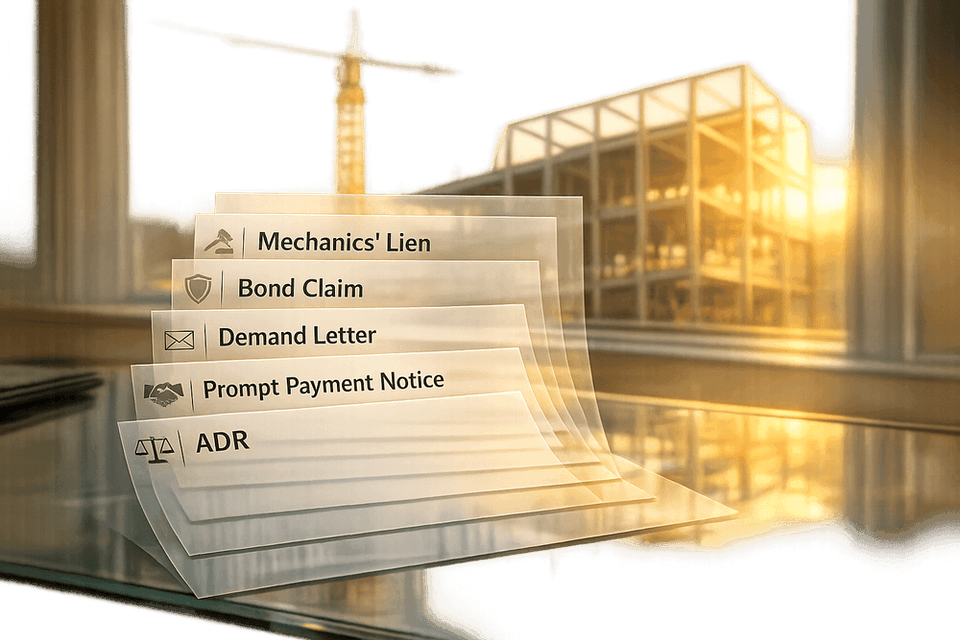
Construction debt collection is about recovering unpaid funds for labor, materials, or services provided in construction projects. The process is often complex due to the payment chain involving owners, lenders, contractors, subcontractors, and suppliers. Tools like mechanics' liens and bond claims are essential for securing payment, depending on whether the project is private or public. Key challenges include late payments, disputes, and compliance with state-specific laws and deadlines.
Key Takeaways:
- Mechanics' Liens: Legal claims on private property to secure payment. Strict deadlines and notice requirements apply.
- Bond Claims: Used for public projects where liens are not allowed. Governed by laws like the Miller Act.
- Payment Delays: Construction businesses often wait 83 days on average for payment, with only 5% of subcontractors paid on time.
- Prompt Payment Laws: Enforce deadlines (7–14 days after invoice approval) and impose penalties for late payments.
- Dispute Resolution: Alternatives like mediation or arbitration can resolve issues faster than litigation.
Effective debt recovery requires tracking deadlines, sending notices, and using tools like demand letters or legal actions to enforce payment. Technology platforms can streamline this process, ensuring compliance and improving cash flow.
Legal Framework for Construction Debt Collection
Prompt Payment Laws Explained
Navigating construction debt collection often starts with understanding prompt payment laws. These laws set strict deadlines for payments between owners, contractors, and subcontractors. Nearly every U.S. state has such statutes, though some apply exclusively to public projects, while others cover both public and private work. To enforce these deadlines, many states impose statutory interest charges for late payments. For example, Tennessee defaults to an annual interest rate of 18% if no specific rate is agreed upon. Additionally, states like Pennsylvania and Tennessee allow contractors to suspend work if payments are overdue, provided proper notice is given.
When disputes arise, the rules governing payment withholds are equally strict. Payors can only withhold funds for "good faith" disputes tied directly to specific work issues. In 2018, the California Supreme Court clarified this in United Riggers & Erectors, Inc. v. Coast Iron & Steel Co., ruling that withheld funds must pertain solely to the disputed payment. Similarly, Massachusetts law deems pay applications approved if not rejected in writing within 15 days, complete with detailed factual and contractual reasons. A 2022 ruling in Tocci Bldg. Corp. v. IRIV Partners, LLC upheld this, forcing a project owner to pay over $4.6 million due to their failure to properly reject payment applications.
"Anything short of strict statutory compliance will not meet legal requirements when rejecting applications for payment in Massachusetts" - Jeffrey R. Blease and Benjamin J. Morris, Attorneys, Foley & Lardner LLP
Many state laws also allow the prevailing party in payment disputes to recover attorney fees and court costs, raising the stakes for those who unjustifiably withhold payments. While prompt payment laws aim to ensure timely payments, mechanics' liens provide a legal safety net for securing unpaid debts.
How Mechanics' Liens Work
Mechanics' liens are a powerful legal tool for addressing unpaid construction debts. Essentially, a mechanics' lien is a claim against real property that secures payment for labor, materials, or services provided. Unlike voluntary agreements, these liens are statutory and do not require the property owner's consent. Once filed, the lien creates a "cloud" on the title, complicating the owner's ability to sell or refinance until the debt is resolved.
The strength of a mechanics' lien lies in its ability to enforce construction contracts that require properties to remain free of encumbrances. Any party contributing to permanent improvements - whether through labor, materials, or services - may have lien rights, though eligibility varies by state.
Timing is critical when filing mechanics' liens. Deadlines range from two months to one year after work completion or the last delivery of materials. In 34 states, subcontractors must send a preliminary notice at the start of a project to preserve lien rights. This notice must include the property's full legal description and the claimant's full legal business name. For example, New York requires liens to be filed within specific timeframes and remain valid for one year unless extended through foreclosure action. In California, liens must be filed within 90 days of project completion and enforced within an additional 90 days. If payment is still not secured, the claimant may need to initiate a foreclosure lawsuit, potentially leading to a sheriff's sale of the property to recover the debt. Filing fees also vary widely, from $5 in Montana to $345 in Hawaii.
State Differences in Collection Laws
Construction debt collection laws differ significantly across states, requiring tailored strategies. While prompt payment laws exist nationwide, some apply exclusively to public projects, while others extend to private sectors as well. Payment deadlines vary, with statutes often distinguishing between progress payments and final payments, including retainage release timelines.
States also differ in their treatment of "pay-if-paid" clauses, which shift non-payment risk to subcontractors. Retainage limits, typically capped at 5%–10%, and their release timelines further add to the complexity. Notice requirements are another critical factor; subcontractors and suppliers often need to provide preliminary notices within specific timeframes to preserve lien rights.
Recent legislative changes reflect a trend toward more claimant-friendly policies. For instance, Virginia's 2023 reforms expanded prompt payment protections to cover more contracts and parties. Many states now mandate detailed, written explanations for rejecting payment applications to prevent arbitrary denials.
"By demanding clear and justifiable reasons for payment rejections, states uphold the principles of fairness and equity in payment disputes" - American Bar Association
To navigate these differences effectively, stakeholders must first determine whether a project is public or private, as this dictates the applicable laws for prompt payment, lien claims, or bond claims. From the project's outset, tracking preliminary notice deadlines, maintaining detailed records of disputes, and reviewing contract clauses for "pay-if-paid" or "pay-when-paid" provisions are essential steps. These jurisdictional nuances heavily influence how legal tools like prompt payment laws and mechanics' liens are applied.
Mechanics Lien: How to preserve your lien rights and get paid
Tools for Construction Debt Collection
Mechanics Liens vs Bond Claims: Key Differences for Construction Debt Collection
Mechanics Liens vs Bond Claims: Key Differences for Construction Debt Collection
Mechanics' Liens vs. Bond Claims
Deciding between mechanics' liens and bond claims boils down to whether you're working on a private or public project. Mechanics' liens are tied to private properties - such as commercial buildings, residential homes, or privately owned land - and act as a security interest. Essentially, they prevent the owner from selling or refinancing the property until the debt is paid off. On the other hand, bond claims focus on payment bonds provided by surety companies, rather than the property itself. This is particularly important for public projects since government-owned properties can't be seized or sold. For federal, state, and municipal projects, bond claims are the go-to option.
Federal projects exceeding $100,000 fall under the Miller Act, which requires prime contractors to secure payment bonds equal to the contract price. Many states have adopted similar laws, often referred to as "Little Miller Acts", for public works. Mechanics' liens often take precedence over other debts during foreclosure, making them crucial in larger disputes.
| Feature | Mechanics' Lien | Payment Bond Claim |
|---|---|---|
| Project Type | Private (Commercial/Residential) | Public (Federal/State/Local) |
| Claim Target | The real property/land | The surety bond (insurance) |
| Primary Benefit | Blocks property sale/refinance | Ensures payment via a surety |
| Notice Requirements | Often requires a 20-day notice | Typically within 90 days of work |
| Enforcement | Foreclosure lawsuit | Lawsuit against surety/contractor |
The first step is determining ownership - whether the land is privately owned or government-held - to decide which remedy applies. For public projects, request a copy of the payment bond from the general contractor or public agency early on. Both mechanics' liens and bond claims usually come with strict 90-day deadlines for filing or issuing notices after the last day of work. Missing these deadlines could jeopardize your claim, underscoring the importance of timely preliminary notices.
Preliminary Notices and Filing Deadlines
Timely preliminary notices are critical to securing the right to file mechanics' liens or bond claims. In many states, failing to send this notice at the project's outset can completely void your lien rights. Deadlines for these notices are often short - measured in months - compared to longer breach-of-contract statutes, which might allow three to six years.
"The single most important legal consideration when considering your ability to file a lien is time." – Brian Farkas, Attorney, Benjamin N. Cardozo School of Law
Deadlines vary by state. For instance:
- In California and Arizona, notices must be sent within 20 days of starting work or delivering materials.
- Florida requires subcontractors and suppliers to issue notice within 45 days of beginning labor or material delivery.
- Texas demands a pre-lien notice by the 15th day of the third month.
- Under the federal Miller Act, second-tier subcontractors must notify the prime contractor within 90 days after their last labor or material supply.
In states like Alabama or Arizona, which operate under "Unpaid Balance" rules, missing the notice deadline may limit recovery to the remaining funds the owner holds at the time of filing - rather than the full contract value. Even without pursuing foreclosure, a properly filed lien can "cloud" the property title, effectively blocking sales or refinancing and often prompting settlements without litigation. Filing fees vary, with professional services costing around $349, and county fees ranging from $5 to $345.
To protect your rights without seeming confrontational, make it a habit to send preliminary notices for every project. Accurately track the "last day of work", as it starts the clock for filing deadlines. Use certified mail or other verifiable delivery methods to ensure compliance. Once notice procedures are in place, the next step is crafting an effective demand letter to resolve disputes.
Demand Letters and Negotiation Tactics
After establishing legal safeguards, a well-written demand letter can speed up payment resolution without heading straight to court. A demand letter should be professional, fact-based, and concise. Use a formal business letterhead and include key details like the property description, completed work, invoice dates, and the exact amount owed.
"A payment demand letter doesn't need to be overly aggressive. It should be polite and straightforward, providing a logical argument spelling out why they should pay you." – Levelset
Set a specific payment deadline - usually 7 to 10 business days - and explain the actions you'll take if payment isn't made, such as filing a mechanics lien or bond claim. Referencing state-specific payment laws can also highlight your right to collect interest and attorney fees. Sending copies to all relevant parties, including the property owner, general contractor, and lender, can increase pressure for a faster response. You might even mention that unpaid debts could be reported as "Debt Cancellation Income" to the IRS, which could result in tax consequences for the debtor.
Statistics show that 97.5% of construction projects are paid before a mechanics lien becomes necessary when a structured approach - "Protect, Monitor, Warn, Secure" - is followed. Always send demand letters via certified mail with a return receipt to create a verifiable paper trail for court use. Avoid settling for less than the full amount too early; instead, express a willingness to arrange a payment plan while holding firm on your claim.
If you draft the letter yourself, costs are limited to postage and certified mail fees. Hiring an attorney for this task could cost $100 to $500. In many states, a demand letter can also double as a statutory Notice of Intent to Lien, which is often required before filing a valid mechanics lien.
Dispute Resolution and Litigation Strategies
Alternative Dispute Resolution (ADR) Methods
Mediation and arbitration provide quicker, private ways to handle payment disputes. In mediation, a neutral facilitator works with both parties to reach an agreement without deciding on liability or damages. Since it's non-binding, parties can still pursue other legal options if no resolution is reached. Arbitration, on the other hand, involves a private arbitrator who delivers a binding decision, offering a more structured approach.
For larger or more complex projects, a Dispute Resolution Board (DRB) can be set up at the start of the project. Made up of one to three industry experts, a DRB steps in to address disputes as they arise, preventing minor disagreements from escalating into costly legal battles. These methods save time and maintain confidentiality, avoiding the lengthy delays of traditional court proceedings.
As James J. Hartnett, a partner at Faegre Drinker Biddle & Reath LLP, explains:
"Arbitration determines how much the contractor is owed, while the mechanic's lien provides security for payment of the amount owed."
Attorney Matt Viator adds a cautionary note:
"If you don't file your [lien] claim before mediation, it's likely that you won't have it after mediation."
To protect your rights, always file your lien claim before mediation. If you're facing a foreclosure deadline during arbitration, file the foreclosure action in court and request a stay while waiting for the arbitrator's decision.
Before signing any construction contract, take a close look at the dispute resolution clauses. Many contracts specify ADR methods or require waiving the right to litigate. When choosing a mediator or arbitrator, prioritize those with expertise in construction, as they’ll better understand technical issues like change orders, defective work, and payment disputes.
If ADR doesn’t resolve the issue, litigation becomes the next step.
Litigation for Construction Debt Recovery
When disputes persist despite ADR efforts, litigation may be necessary. Before filing a lawsuit, research the debtor’s credit history, court records, and assets. Knowing what tangible assets - like land, equipment, or vehicles - the debtor owns can help determine whether a judgment will be collectible.
Prepare all relevant documents, including contracts, invoices, and correspondence, before proceeding. Pay close attention to contractual terms, particularly the difference between "pay-if-paid" clauses (which make payment contingent on the owner receiving funds) and "pay-when-paid" clauses (which only delay payment timing). The litigation venue is often dictated by the forum clause in your contract; if none exists, the case is typically filed in the county where the property is located.
For example, in Florida, over half of mechanics’ lien cases are resolved within three months of filing. However, construction litigation can be unpredictable, with costs and timelines that may strain project financing or client relationships. Hiring a reputable law firm to issue demand letters can add weight to your case and signal your readiness to escalate the matter.
Always respond to legal summons promptly to avoid a default judgment, which could allow creditors to garnish wages or seize bank accounts without your input. In California, for instance, the statute of limitations for filing a debt recovery lawsuit based on a written contract is generally four years. When filing mechanics’ liens, avoid generic online templates. Instead, ensure your lien language complies with state-specific regulations, like Florida Statutes 713.001-713.37, to preserve enforceability during foreclosure.
Enforcing Judgments and Recovering Assets
Winning a judgment is just the beginning. The real challenge often lies in recovering the funds. As Thea Dudley, author of The Credit Overlord's Guide to Credit & Collections, puts it:
"Winning the court case does not mean you will be handed the funds... the challenge of recovery begins thereafter. You won, but you still must get the debtor to let go of the money."
Once you have a judgment, start asset discovery immediately. Use subpoenas, depositions, and debtor examinations to uncover information about bank accounts, real estate, and equipment. Recording your judgment with the county clerk or secretary of state is critical for creating a lien on the debtor’s property - some states do this automatically, while others require manual filing.
A writ of execution allows for the seizure and sale of non-exempt property, while a writ of garnishment targets assets held by third parties, like bank accounts or wages. In construction cases, foreclosing on a mechanics’ lien can result in a sheriff’s sale of the property where the work was performed.
If the debtor’s assets are in another state, you may need to domesticate the judgment under the Uniform Enforcement of Foreign Judgments Act (UEFJA) to enforce it locally. Maryland construction attorney Joseph Katz shares his approach:
"I have hired private investigators to stake out homes and offices and follow the debtors' trucks in the morning to find out where they are working, and then garnished those individuals for any funds owed to the debtor."
Review past financial transactions, such as checks or wire transfers, to identify the debtor’s bank accounts for garnishment. Record your judgment in every county where the debtor owns property to ensure liens attach to all relevant assets. Be aware of homestead exemptions; for instance, in Texas, primary residences are often protected from judgment liens, though personal property like vehicles may still be seized.
Finally, consider negotiating a post-judgment settlement. Offering to waive a portion of interest or attorney fees could encourage the debtor to make an immediate payment.
Managing Construction Debt Portfolios
Using Technology for Debt Collection
Technology has become an essential part of managing debt portfolios in the construction industry. Modern software platforms now handle tasks like tracking payment deadlines and managing lien rights automatically. This automation minimizes missed deadlines and helps reduce Days Sales Outstanding (DSO). By streamlining the tracking of preliminary notice deadlines, these tools strengthen the lien strategies discussed earlier. They also monitor state-specific deadlines for preliminary notices, notices of intent, and lien filings, ensuring companies don’t lose collection rights due to oversight. Businesses using these platforms have seen a 20-day reduction in DSO and a 97% success rate in collecting payments for construction projects.
"With hundreds of active projects and monthly work orders, Levelset takes the guesswork out of tracking lien dates."
Crystal P. from Prism Electric highlights how tools like Levelset simplify the process. Similarly, Nate Budde, Chief Legal Officer at Levelset, emphasizes the importance of preliminary notices:
"Sending preliminary notices informs the parties closest to the money that a particular party is on the job, and doing work".
Risk monitoring features in these platforms alert users to potential issues like bankruptcy filings, payment bond claims, or project delays before they turn into major problems. Additionally, digital lien waiver management systems replace outdated paper-based processes, ensuring subcontractors don’t give up their rights prematurely while keeping payments on schedule. For companies managing construction debt portfolios, specialized platforms like Debexpert offer tools for portfolio analytics, secure file sharing, and real-time communication among all parties involved in debt transactions.
Working with Professional Collection Services
When standard collection efforts fail, turning to specialized construction collection agencies can make a difference. These professionals are well-versed in industry-specific laws, such as the Prompt Payment Act and mechanics' liens. Before hiring an agency, confirm that they are licensed in your state and ask for references from other construction companies to ensure they have a proven track record.
Monitoring Debt and Reducing Risk
A strong credit policy and active monitoring are key to maintaining a solid debt collection framework. Establish a written credit policy that outlines when to send payment reminders, demand letters, and notices of intent to lien. Before starting a project, verify owner details and prequalify customers by reviewing their financial stability and payment histories. Incorrect or incomplete information can jeopardize future claims.
To further protect your interests, exchange lien waivers for progress payments. This prevents double payments while safeguarding your lien rights.
A structured approach - Protect, Monitor, Warn, Secure, Enforce - helps ensure lien rights remain intact throughout a project. Consistently sending preliminary notices often results in payments being made without the need for formal lien filings. This underscores the value of proactive monitoring. As Contractor Business Help puts it:
"A business that wants consistent cash flow must treat lien compliance with the same rigor as safety compliance or accounting standards".
Conclusion
Managing construction debt collection demands a disciplined and proactive approach to avoid payment delays. With the construction industry accounting for 16% of U.S. business insolvencies - 410 companies in a recent tracking period - it’s clear why maintaining financial discipline is critical for survival. At the heart of this discipline lies the effective use of legal tools, like mechanics' liens.
Mechanics' liens offer strong leverage by attaching directly to property titles, pressuring property owners to resolve payments quickly to avoid complications with refinancing or selling. However, even minor compliance errors can weaken this leverage. Staying on top of state-specific deadlines and using the correct forms ensures your rights are protected from the start.
A structured debt collection strategy is key: start with reminders, proceed with formal Notices of Intent, and escalate legally only when necessary. Modern software tools simplify this process by automating deadlines, tracking lien waivers, and flagging high-risk accounts. These tools reduce errors and improve collection rates, aligning with best practices for debt recovery. Additionally, approaching debtors with empathy can make a difference - 38% of consumers respond positively to a genuine and helpful approach.
"Debt doesn't have to be a bottleneck, but the stepping stone for company's growth and success." – Pacific Accounting and Business Services
To further safeguard cash flow, maintain meticulous records of contracts, invoices, delivery tickets, and change orders for dispute resolution. Exchanging lien waivers for progress payments and verifying data early on ensures smoother cash flow and strengthens relationships with banks and sureties. These practices not only stabilize cash flow but also contribute to long-term business stability.
FAQs
When should I file a mechanics’ lien?
If you haven't been paid for your work, labor, or materials on a construction project, filing a mechanics’ lien might be your next step. This legal tool is often used after other collection methods have been unsuccessful. However, timing is critical - mechanics’ liens must be filed within the deadlines outlined by your state. Be sure to review your state's specific rules to ensure you meet all filing requirements and procedures.
Lien or bond claim - which one applies?
A mechanics' lien is a legal tool used on private construction projects. It allows contractors, subcontractors, or suppliers to secure a claim against the property itself to recover unpaid amounts. On the other hand, a bond claim is specific to public projects. Since public property cannot be subjected to liens, a payment bond is typically posted, and claims can be made against that bond instead of the property. The type of project determines which option applies: mechanics' liens for private projects and bond claims for public ones.
What records do I need to collect faster?
To speed up collections, keep thorough records for your construction project. This includes documenting work completed, materials provided, and all communications with the property owner or contractor. Essential documents to maintain are notices of intent to lien, filed lien documents, invoices, payment histories, and correspondence about payment disputes. Staying organized and keeping records updated not only protects your lien rights but also simplifies the process of recovering payments.
